

Voyage to the bottom of the sea, or simply look along the bottom of a clear stream and you may spy lobsters or crayfish waving their antennae. Look closer, and you will see them feeling around with their legs and flicking their antennules – the small, paired sets of miniature feelers at the top of their heads between the long antennae. Both are used for sensing the environment. The long antennae are used for getting a physical feel of an area, such as the contours of a crevice. The smaller antennules are there to both help the creature smell for food or mates or dangerous predators and also to sense motion in the water that also could indicate the presence of food, a fling or danger. The legs also have receptors that detect chemical signatures, preferably those emanating from a nice hunk of dead fish.

| Biology | August 31, 2007 10:29 PM |

Roaring male Iberian red deer with females (photograph by Juan Carranza) In the September issue of The American Naturalist, Juan Carranza (Biology and Ethology Unit, University of Extremadura, Spain) and Javier Pérez-Barbería (Macaulay Institute, United Kingdom) offer a new explanation for why males of ungulate species subjected to intense competition are born with lower survival expectancies than females. The research reveals that male ungulates have smaller molars relative to their body size – and hence less durable teeth that will wear out sooner, which might contribute to their shorter lives compared with females.
| Full story | 0 Comments | 9273 views |
| Biology | August 31, 2007 09:29 PM |
The reported sighting of a Yangtze River dolphin, or Baiji, means there is still a chance for people to take further action and protect the cetaceans in the Yangtze from extinction, according to World Wildlife Fund.
| Full story | 0 Comments | 8992 views |
| Biology | August 31, 2007 08:29 PM |
Before the worst mass extinction of life in Earth’s history – 252 million years ago – ocean life was diverse and clam-like organisms called brachiopods dominated. After the calamity, when little else existed, a different kind of clam-like organism, called a bivalve, took over.
| Full story | 0 Comments | 11642 views |

| Health & Medicine | August 31, 2007 07:29 PM |
Starting to diet seems to double the odds a teenage girl will begin smoking, a University of Florida study has found.
| Full story | 0 Comments | 10089 views |
| Health & Medicine | August 31, 2007 06:27 PM |
When it comes to recognizing faces, children with autism aren’t as readily adaptable as are normal kids, according to a study reported online in Current Biology, a publication of Cell Press, on August 30, 2007. That’s despite the fact that kids with autism can identify similarities among related faces just as well as other children, the researchers found.
| Full story | 0 Comments | 7419 views |

| Microarray | August 31, 2007 05:27 PM |
Other than visually inspecting the disease, doctors have no genetic blueprint to classify melanomas, a lethal form of skin cancer. Tumors generally are ranked by how deeply the growth has invaded underlying skin tissue. The deeper it burrows into the skin, the more lethal the cancer, but some patients defy the odds and survive with thick tumors or die from thin ones. “Two melanoma patients with cancers of the same invasion depth and appearance under the microscope can have completely different outcomes,” says Rhoda Alani, M.D., associate professor of oncology, dermatology and molecular biology and genetics at Hopkins’ Kimmel Cancer Center.
| Full story | 0 Comments | 7522 views |
| Biology | August 31, 2007 04:27 PM |
If Mark Boyce could converse with elk, he might give them a word of advice: avoid open, flat, snowy areas near rivers and roads.
| Full story | 0 Comments | 6566 views |

| Molecular & Cell Biology | August 31, 2007 02:27 PM |
Scientists have provided new details about how cancer cells spread by surrounding themselves with platelets – the blood cells needed for blood clotting. Katsue Suzuki-Inoue, Associate Professor of Medicine at the University of Yamanashi, Japan, and colleagues have identified for the first time a protein on the surface of platelets that plays a key role in cancer-induced platelet aggregation. These results could help design new drugs that prevent cancer cells from metastasizing, or spreading throughout the body.
| Full story | 0 Comments | 7795 views |
| Biology | August 31, 2007 12:27 PM |
In work that could one day help prevent millions of dollars in economic losses for seaside communities, MIT chemists have demonstrated how tiny marine organisms likely produce the red tide toxin that periodically shuts down U.S. beaches and shellfish beds.
| Full story | 0 Comments | 8099 views |

| Biotechnology | August 31, 2007 10:27 AM |
Researchers at the University of Illinois have developed a method for culturing mammalian neurons in chambers not much larger than the neurons themselves. The new approach extends the lifespan of the neurons at very low densities, an essential step toward developing a method for studying the growth and behavior of individual brain cells.
| Full story | 0 Comments | 6647 views |
| Microarray | August 30, 2007 11:27 PM |
A team of coral researchers has taken a major stride towards revealing the workings of the mysterious ‘engine’ that drives Australia’s Great Barrier Reef, and corals the world over.
| Full story | 0 Comments | 7883 views |
| Biology | August 30, 2007 10:27 PM |
The mating ritual of the honey bee is a mysterious affair, occurring at dizzying heights in zones identifiable only to a queen and the horde of drones that court her. Now a research team led by the University of Illinois has identified an odorant receptor that allows male drones to find a queen in flight. The receptor, on the male antennae, can detect an available queen up to 60 meters away.
| Full story | 0 Comments | 8618 views |

| Bioinformatics | August 30, 2007 09:27 PM |
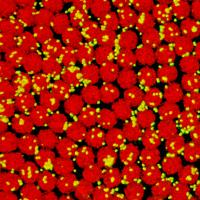
Wolbachia in yellow with host cells in red. Scientists at the University of Rochester and the J. Craig Venter Institute have discovered a copy of the entire genome of a bacterial parasite residing inside the genome of its host species.
| Full story | 0 Comments | 8170 views |

| Microbiology | August 30, 2007 08:27 PM |
University of Illinois at Chicago researchers have identified new sites on the bacterial cell's protein-making machinery where antibiotics can be delivered to treat infections.
| Full story | 0 Comments | 6417 views |
| Biology | August 30, 2007 07:27 PM |
For years, biologists in Africa have known that large mammals – including antelopes and their predators - were disappearing outside reserves. Now a raft of studies, published in the September 2007 issue of the African Journal of Ecology, show that we have moved beyond this. We are losing species from national parks, bastion of biodiversity conservation. Worryingly, this includes the continent’s crown jewels such as Tanzania’s Serengeti National Park.
| Full story | 0 Comments | 6996 views |
| Molecular & Cell Biology | August 30, 2007 06:30 PM |
A cannibalistic process called autophagy spurs dying embryonic stem cells to send "eat me" and "come get me" signals to have their corpses purged, a last gasp that paves the way for normal mammalian development, UT Southwestern Medical Center researchers have found.
| Full story | 0 Comments | 6562 views |
| Health & Medicine | August 30, 2007 06:27 PM |
Thousands of World Trade Center rescue and recovery workers were still suffering serious mental health effects three years after the disaster, the Health Department reported today. New findings released from the World Trade Center Health Registry show that one in eight rescue and recovery workers (12.4%) likely had post-traumatic stress disorder when they were interviewed in 2003 and 2004. The findings were published today in the American Journal of Psychiatry, available online at www.ajp.psychiatryonline.org (direct link: http://ajp.psychiatryonline.org/cgi/reprint/164/9/1385).
| Full story | 0 Comments | 6900 views |
| Biotechnology | August 30, 2007 05:30 PM |
The environmental consequences of transgenic crops are the focus of numerous investigations, such as the one published in the journal PloS ONE, which was carried out by Cristina Faria and her colleagues, under the supervision of Ted Turlings, professor in chemical ecology at the University of Neuchâtel. The researchers observed that most transgenic maize lines were significantly more susceptible to the aphid Rhopalosiphum maidis than their conventional equivalents. "We have studied six lines of Bt maize containing an insecticidal gene derived from the bacteria Bacillus thuringiensis. The toxin produced by these genes is very specific and only affects the caterpillars feeding on the plants, not the aphids. Five of the lines contained up to twice the number of aphids", states Cristina Faria. She does, however, go on to clarify what seems, at a first glance, detrimental to the plant.
| Full story | 0 Comments | 7279 views |
| Biology | August 30, 2007 04:30 PM |
While you may not catch a fly sipping Perrier, the insect has specialized taste cells for carbonated water that probably encourage it to binge on food with growing microorganisms. Yeast and bacteria both produce carbon dioxide (CO2) when they feast, and CO2 dissolves readily in water to produce seltzer or soda water.
| Full story | 0 Comments | 8946 views |
| Health & Medicine | August 30, 2007 02:30 PM |
Smoking tobacco is no longer considered sexy, but it may prove a permanent turn on for some genes. Research published today in the online open access journal BMC Genomics could help explain why former smokers are still more susceptible to lung cancer than those who have never smoked.
| Full story | 0 Comments | 8549 views |
| Microbiology | August 30, 2007 12:30 PM |
With infections increasingly resistant to even the most modern antibiotics, researchers at the Los Angeles Biomedical Research Institute at Harbor-UCLA Medical Center (LA BioMed) report in the September issue of Nature Reviews Microbiology on new clues they have uncovered in immune system molecules that defend against infection.
| Full story | 0 Comments | 6061 views |
| Microbiology | August 30, 2007 10:30 AM |
As summer temperatures cool in the United States, fewer mosquitoes whir around our tiki torches. But mosquitoes swarming around nearly 40 percent of the world’s population will continue to spread a deadly parasitic disease — malaria. Now an interdisciplinary team led by researchers from Rensselaer Polytechnic Institute has found a key link that causes malarial infection in both humans and mosquitoes.
| Full story | 0 Comments | 7707 views |

| Stem Cell Research | August 29, 2007 11:30 PM |
How do adult stem cells protect themselves from accumulating genetic mutations that can lead to cancer?
| Full story | 0 Comments | 6224 views |
| Biology | August 29, 2007 10:30 PM |
Biologists at Harvard University have identified the ancient fossilized remains of a pollen-bearing bee as the first hint of orchids in the fossil record, a find they say suggests orchids are old enough to have co-existed with dinosaurs.
| Full story | 0 Comments | 6650 views |
| Microbiology | August 29, 2007 09:30 PM |
A review of measures taken to address a 2004 outbreak of the highly infectious Norwalk virus at The Johns Hopkins Hospital has provided the first solid documentation of expenses and efforts in the United States to stop the infection from spreading among patients, staff and visitors. Total hospital costs for the three-month outbreak - including extra cleaning supplies, staff sick leave, diagnostic tests, replacement staff, and salaries and lost revenue from closed beds - were estimated at more than $650,000.
| Full story | 0 Comments | 7966 views |
| Health & Medicine | August 29, 2007 08:30 PM |
University of Pennsylvania researchers and their colleagues at the Wistar Institute and University of Oxford have discovered the molecular process by which the PAX5 protein, necessary for lymphocyte development, promotes the growth of common lymphomas, thereby unveiling a potential new target in the fight against cancer.
| Full story | 0 Comments | 6041 views |
| Biology | August 29, 2007 07:30 PM |
It appears that chemical warfare has been around a lot longer than poison arrows, mustard gas or nerve weapons – about 100 million years, give or take a little.
| Full story | 0 Comments | 8061 views |
| Molecular & Cell Biology | August 29, 2007 06:30 PM |
Gene networks are some of the most basic features of a living organism. An external or internal stimulus activates some genes, which in turn control others genes whose activity turns on or off various biological processes (such as the cell cycle, energy production, DNA repair, cellular suicide etc). Many of the regulatory functions are controlled by attachment of special proteins (transcription factors) to 6 - 10 nucleotide long binding sequences located on the DNA, activating or suppressing expression of the regulated gene. Our ability to identify these binding sites is essential to understand the way biological networks operate.
| Full story | 0 Comments | 7557 views |
| Health & Medicine | August 29, 2007 03:39 PM |
Touching stories of living donor transplantation are continuously happening in hospitals. One of these stories is reported recently in the August 14 issue of the World Journal of Gastroenterology because of its shining significance in hepatology. This article is going to bring comfort to many families.
| Full story | 0 Comments | 6972 views |
| Health & Medicine | August 29, 2007 01:39 PM |
Neighborhood property values predict local obesity rates better than education or incomes, according to a study from the University of Washington being published online this week by the journal Social Science and Medicine. For each additional $100,000 in the median price of homes, UW researchers found, obesity rates in a given ZIP code dropped by 2 percent.
| Full story | 0 Comments | 6820 views |
| Biology | August 29, 2007 11:39 AM |
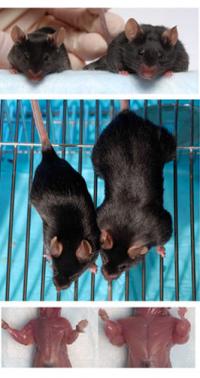
Comparison of body and muscle size between normal (left) and double mutant mice lacking myostatin and overproducing follistatin (right). The Johns Hopkins scientist who first showed that the absence of the protein myostatin leads to oversized muscles in mice and men has now found a second protein, follistatin, whose overproduction in mice lacking myostatin doubles the muscle-building effect.
| Full story | 0 Comments | 14038 views |
| Microbiology | August 28, 2007 08:49 PM |
Researchers may be able to tinker with a single amino acid of an enzyme that helps viruses multiply to render them harmless, according to molecular biologists who say the discovery could pave the way for a fast and cheap method of making vaccines.
| Full story | 0 Comments | 7092 views |
| Molecular & Cell Biology | August 28, 2007 07:49 PM |
Botanists at Oregon State University have discovered that a single plant gene can cause resistance to one disease at the same time it produces susceptibility to a different disease – the first time this unusual phenomenon has ever been observed in plants.
| Full story | 0 Comments | 8144 views |
| Biology | August 28, 2007 06:49 PM |
A new poisonous frog was recently discovered in a remote mountainous region in Colombia by a team of young scientists supported by the Conservation Leadership Programme (CLP). The new frog, which is almost two centimetres in length, was given the name the “golden frog of Supatá.”
| Full story | 0 Comments | 10032 views |
| Molecular & Cell Biology | August 28, 2007 05:49 PM |
Dietary restrictions or other strategies that limit fat formation might make pancreatic cell transplants more effective, UT Southwestern Medical Center researchers report.
| Full story | 0 Comments | 6129 views |
| Molecular & Cell Biology | August 28, 2007 12:09 PM |
Sheets of highly organized epithelial cells line all the cavities and free surfaces of the body, forming barriers that control the movement of liquids and cells in the body organs. The organized structure of normal breast epithelial cells may also serve as a barrier against cancer, according to a study by University of Helsinki scientists. The work appears this week in the online edition of the Proceedings of the National Academy of Sciences (PNAS).
| Full story | 0 Comments | 8097 views |
| Biotechnology | August 28, 2007 10:09 AM |
University of Arkansas researchers have found a simple, inexpensive way to create a nanowire coating on the surface of biocompatible titanium that can be used to create more effective surfaces for hip replacement, dental reconstruction and vascular stenting. Further, the material can easily be sterilized using ultraviolet light and water or using ethanol, making it useful in hospital settings and meat-processing plants
| Full story | 0 Comments | 9915 views |
| Health & Medicine | August 27, 2007 11:09 PM |
A nasal spray is safe and effective at rapidly treating cluster headaches, which are considered to be the most painful kind of headache with few treatment options, according to a study published in the August 28, 2007, issue of Neurology®, the medical journal of the American Academy of Neurology.
| Full story | 1 Comment | 53554 views |
| Microbiology | August 27, 2007 10:09 PM |
A research team has for the first time ever discovered DNA from living bacteria that are more than half a million years old. Never before has traces of still living organisms that old been found. The exceptional discovery can lead to a better understanding of the ageing of cells and might even cast light on the question of life on Mars. The discovery is being published in the current issue of PNAS (Proceedings of The National Academy of Sciences of The United States of America). The discovery was made by Professor Eske Willerslev from the University of Copenhagen and his international rearch team.
| Full story | 0 Comments | 11880 views |

- In some genetic cases of microcephaly, stem cells fail to launch
- Yale team discovers how Zika virus causes fetal brain damage
- Scientists uncover the way a common cell enzyme alerts the body to invading bacteria
- Arctic gives clues on worst mass extinction of life
- Calcium channel blockers caught in the act at atomic level
Search Bio News Net
Free Biology Newsletter
- Flexibility That A.C.A. Lent to Work Force Is Threatened by...International Herald Tribune
- Bacteria Behind Legionnaires’ Disease Found at New York Police StationInternational Herald Tribune
- Prescription Price Crisis? 28 Million Americans See Spike in Drug...MSNBC.com: Health
- Seizing on Opioid Crisis, a Drug Maker Lobbies Hard for...International Herald Tribune
- Republicans are taking a big political risk on health careAP Health News
- Why We're So Divided Over Saving WolvesNational Geographic News