

Scientists from Texas have made an important step toward understanding human mating behavior by showing that certain genes become activated in fruit flies when they interact with the opposite sex. This research, published in the January 2011 issue of the journal GENETICS (http://www.genetics.org), shows that courtship behaviors may be far more influenced by genetics than previously thought. In addition, understanding why and how these genes become activated within social contexts may also lead to insight into disorders such as autism.

Category: Microarray
| Microarray | January 12, 2011 08:25 PM |
Van Andel Research Institute (VARI) researchers have developed a method that can yield more information from archived newborn blood that has implications for a vast array of research, including population health studies and answering questions about diseases in infants and children.
| Full article | 0 Comments | 9524 views |
| Microarray | January 12, 2011 08:25 PM |
23andMe has released its first annual list of what it felt to be the 10 most interesting and significant genetic findings in 2010, as part of an ongoing journey to understand the role of genetics in personal health and human development.
| Full article | 0 Comments | 13721 views |
| Microarray | August 18, 2010 07:43 PM |
Tricking honey bees into thinking they have traveled long distance to find food alters gene expression in their brains, researchers report this month. Their study, in the journal Genes, Brain and Behavior, is the first to identify distance-responsive genes.
| Full article | 0 Comments | 10958 views |
| Microarray | May 25, 2010 04:48 PM |
Researchers working with Professor Gudrun Rappold, Director of the Department of Molecular Human Genetics at Heidelberg University Hospital, have discovered previously unknown mutations in autistic and mentally impaired patients in what is known as the SHANK2 gene, a gene that is partially responsible for linking nerve cells. However, a single gene mutation is not always enough to trigger the illness. In some cases, a certain threshold of mutation must be exceeded. The researchers conclude from their results that a correct inner structure of the nerve cell synapses is necessary to enable the normal development of language, social competence, and cognitive capacity. Essential for the success of the project were the studies by the Heidelberg research team with the doctoral student Simone Berkel and collaboration with a Canadian research team headed by Steve Scherer. The study has already been published online in the leading scientific journal Nature Genetics.
| Full article | 0 Comments | 12185 views |
| Microarray | September 7, 2009 04:11 PM |
British scientists have discovered two new genes associated with Alzheimer's disease, while French colleagues uncovered a third. The results, from the largest ever Alzheimer's genome-wide association study (GWAS) involving 16,000 individuals, are published in Nature Genetics. They are the first new genes found to be associated with the common form of Alzheimer's disease since 1993.
| Full article | 0 Comments | 12209 views |
| Microarray | August 6, 2009 09:56 PM |
A group of genes whose expression is significantly altered following exposure to drug paraphernalia after an enforced 'cold-turkey' period have been identified. Researchers writing in the open access journal BMC Neuroscience studied gene expression in the brains of heroin-addicted rats, identifying those genes that may be involved in precipitating a relapse.
| Full article | 0 Comments | 10794 views |
| Microarray | April 28, 2009 07:18 PM |
InDevR, a small biotech company in Boulder, CO, announced today that they have licensed the FluChip technology from the University of Colorado. The FluChip was invented by a joint team of scientists at the University of Colorado and the Centers for Disease Control and Prevention in an NIH sponsored effort led by Professor Kathy Rowlen.
| Full article | 0 Comments | 12927 views |
| Microarray | April 21, 2009 11:36 PM |
The human genome complete sequencing project in 2003 revealed the enormous instruction manual necessary to define a human being. However, there are still many unanswered questions. There are few indications on where the functional elements are found in this manual. To explain how we develop, scientists will have to decode the entire network of biological complexes that regulate development. One of the biggest challenges is to analyse the key proteins involved in the development of a human being, namely the proteins that bind to DNA. "If the genome provides the recipe to define a human being, the DNA proteins are the "chefs" that cook it", describes Herbert Auer, manager of the Functional Genomics Facility at the Institute for Research in Biomedicine (IRB Barcelona) and co-organizer, together with Erich Grotewold, at the Ohio State University, of the Barcelona Biomed Conference, "The DNA proteome". Invited by IRB Barcelona and the BBVA Foundation, twenty-one authorities in the field of genomics present their recent work on 20, 21 and 22 April at the "Institut d'Estudis Catalans", in Barcelona.
| Full article | 0 Comments | 11791 views |
| Microarray | March 22, 2009 11:35 PM |
One minute, he's a strapping 40-year-old with an enviable cholesterol level, working out on his treadmill.
| Full article | 0 Comments | 11344 views |
| Microarray | March 17, 2009 10:10 AM |
The medical costs that businesses pay to care for one premature baby for a year could cover the costs for nearly a dozen healthy, full-term infants, according to new statistics from the March of Dimes.
| Full article | 0 Comments | 14494 views |
| Microarray | December 15, 2008 02:37 PM |
The metastasis or spread of breast cancer to other tissues in the body can be predicted more accurately by examining subnetworks of gene expression patterns in a patient's tumor, than by conventional gene expression microarrays, according to a presentation at the American Society for Cell Biology (ASCB) 48th Annual Meeting, Dec. 13-17, 2008 in San Francisco.
| Full article | 0 Comments | 12037 views |
| Microarray | December 11, 2008 09:55 PM |
In the art world, the most successful portraits are often those that reveal the true essence of the subject – a subject that on canvas, at least, will never age. In the science world, researchers are relying on portraits of gene expression patterns – but, in this case, the images are helping to reveal how various tissues form.
| Full article | 0 Comments | 11360 views |
| Microarray | December 8, 2008 04:24 AM |
An international research team has identified 11 novel locations in the human genome where common variations appear to influence cholesterol or triglyceride levels, bringing the total number of lipid-associated genes to 30. While major mutations in some of these genes have been known to underlie rare lipid metabolism disorders, it is becoming apparent that common changes in the same genes that have modest effects can combine with risk-associated variants in other genes to significantly influence blood lipid levels. The report to appear in the journal Nature Genetics is being released online.
| Full article | 0 Comments | 11886 views |
| Microarray | November 17, 2008 05:05 PM |
A "chip" or array that can quickly detect disorders such as Down syndrome or other diseases associated with chromosomal abnormalities proved an effective tool in prenatal diagnosis in a series of 300 cases at Baylor College of Medicine, said researchers in a report that appears in the current issue of the journal Prenatal Diagnosis.
| Full article | 0 Comments | 12328 views |
| Microarray | October 15, 2008 07:14 PM |
Researchers are poised to unlock the genetic secrets stored in hundreds of thousands of cancer biopsy samples locked in long-term storage and previously thought to be useless for modern genetic research. With the aid of a new technique developed by Howard Hughes Medical Institute researchers, scientists can now reconstruct thousands of genes that are "shredded" into tiny pieces when tissue samples are treated with a chemical fixative and stored in wax – a protocol that is commonly used to preserve the samples.
| Full article | 0 Comments | 10949 views |
| Microarray | September 4, 2008 02:37 PM |
The most comprehensive to-date genomic analysis of a cancer – the deadly brain tumor glioblastoma multiforme – shows previously unrecognized changes in genes and provides an overall view of the missteps in the pathways that govern the growth and behavior of cells, said members of The Cancer Genome Atlas Research Network in a report that appears online today in the journal Nature.
| Full article | 0 Comments | 12227 views |
| Microarray | June 30, 2008 05:56 PM |
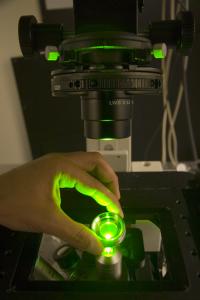
DNA microarrays can be easily interrogated with only the naked eye using a new electrostatic imaging technique developed in the laboratory of Jay Groves, a chemist with Berkeley Lab, UC Berkeley and HHMI. Credit: Photo Michael Barnes, UC Berkeley Chemistry Department The dream of personalized medicine — in which diagnostics, risk predictions and treatment decisions are based on a patient's genetic profile — may be on the verge of being expanded beyond the wealthiest of nations with state-of-the-art clinics. A team of researchers with the U.S. Department of Energy's Lawrence Berkeley National Laboratory (Berkeley Lab) has invented a technique in which DNA or RNA assays — the key to genetic profiling and disease detection — can be read and evaluated without the need of elaborate chemical labeling or sophisticated instrumentation. Based on electrostatic repulsion — in which objects with the same electrical charge repel one another — the technique is relatively simple and inexpensive to implement, and can be carried out in a matter of minutes.
| Full article | 0 Comments | 12026 views |
| Microarray | June 19, 2008 08:48 PM |
Gene-expression data from liver tissue or whole blood can be used to classify histopathologic differences in the effects of hepatotoxins. It is hoped that these findings, published in BioMed Central's open access journal, Genome Biology, will lead to a more precise way of defining the potential hepatotoxicity of new compounds.
| Full article | 0 Comments | 10661 views |
| Microarray | May 4, 2008 09:48 PM |
A person with dilated cardiomyopathy has an enlarged and stretched heart cavity, usually too weak to pump normally; most people will go on to develop heart failure. While clinicians know that up to 36 percent of all cases of dilated cardiomyopathy may be due to excessive drinking, it has been difficult to differentiate between alcohol-induced heart failure and heart failure due to idiopathic dilated cardiomyopathy. A first-of-its-kind study has found a way to both diagnose alcohol-induced heart failure and possibly reverse it through therapeutic interventions.
| Full article | 0 Comments | 13139 views |
| Microarray | April 14, 2008 09:40 PM |
The nature vs. nurture debate is familiar to most people, and modern conclusions usually predict a balance between the two. A new paper published this week in the open-access journal PLoS Biology shows that there is a similar balance between the genes we inherit—nature—and the environment—nurture—in determining thousands of traits in yeast. As we approach the age of personal genomics, in which each of us knows something about the genetic variations we carry, it is important to understand how genes and the environment interact in order to draw medically sound conclusions from the information available—e.g. whether exercise can reduce risks that are increased because of a genetic predisposition towards a certain illness.
| Full article | 0 Comments | 11121 views |
| Microarray | April 14, 2008 08:40 PM |
DNA samples from 120,000 people are to be analysed in a £30 million follow up to last year's Wellcome Trust Case Control Consortium (WTCCC), the largest ever study of the genetics behind common diseases. The seven-fold increase in the number of samples to be analysed will allow researchers to look at a 25 diseases as well as studying the genetics of learning in children and individuals' responses to statins.
| Full article | 0 Comments | 11603 views |
| Microarray | March 28, 2008 03:24 PM |
Researchers from the University of Turin, Italy and the University of Nijmegen, The Netherlands, have devised a new method that may help the medical community to determine the genetic basis of many common diseases. Their findings are described in an article published March 21st in the open-access journal PLoS Computational Biology.
| Full article | 0 Comments | 11783 views |
| Microarray | February 28, 2008 11:54 PM |
Differences in gene expression levels between people of European versus African ancestry can affect how each group responds to certain drugs or fights off specific infections, report researchers from the University of Chicago Medical Center and the Expression Research Laboratory at Affymetrix Inc. of Santa Clara, CA.
| Full article | 0 Comments | 11970 views |
| Microarray | December 27, 2007 09:35 PM |
Scientists who study cancer may be prone to drawing simplistic conclusions from the powerful molecular tools now available because they don’t appreciate how complex the data is that is being generated, said a team of Georgetown University Medical Center (GUMC) researchers in the January issue of Nature Reviews Cancer.
| Full article | 0 Comments | 10318 views |
| Microarray | December 27, 2007 09:35 PM |
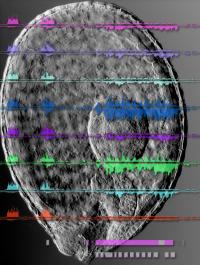
The image shows a growth-arrested embryo from a mutant Arabidopsis plant that contains a genetic lesion in a gene encoding an essential part of the exosome. The embryo is overlaid on a genome browser image of tiling expression data from an intergenic region that exhibits strong upregulation of a cluster of novel tandem repeat-associated, exosome-regulated transcripts. Cells keep a close watch over the transcriptome – the totality of all parts of the genome that are expressed in any given cell at any given time. Researchers at the Salk Institute for Biological Studies and the University of Missouri-Kansas City teamed up to peel back another layer of transcriptional regulation and gain new insight into how genomes work.
| Full article | 0 Comments | 11613 views |
| Microarray | December 17, 2007 07:00 PM |

Human liver cells are dotted across the new DataChip to quickly determine if various chemicals, drugs, and drug candidates are toxic. When coupled with the MetaChip, the two biochips could provide a highly predictive alternative to animal testing. Credit: Moo-Yeal Lee/Rensselaer Polytechnic Institute A new biochip technology could eliminate animal testing in the chemicals and cosmetics industries, and drastically curtail its use in the development of new pharmaceuticals, according to new findings from a team of researchers at Rensselaer Polytechnic Institute, the University of California at Berkeley, and Solidus Biosciences Inc.
| Full article | 0 Comments | 11778 views |
| Microarray | December 11, 2007 12:25 PM |
When a female is attracted to a male, entire suites of genes in her brain turn on and off, show biologists from The University of Texas at Austin studying swordtail fish.
| Full article | 0 Comments | 10798 views |
| Microarray | December 6, 2007 02:35 PM |
Gene-expression profiles might be used to identify prognostic biomarkers for Kawasaki disease, and help to unravel the underlying biology of the illness, research published this week in the online open access journal Genome Biology reveals. The new findings also support the idea that gene-expression profiles might be used to generate biomarkers for other systemic inflammatory illnesses.
| Full article | 0 Comments | 10619 views |
| Microarray | November 29, 2007 03:28 PM |
A team led by scientists at MIT and Harvard University and supported in part by the National Institute of Allergy and Infectious Diseases, a component of the National Institutes of Health, collected blood samples from 43 P. falciparum-infected malaria patients in Senegal who were suffering from a range of malaria symptoms. The scientists isolated the parasites’ genomic information and determined which of the nearly 6,000 P. falciparum genes were switched on or off during infection, revealing distinct groups of parasites with characteristic sets of active and inactive genes. By comparing this information about P. falciparum with gene activation patterns in a similar but better-understood organism—baker’s yeast—the scientists described three biological classes of malaria parasites, each with a different metabolic state. One state is well known from laboratory studies, but the other two have never been observed before. One newly described state appears to reflect starving parasites, while the other suggests parasites under extreme environmental stress. Remarkably, say the scientists, the latter group correlated with specific patient symptoms, including high fevers and elevated levels of inflammatory markers in their blood.
| Full article | 0 Comments | 10778 views |
Return to Biology News Net Homepage

- In some genetic cases of microcephaly, stem cells fail to launch
- Yale team discovers how Zika virus causes fetal brain damage
- Scientists uncover the way a common cell enzyme alerts the body to invading bacteria
- Arctic gives clues on worst mass extinction of life
- Calcium channel blockers caught in the act at atomic level
- Flexibility That A.C.A. Lent to Work Force Is Threatened by...International Herald Tribune
- Bacteria Behind Legionnaires’ Disease Found at New York Police StationInternational Herald Tribune
- Prescription Price Crisis? 28 Million Americans See Spike in Drug...MSNBC.com: Health
- Seizing on Opioid Crisis, a Drug Maker Lobbies Hard for...International Herald Tribune
- Republicans are taking a big political risk on health careAP Health News
- Why We're So Divided Over Saving WolvesNational Geographic News
Top Biology News about Microarray
Biology Articles & News
Last 7 Days
Biology Articles & News
Most popular ever in Microarray
- Characterizing Skin Cancer by Microarrays (47350)
- Alcohol's effects on gene expression in the central nervous system (22721)
- Affymetrix Microarray System Cleared by FDA (18246)
- 'Virus chip' detects new virus in prostate tumors (14973)
- Medical costs for one premature baby could cover a dozen healthy births (14494)
- Gene expression profile helps predict chemotherapy response in ovarian cancer patients (14366)
- Chemical Engineer Kao Explores Antibiotic Synthesis With DNA Chips (13760)