

Eye diseases such as diabetic retinopathy and age-related macular degeneration are among the leading causes of irreversible vision loss and blindness worldwide. Currently, gene therapy can be administered to treat these conditions -- but this requires an injection. Now researchers report in the journal ACS Applied Materials & Interfaces a new way to deliver the treatment topically, without a needle.

Category: Gene Therapy
| Gene Therapy | July 27, 2016 05:24 PM |
A discovery by Washington State University scientist Dan Rodgers and collaborator Paul Gregorevic could save millions of people suffering from muscle wasting disease.
| Full article | 0 Comments | 10546 views |
| Gene Therapy | July 5, 2016 05:36 PM |
Researchers have developed a new strategy using lung-targeted gene therapy that may lead to improved treatments for inherited diseases including emphysema.
| Full article | 0 Comments | 9306 views |
| Gene Therapy | April 28, 2016 04:59 PM |
Pioneering gene therapy has restored some vision to patients with a rare form of genetic blindness for as long as four years, raising hopes it could be used to cure common causes of vision loss, new University of Oxford research published today shows.
| Full article | 0 Comments | 11761 views |
| Gene Therapy | November 16, 2015 09:05 PM |
An improved gene therapy treatment can cure mice with cystic fibrosis (CF). Cell cultures from CF patients, too, respond well to the treatment. Those are the encouraging results of a study presented by the Laboratory for Molecular Virology and Gene Therapy at KU Leuven, Belgium.
| Full article | 0 Comments | 12713 views |
| Gene Therapy | October 22, 2015 03:41 PM |
Muscular dystrophy, which affects approximately 250,000 people in the U.S., occurs when damaged muscle tissue is replaced with fibrous, fatty or bony tissue and loses function. For years, scientists have searched for a way to successfully treat the most common form of the disease, Duchenne Muscular Dystrophy (DMD), which primarily affects boys. Now, a team of University of Missouri researchers have successfully treated dogs with DMD and say that human clinical trials are being planned in the next few years.
| Full article | 0 Comments | 9223 views |
| Gene Therapy | August 31, 2015 02:34 PM |
Mice lacking the protein retGC1, which is deficient in humans suffering Leber congenital amaurosis-1 (LCA1), a disorder that causes severe visual impairment beginning in infancy, received gene therapy to replace retGC1 and showed fully restored visual function that persisted for at least 6 months. The success of this approach strongly support clinical testing of a gene therapy targeted to the retinas of LCA1 patients, conclude the authors of the study published in Human Gene Therapy. The article is available free on the Human Gene Therapy website until September 30, 2015.
| Full article | 0 Comments | 8990 views |
| Gene Therapy | August 27, 2015 04:31 PM |
Degenerating neurons in patients with Alzheimer's disease (AD) measurably responded to an experimental gene therapy in which nerve growth factor (NGF) was injected into their brains, report researchers at University of California, San Diego School of Medicine in the current issue of JAMA Neurology.
| Full article | 0 Comments | 9055 views |
| Gene Therapy | July 13, 2015 07:06 PM |
Korean researchers have described a novel control system to regulate the expression of a therapeutic transgene by targeting the passenger strand of a microRNA (miR-122) linked to the transgene. The researchers report that a control system based on targeting the passenger strand of miR-122 rather than the guide strand can regulate expression of an exogenous, therapeutic gene, while not affecting the expression of endogenous genes, in an article in Nucleic Acid Therapeutics. The article is available free on the Nucleic Acid Therapeutics website until August 13, 2015.
| Full article | 0 Comments | 8712 views |
| Gene Therapy | April 29, 2015 07:13 PM |
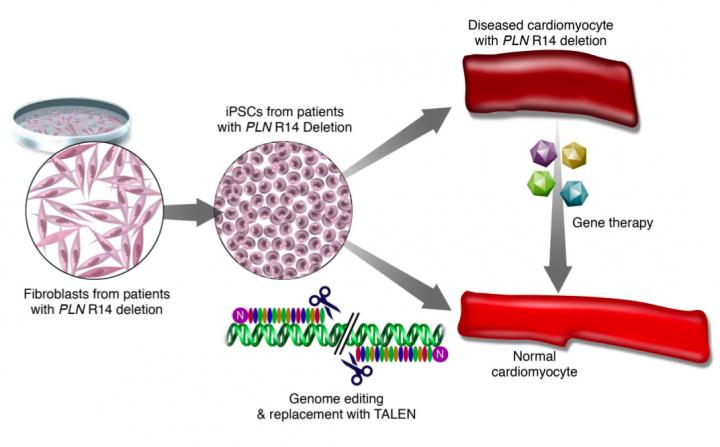
This image shows the heart failure gene editing process. Gene therapy can clip out genetic material linked to heart failure and replace it with the normal gene in human cardiac cells, according to a study led by researchers from the Cardiovascular Research Center at Icahn School of Medicine at Mount Sinai. The study is published in the April 29 edition of Nature Communications.
| Full article | 0 Comments | 10147 views |
| Gene Therapy | August 26, 2014 06:45 PM |
Treating the rare disease MPS I is a challenge. MPS I, caused by the deficiency of a key enzyme called IDUA, eventually leads to the abnormal accumulation of certain molecules and cell death.
| Full article | 0 Comments | 8948 views |
| Gene Therapy | July 11, 2014 05:47 PM |
Researchers from Salk Institute for Biological Studies, BGI, and other institutes for the first time evaluated the safety and reliability of the existing targeted gene correction technologies, and successfully developed a new method, TALEN-HDAdV, which could significantly increased gene-correction efficiency in human induced pluripotent stem cell (hiPSC). This study published online in Cell Stell Cell provides an important theoretical foundation for stem cell-based gene therapy.
| Full article | 0 Comments | 7742 views |
| Gene Therapy | November 16, 2011 07:19 PM |
A new episode in the American Chemical Society's (ACS) award-winning "Global Challenges/Chemistry Solutions" podcast series spins a real-life tale in which spider silk shows promise for overcoming a major barrier to the use of gene therapy in everyday medicine.
| Full article | 0 Comments | 11633 views |
| Gene Therapy | November 3, 2011 06:11 PM |
For the first time, researchers have combined gene therapy and stem cell transplantation to successfully reverse the severe, crippling bleeding disorder hemophilia A in large animals, opening the door to the development of new therapies for human patients.
| Full article | 0 Comments | 13592 views |
| Gene Therapy | October 13, 2011 05:21 PM |
National Institutes of Health-funded scientists have corrected sickle cell disease in adult laboratory mice by activating production of a special blood component normally produced before, but not after, birth.
| Full article | 0 Comments | 11087 views |
| Gene Therapy | March 18, 2011 10:49 AM |
A multi-center gene therapy trial for patients with advanced Parkinson’s disease demonstrated reduced symptoms of the progressive movement disorder, according to a new study published in Lancet Neurology. The study was designed to deliver the gene for glumatic acid decarboxylase (GAD) packaged in inert viral vectors into an area of the brain called the subthalamic nucleus. GAD makes an important inhibitory chemical called GABA. The subthalamic nucleus is abnormally activated in Parkinson’s disease and this activity leads to the debilitating movement problems. The idea of the gene therapy is that the billions of AAV-2 GAD viral vectors delivered into the subthalamic nucleus will increase GABA, thereby quieting this brain region.
| Full article | 0 Comments | 13338 views |
| Gene Therapy | January 12, 2011 01:23 AM |
One of the challenges of gene therapy - a set of methodologies aimed at treating several nucleic acid diseases (DNA or RNA) - is to assure that this material arrives directly to the nucleus of the cell without losing a substantial amount along the way and without producing any undesired side effects. With this aim, scientists experiment with the use of different types of vectors, molecules capable of transporting genetic material to the correct place. Presently, natural "deactivated" viruses are the most commonly used vectors in clinical trials, their side effects however often limit therapeutic application.
| Full article | 0 Comments | 12514 views |
| Gene Therapy | November 15, 2010 10:28 PM |
It is common for cancer cells to find some way to disarm p53, also known as "guardian of the genome" due to its action in preventing defective cells from dividing. "The critical importance of the protective function of p53 is underscored by the diversity of molecular strategies employed by cancer cells to subvert p53 activity, such as overexpression of antagonistic proteins like HDM2 and HDMX," explains senior study author Dr. Loren D. Walensky from Harvard Medical School. "Restoration of p53 activity remains an important goal in the quest for more effective cancer therapeutics."
| Full article | 0 Comments | 10998 views |
| Gene Therapy | October 7, 2010 04:01 AM |
An immune reaction to dystrophin, the muscle protein that is defective in patients with Duchenne muscular dystrophy, may pose a new challenge to strengthening muscles of patients with this disease, suggests a new study appearing in the October 7, 2010, issue of The New England Journal of Medicine.
| Full article | 0 Comments | 11752 views |
| Gene Therapy | August 17, 2010 01:06 AM |
In one of only two studies of its kind, a study from researchers at Tufts University School of Medicine and the Sackler School of Graduate Biomedical Sciences at Tufts demonstrates that non-viral gene therapy can delay the onset of some forms of eye disease and preserve vision. The team developed nanoparticles to deliver therapeutic genes to the retina and found that treated mice temporarily retained more eyesight than controls. The study, published online in advance of print in Molecular Therapy, brings researchers closer to a non-viral gene therapy treatment for degenerative eye disorders.
| Full article | 0 Comments | 11385 views |
| Gene Therapy | July 13, 2010 09:38 PM |
Italian scientists pioneering a new gene transfer treatment for the blood disorder β-thalassemia have successfully completed preclinical trials, claiming they can correct the lack of beta-globin (ß-globin) in patients' blood cells which causes the disease. The research, published in EMBO Molecular Medicine, reveals how gene therapy may represent a safe alternative to current cures that are limited to a minority of patients.
| Full article | 0 Comments | 10411 views |
| Gene Therapy | July 6, 2010 07:14 PM |
Scientists have designed a nanoparticle that appears to effectively deliver genetic material into cells with minimal toxic effects.
| Full article | 0 Comments | 9837 views |
| Gene Therapy | June 24, 2010 06:25 PM |
EUREKA project E! 3371 Gene Transfer Agents has made great advances in the development of novel non-viral carriers able to introduce genetic material into the target cells. These new agents, derivatives of cationic amphiphilic 1,4-dihydropyridine (1,4-DHP), avoid the problems of the recipient's immune system reacting against a viral carrier. The project partners have developed methods to produce them in large amounts, which solves another of the problems with viral delivery. But the greatest advantage is that the new compounds are significantly more effective at delivering DNA into cell nuclei than other standard synthetic carriers; increasing the chance of the DNA successfully controlling the defective genes, and the disease.
| Full article | 0 Comments | 8795 views |
| Gene Therapy | June 21, 2010 08:29 PM |
Researchers have developed an experimental cure for Type 1 diabetes, a disease that affects about one in every 400 to 600 children and adolescents. They will present their results in a mouse model of Type 1 diabetes on Sunday at The Endocrine Society's 92nd Annual Meeting in San Diego.
| Full article | 0 Comments | 11890 views |
| Gene Therapy | June 5, 2010 12:25 PM |
Researchers at Mount Sinai School of Medicine have developed a new gene therapy that is safe and effective in reversing advanced heart failure. SERCA2a (produced as MYDICAR®) is a gene therapy designed to stimulate production of an enzyme that enables the failing heart to pump more effectively. In a Phase II study, SERCA2a injection through a routine minimally invasive cardiac catheterization was safe and showed clinical benefit in treating this patient population and decreasing the severity of heart failure. The data were presented this week at the Heart Failure Congress of the European Society of Cardiology in Berlin.
| Full article | 0 Comments | 10968 views |
| Gene Therapy | December 9, 2009 02:02 AM |
Blood vessel blockage, a common condition in old age or diabetes, leads to low blood flow and results in low oxygen, which can kill cells and tissues. Such blockages can require amputation resulting in loss of limbs. Now, using mice as their model, researchers at Johns Hopkins have developed therapies that increase blood flow, improve movement and decrease tissue death and the need for amputation. The findings, published online last week in the early edition of the Proceedings of the National Academy of Sciences, hold promise for developing clinical therapies.
| Full article | 0 Comments | 13611 views |
| Gene Therapy | October 25, 2009 02:28 AM |
Born with a retinal disease that made him legally blind, and would eventually leave him totally sightless, the nine-year-old boy used to sit in the back of the classroom, relying on the large print on an electronic screen and assisted by teacher aides. Now, after a single injection of genes that produce light-sensitive pigments in the back of his eye, he sits in front with classmates and participates in class without extra help. In the playground, he joins his classmates in playing his first game of softball.
| Full article | 0 Comments | 14752 views |
| Gene Therapy | October 19, 2009 05:34 PM |
Over-expressing a gene that lets brain cells communicate just a fraction of a second longer makes a smarter rat, report researchers from the Medical College of Georgia and East China Normal University.
| Full article | 0 Comments | 15468 views |
| Gene Therapy | October 5, 2009 10:12 PM |
Scientists from the Universities of Michigan and Minnesota show in a research report published online in the FASEB Journal (http://www.fasebj.org) that gene therapy may be used to improve an ailing heart's ability to contract properly. In addition to showing gene therapy's potential for reversing the course of heart failure, it also offers a tantalizing glimpse of a day when "closed heart surgery" via gene therapy is as commonly prescribed as today's cocktail of drugs.
| Full article | 0 Comments | 13982 views |
| Gene Therapy | July 29, 2009 06:08 PM |
An international team of scientists and clinicians from the United States and Saudi Arabia are working to develop gene therapy for treating a rare, hereditary retinal disease. The therapy has been shown to restore lost vision in animal models of retinitis pigmentosa (RP). Their work is being funded in part by a $1.5 million grant from the Prince Salman Center for Disability Research in Saudi Arabia, where the recessive gene mutation that leads to the eye disease RP has been found in children from several families.
| Full article | 0 Comments | 11886 views |
Return to Biology News Net Homepage

- In some genetic cases of microcephaly, stem cells fail to launch
- Yale team discovers how Zika virus causes fetal brain damage
- Scientists uncover the way a common cell enzyme alerts the body to invading bacteria
- Arctic gives clues on worst mass extinction of life
- Calcium channel blockers caught in the act at atomic level
- Flexibility That A.C.A. Lent to Work Force Is Threatened by...International Herald Tribune
- Bacteria Behind Legionnaires’ Disease Found at New York Police StationInternational Herald Tribune
- Prescription Price Crisis? 28 Million Americans See Spike in Drug...MSNBC.com: Health
- Seizing on Opioid Crisis, a Drug Maker Lobbies Hard for...International Herald Tribune
- Republicans are taking a big political risk on health careAP Health News
- Why We're So Divided Over Saving WolvesNational Geographic News
Top Biology News about Gene Therapy
Biology Articles & News
Last 7 Days
Biology Articles & News
Most popular ever in Gene Therapy
- Gene therapy shows promise as weapon against HIV (81804)
- Gene therapy completely corrects hemophilia in laboratory animals (17957)
- The RNA drug revolution -- a new approach to gene therapy (15829)
- Smart rat 'Hobbie-J' produced by over-expressing a gene that helps brain cells communicate (15468)
- Sickle cell disease corrected in human models using stem cell-based gene therapy (15035)
- Therapeutic cloning treats Parkinson's disease in mice (14898)
- 1 shot of gene therapy and children with congenital blindness can now see (14752)