


A collaboration between researchers at the Salk Institute for Biological Studies and the University of California at Los Angeles captured the genome-wide DNA methylation pattern of the plant Arabidopsis thaliana - the "laboratory rat" of the plant world - in one big sweep.

| Environment | August 31, 2006 10:34 PM |
A NASA-sponsored study shows that by using a new technique, scientists can determine what limits the growth of ocean algae, or phytoplankton, and how this affects Earth's climate.
| Full story | 1 Comment | 8836 views |

| Molecular & Cell Biology | August 31, 2006 09:34 PM |
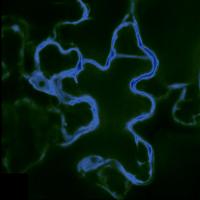
This false-color image shows a cell from the epidermis of an Arabidopsis thaliana plant; the cell has been marked with fluorescent imaging sensors designed to detect the sugar glucose.Scientists at Carnegie's Department of Plant Biology have made the first real-time observations of sugars in the cells of intact and living plant tissues. With the help of groundbreaking imaging techniques, the group has determined that plants maintain extremely low levels of sugar in their roots--as much as 100,000 times lower than previous estimates. The new technology will enable new studies of sugar metabolism in plants, which will inform the effort to engineer higher crop yields for food and biofuel production.
| Full story | 0 Comments | 8510 views |
| Molecular & Cell Biology | August 31, 2006 04:36 PM |
A former astronaut and researcher at the San Francisco VA Medical Center will be traveling to the Cosmodrome space-launch site at Baikonur, Kazakhstan, this Saturday, Sept. 2, 2006, to prepare a crucial experiment designed to demonstrate how human immune response is suppressed in the weightless environment of space.
| Full story | 0 Comments | 7481 views |

| Biology | August 31, 2006 02:36 PM |
A team led by a conservationist from the Bronx Zoo-based Wildlife Conservation Society, working with the Chadian government and the European Union project CURESS near Chad's Zakouma National Park, has discovered 100 slaughtered elephants, most of them missing only their tusks -- a sure sign that poaching is on the upswing just outside of this renowned protected area.
| Full story | 1 Comment | 7189 views |
| Molecular & Cell Biology | August 31, 2006 12:36 PM |
A two-step process appears to regulate cell fate decisions for many types of developing cells, according to researchers from the University of Chicago.
| Full story | 0 Comments | 5714 views |

| Biotechnology | August 31, 2006 10:36 AM |
Researchers are touting the use of liquid crystalline polymers (LCP) as a viable tool for use in devices such as the sought-after lab-on-a-chip technology.
| Full story | 0 Comments | 6561 views |

| Microbiology | August 30, 2006 11:36 PM |
Freedom of expression is great, but silence is golden – at least when it comes to amoebae, which are intestine-dwelling parasites that cause life-threatening dysentery in many parts of the world. Three years ago, scientists at the Weizmann Institute accidentally discovered a way to silence the expression of a key amoebic gene, one which codes for a toxic protein that kills human intestinal cells infected with this devastating illness. Now the scientists have developed a way to successfully silence the expression of two additional virulence genes in the same amoebae.
| Full story | 0 Comments | 6329 views |
| Molecular & Cell Biology | August 30, 2006 10:36 PM |
Research confirming the human body is designed to strongly resist attempts to lose weight will be presented at an international gathering of obesity experts hosted by QUT this week.
| Full story | 1 Comment | 8859 views |
| Environment | August 30, 2006 09:36 PM |
Concentrations of atmospheric ozone -- which protects Earth from the sun's ultraviolet radiation -- are showing signs of recovery in the most important regions of the stratosphere above the mid-latitudes in both the Northern and Southern hemispheres, a new study shows.
| Full story | 0 Comments | 7143 views |
| Environment | August 30, 2006 08:36 PM |
A new study has found that large segments of the Pacific Ocean lack sufficient iron to trigger healthy phytoplankton growth and the absence of the mineral stresses these microscopic ocean plants, triggering them to produce additional pigments that make ocean productivity appear more robust than it really is.
| Full story | 0 Comments | 6513 views |
| Microbiology | August 30, 2006 07:36 PM |
How do some microorganisms manage to exist and even thrive in surroundings ranging from Antarctica to boiling hot springs? A team of scientists from the Weizmann Institute's Plant Sciences Department, led by Prof. Avigdor Scherz, has found that a switch in just two amino acids (the building blocks of protein) can make a difference between functioning best at moderate temperatures and being adapted to living in extreme heat. The results of their research, which recently appeared in Nature, might have implications for future attempts to adjust crops to differing climate conditions or improve enzyme efficiency in industrial processes.
| Full story | 1 Comment | 8293 views |
| Biology | August 30, 2006 06:44 PM |
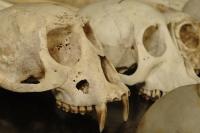
In the foreground, a skull of a Diana monkey. The large hole to the right of the nasal cavity was likely inflicted by an African crowned eagle.A new study suggests that prehistoric birds of prey made meals out of some of our earliest human ancestors.
| Full story | 0 Comments | 8012 views |
| Microbiology | August 30, 2006 04:44 PM |
Bacteria have hair-like protrusions with a sticky protein on the tip that lets them cling to surfaces. The coiled, bungee cord-like structure of the protrusions helps the bacteria hang on tightly, even under rough fluid flow inside the body, researchers report in the journal PLoS Biology.
| Full story | 0 Comments | 6246 views |
| Biology | August 30, 2006 02:44 PM |
Transferring knowledge through a chain of generations is a behavior not exclusive to humans, according to new findings by researchers at the Yerkes National Primate Research Center of Emory University and the University of St. Andrews, Scotland. For the first time, researchers have shown chimpanzees exhibit generational learning behavior similar to that in humans. Unlike previous findings that indicated chimpanzees simply conform to the social norms of the group, this study shows behavior and traditions can be passed along a chain of individual chimpanzees. These findings, based upon behavioral data gathered at the Yerkes Field Station in Lawrenceville, Ga., will publish online in the August 28 early edition of the Proceedings of the National Academy of Sciences.
| Full story | 3 Comments | 7480 views |

| Health & Medicine | August 30, 2006 12:03 PM |
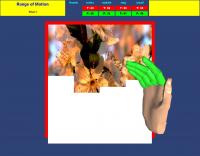
In one exercise, a patient attempts to wipe clean four vertical bars that obscure an image on a computer display. The bars are erased in proportion to each finger's flexing...Engineers at Rutgers, The State University of New Jersey, have modified a popular home video game system to assist stroke patients with hand exercises, producing a technology costing less than $600 that may one day rival systems 10 times as expensive.
| Full story | 0 Comments | 6999 views |
| Biotechnology | August 30, 2006 10:03 AM |
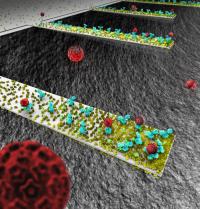
This rendition depicts an array of tiny, diving-boardlike devices called nanocantilevers. The devices are coated with antibodies to capture viruses, which are represented as red spheres.Researchers at Purdue University have made a discovery about the behavior of tiny structures called nanocantilevers that could be crucial in designing a new class of ultra-small sensors for detecting viruses, bacteria and other pathogens.
| Full story | 0 Comments | 5912 views |
| Health & Medicine | August 29, 2006 11:03 PM |
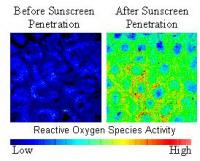
Two-photon fluorescence intensity images of cells deep in the epidermis showing reactive oxygen species activity following sunscreen application to the skin surface.Are sunscreens always beneficial, or can they be detrimental to users? A research team led by UC Riverside chemists reports that unless people out in the sun apply sunscreen often, the sunscreen itself can become harmful to the skin.
| Full story | 0 Comments | 9992 views |

| Bioinformatics | August 29, 2006 10:03 PM |
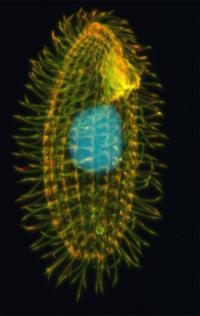
The genome sequence of the single-celled ciliate Tetrahymena thermophila sheds light on early eukaryotic evolution.In an effort to improve our understanding of eukaryotic evolution, a team of over 50 researchers led by Jonathan Eisen sequenced the macronuclear genome of the single-celled ciliate Tetrahymena themophila. Published online this week in the open-access journal PLoS Biology, the authors provide insights into the biology of this organism.
| Full story | 1 Comment | 7714 views |
| Bioinformatics | August 29, 2006 09:03 PM |
If you could peer microscopically into the closest freshwater pond, you'd hesitate before dipping a toe. Amid the murky water, you'd probably notice an oddly furry, pear-shaped organism gliding along--and gobbling up everything in its path.
| Full story | 0 Comments | 5827 views |
| Molecular & Cell Biology | August 29, 2006 08:03 PM |
How are you? In biological terms this question could involve a feedback loop that lets the body check in on itself and then act on that information. Although feedback loops are essential and they abound in biology, they aren't well understood. Feedback loops enable an organ such as the liver to detect if it is injured, ascertain if it is growing and developing normally, and if it needs to regenerate itself. When such loops derail, cancer and other diseases can arise.
| Full story | 0 Comments | 5221 views |
| Biotechnology | August 29, 2006 07:03 PM |
Scientists have found a way to trick cancer cells into committing suicide. The novel technique potentially offers an effective method of providing personalized anti-cancer therapy.Most living cells contain a protein called procaspase-3, which, when activated, changes into the executioner enzyme caspase-3 and initiates programmed cell death, called apoptosis. In cancer cells, however, the signaling pathway to procaspase-3 is broken. As a result, cancer cells escape destruction and grow into tumors.
| Full story | 0 Comments | 9071 views |
| Biology | August 29, 2006 06:03 PM |
Socks in the sock drawer, shirts in the shirt drawer, the time-honored lessons of helping organize one's clothes learned in youth. But what parts of the brain are used to encode such categories as socks, shirts or any other item, and how does such learning take place?
| Full story | 0 Comments | 6878 views |
| Biotechnology | August 29, 2006 04:03 PM |
High-tech laboratory tools, like computers, are often updated publicly as their analytical capabilities expand. In the September issue of the Journal of Molecular Diagnostics, NIH grantees report they have developed a second generation "lab on a silicon chip" called the MitoChip v2.0 that for the first time rapidly and reliably sequences all mitochondrial DNA. Mitochondria, the energy-producing organelles that power our cells, are unique because they are equipped with their own genetic instructions distinct from the DNA stored in the cell nucleus.
| Full story | 0 Comments | 6961 views |
| Molecular & Cell Biology | August 29, 2006 02:03 PM |
A newly discovered enzyme inhibitor, identified by researchers originally looking for biological pest controls, may lead to pain relief for sufferers of arthritis and other inflammatory diseases, say researchers at the University of California, Davis. The finding, hailed by a noted inflammatory disease expert "as the most important discovery in inflammation in more than a decade," may also reduce side effects associated with the painkiller, Vioxx.
| Full story | 0 Comments | 5652 views |
| Molecular & Cell Biology | August 29, 2006 12:03 PM |
Researchers at The Forsyth Institute have confirmed in human gingival tissue that immune cells play a destructive role in periodontal disease. Although researchers had suspected the correlation between bone loss in periodontal (gum) disease and immune cells, this is the first time that this has been confirmed in human tissue samples. With this work, Forsyth scientists and colleagues hope to determine methods for intervening and halting bone loss and thus improving the health outcomes of the estimated 80 million Americans suffering from periodontal disease.
| Full story | 0 Comments | 6610 views |
| Molecular & Cell Biology | August 29, 2006 10:03 AM |
The breakthrough came as Barry Thompson from Stephen Cohen's group at EMBL looked at a recently discovered signaling pathway called "Hippo."
| Full story | 0 Comments | 6626 views |
| Microbiology | August 28, 2006 11:03 PM |
In the 1980s, the phrase "T cell count" burst into the world's medical vocabulary as thousands and then millions of patients died of AIDS. The public began to understand the crucial importance of T cells--cellular Pac-Men that roam the bloodstream gobbling up infection and guarding against future attacks.
| Full story | 0 Comments | 5245 views |
| Molecular & Cell Biology | August 25, 2006 04:51 PM |
For the first time, researchers have developed a way to synthesize a cancer-killing compound called rasfonin in enough quantity to learn how it works.
| Full story | 0 Comments | 6652 views |
| Biotechnology | August 25, 2006 02:51 PM |
Opening a whole new interface between nanotechnology and neuroscience, scientists at Harvard University have used slender silicon nanowires to detect, stimulate, and inhibit nerve signals along the axons and dendrites of live mammalian neurons.
| Full story | 0 Comments | 5482 views |
| Molecular & Cell Biology | August 25, 2006 12:51 PM |
For the first time, researchers have developed a way to synthesize a cancer-killing compound called rasfonin in enough quantity to learn how it works.
| Full story | 0 Comments | 255 views |
| Biology | August 25, 2006 10:51 AM |
The recovery of biodiversity after the end-Cretaceous mass extinction was much more chaotic than previously thought, according to paleontologists. New fossil evidence shows that at certain times and places, plant and insect diversity were severely out of balance, not linked as they are today. The extinction took place 65.5 million years ago. Labeled the K-T extinction, it marks the beginning of the Cenozoic Era and the Paleocene Epoch.
| Full story | 0 Comments | 7680 views |
| Molecular & Cell Biology | August 24, 2006 11:51 PM |
Studying the parasite that causes African sleeping sickness, scientists at Johns Hopkins have discovered a previously unknown way of making fatty acids, a component of fat and the outer layer of all cells. The find unveils more about the biology of this hard-to-kill parasite and could lead to a target for designing new drugs to fight the illness that infects a half-million people and kills 50,000 a year worldwide.
| Full story | 0 Comments | 7766 views |

| Gene Therapy | August 24, 2006 10:51 PM |
An enzyme that helps neurons rid themselves of excess or aberrant proteins is required for normal brain function, according to a new report in the August 25, 2006 issue of the journal Cell, published by Cell Press. What's more, by increasing brain levels of the enzyme in mice with Alzheimer's symptoms, the researchers found they could reverse lapses of memory characteristic of the debilitating disease.
| Full story | 0 Comments | 7715 views |

| Stem Cell Research | August 24, 2006 09:51 PM |
With the introduction of just four factors, researchers have successfully induced differentiated cells taken from mouse embryos or adult mice to behave like embryonic stem cells. The researchers reported their findings in an immediate early publication of the journal Cell, published by Cell Press.
| Full story | 0 Comments | 8732 views |
| Health & Medicine | August 24, 2006 08:51 PM |
Doctors at the University of Virginia Health System have shown for the first time that getting rid of poisonous RNA (ribonucleic acid) in muscle cells can reverse myotonic dystrophy, the most common type of muscular dystrophy in adults.
| Full story | 0 Comments | 7247 views |
| Microbiology | August 24, 2006 07:51 PM |
When space shuttle Atlantis rockets into space later this week, it will take along three kinds of microbes so scientists can study how their genetic responses and their ability to cause disease change.
| Full story | 0 Comments | 7349 views |
| Molecular & Cell Biology | August 24, 2006 06:51 PM |
In creating the first "encyclopedia" of an entire superfamily of nuclear receptors – proteins that turn genes on and off throughout the body – UT Southwestern Medical Center researchers found that certain receptors form networks and interact to regulate disease states and physiology in two main areas, reproduction and nutrient metabolism.
| Full story | 0 Comments | 6489 views |
| Stem Cell Research | August 24, 2006 05:51 PM |
A certain type of adult stem cell can turn into bone, muscle, neurons or other types of tissue depending on the "feel" of its physical environment, according to researchers at the University of Pennsylvania.
| Full story | 0 Comments | 5813 views |
| Molecular & Cell Biology | August 23, 2006 09:07 PM |
Skin is our first line of defense against infection. But people with a rare, life-threatening autoimmune disease called pemphigus vulgaris lack that protection because their immune system attacks the proteins that hold skin cells together. They develop severe blisters and raw sores as the top layer of their skin falls apart, leaving them extremely vulnerable to infection.
| Full story | 0 Comments | 7382 views |

- In some genetic cases of microcephaly, stem cells fail to launch
- Yale team discovers how Zika virus causes fetal brain damage
- Scientists uncover the way a common cell enzyme alerts the body to invading bacteria
- Arctic gives clues on worst mass extinction of life
- Calcium channel blockers caught in the act at atomic level
Search Bio News Net
Free Biology Newsletter
- Flexibility That A.C.A. Lent to Work Force Is Threatened by...International Herald Tribune
- Bacteria Behind Legionnaires’ Disease Found at New York Police StationInternational Herald Tribune
- Prescription Price Crisis? 28 Million Americans See Spike in Drug...MSNBC.com: Health
- Seizing on Opioid Crisis, a Drug Maker Lobbies Hard for...International Herald Tribune
- Republicans are taking a big political risk on health careAP Health News
- Why We're So Divided Over Saving WolvesNational Geographic News