

Many adults over age 35 cover their mouth to avoid smiling in public in order to hide their teeth darkened by tetracycline stains. Typically, invasive as well as costly treatment options, such as veneers, crowns and bonding, served as the only treatment options to help these individuals hide such stains and boost their self-esteem.

| Biology | July 31, 2006 09:21 PM |
The rusty crayfish - a voracious, bullying exotic that has visited ecological havoc on numerous Wisconsin lakes - may have finally met its match.
| Full story | 0 Comments | 6214 views |

| Molecular & Cell Biology | July 31, 2006 08:21 PM |
Researchers from the University of Pennsylvania School of Veterinary Medicine have identified how molecules of microRNA are responsible for the growth of blood vessels in a model for human colon cancer. The process, called angiogenesis, results in ability of ravenous cancer cells to recruit blood vessels and receive a steady supply of nutrients and oxygen.
| Full story | 0 Comments | 6186 views |

| Biotechnology | July 31, 2006 07:21 PM |
Researchers at the University of Minnesota were successful in using robotic surgery to deliver stem cell treatment to damaged heart tissue in pigs.
| Full story | 0 Comments | 6950 views |
| Molecular & Cell Biology | July 31, 2006 06:21 PM |
In a finding that may have broader implications for understanding kidney disorders, genetics researchers at The Children's Hospital of Philadelphia have identified a second gene that gives rise to Alagille syndrome, a genetic developmental disease that affects multiple organs. The Children's Hospital team previously discovered the first gene associated with this disease.
| Full story | 0 Comments | 8028 views |

| Health & Medicine | July 31, 2006 05:21 PM |
Reports of a traditional Chinese medicine having beneficial effects for people suffering from type 2 diabetesnow has some scientific evidence to back up the claims. A collaboration between Chinese, Korean, andAustralian scientists at Sydney's Garvan Institute, has revealed that the natural plant product berberine could be a valuable new treatment.
| Full story | 0 Comments | 6618 views |

| AIDS & HIV | July 30, 2006 11:24 PM |
UC Davis researchers have discovered that the human immunodeficiency virus, the virus that causes AIDS, is able to survive efforts to destroy it by hiding out in the mucosal tissues of the intestine. They also found that HIV continues to replicate in the gut mucosa, suppressing immune function in patients being treated with antiretroviral therapy--even when blood samples from the same individuals indicated the treatment was working. Results of the three-year study appear in the August issue of the Journal of Virology (available online today at http://jvi.asm.org).
| Full story | 0 Comments | 6582 views |
| Molecular & Cell Biology | July 30, 2006 09:24 PM |
A Northwestern University research group has discovered that aggressive melanoma cells secrete Nodal, a protein that is critical to proper embryo formation.
| Full story | 0 Comments | 7283 views |
| Biotechnology | July 28, 2006 11:39 PM |
Spray-on skin is helping child burns victims cope with the trauma of scarring, according to a study by University of Queensland researchers at the Royal Children's Hospital in Brisbane.
| Full story | 0 Comments | 7224 views |
| Health & Medicine | July 28, 2006 10:39 PM |
Through studying pigeons with genetic heart disease, researchers at Wake Forest University School of Medicine have discovered a clue about why some patients' heart vessels are prone to close back up after angioplasty.
| Full story | 0 Comments | 6683 views |
| AIDS & HIV | July 28, 2006 09:39 PM |
A family of proteins that serve as the body's first line of defense against bacterial infections may provide a lifeline for individuals with compromised immune systems, according to researchers at the Indiana University School of Medicine – Northwest.
| Full story | 0 Comments | 6706 views |

| Gene Therapy | July 28, 2006 08:39 PM |
A new way of delivering corrective genes with a single injection into a vein holds promise for long-lasting treatments of hereditary diseases of the heart, University of Florida researchers report.
| Full story | 0 Comments | 6416 views |

| Microbiology | July 28, 2006 07:39 PM |
Scientists have long known that epidemics of dengue fever wax and wane over a period of several years, but they've never been quite sure why. With the incidence and range of the potentially deadly mosquito-borne illness increasing, understanding the factors that influence these epidemics has never been more important.
| Full story | 0 Comments | 6366 views |

| Environment | July 28, 2006 06:39 PM |
A relatively benign compound contained in a widely used group of insecticides can mix with and increase the toxicity of existing pesticides in the environment, according to a new study led by biologists at the University of California, Berkeley.
| Full story | 0 Comments | 7299 views |
| Molecular & Cell Biology | July 28, 2006 02:48 PM |
A drug made to enhance memory appears to trigger a natural mechanism in the brain that fully reverses age-related memory loss, even after the drug itself has left the body, according to researchers at UC Irvine.
| Full story | 0 Comments | 25090 views |
| Health & Medicine | July 28, 2006 12:48 PM |
A household remedy millennia old is being reinstated: honey helps the treatment of some wounds better than the most modern antibiotics. For several years now medical experts from the University of Bonn have been clocking up largely positive experience with what is known as medihoney. Even chronic wounds infected with multi-resistant bacteria often healed within a few weeks. In conjunction with colleagues from Düsseldorf, Homburg and Berlin they now want to test the experience gained in a large-scale study, as objective data on the curative properties of honey are thin on the ground.
| Full story | 5 Comments | 33307 views |
| Health & Medicine | July 28, 2006 10:48 AM |
New research shows that a chemical compound found in many air fresheners, toilet bowl cleaners, mothballs and other deodorizing products, may be harmful to the lungs. Human population studies at the National Institute of Environmental Health Sciences (NIEHS), a part of the National Institutes of Health, found that exposure to a volatile organic compound (VOC), called 1,4 dichlorobenzene (1,4 DCB) may cause modest reductions in lung function.
| Full story | 0 Comments | 7309 views |
| Molecular & Cell Biology | July 27, 2006 10:48 PM |
A single protein can turn on and off a key component of the immune system by changing partners in an elegant genomic dance, said researchers at the University of Southern California and Harvard Medical School.
| Full story | 1 Comment | 6382 views |
| Health & Medicine | July 27, 2006 09:48 PM |
An Oregon Health & Science University study shows motion and door sensors placed in elders' homes can help track activity patterns thought to relate to memory changes that are early signs of dementia.
| Full story | 0 Comments | 6561 views |
| Molecular & Cell Biology | July 27, 2006 08:48 PM |
Death by snakebite is horrible. The immediate pain of the bite is followed by swelling, bruising and weakness, then sweating or chills, with numbness, nausea, blurred vision and possibly convulsions before it's all over. Such misery is produced by a veritable witches' brew of toxins in snake venom.
| Full story | 0 Comments | 7287 views |
| Biotechnology | July 27, 2006 07:48 PM |
Researchers at Purdue University have developed a new low-cost system that analyzes scattered laser light to quickly identify bacteria for applications in medicine, food processing and homeland security at one-tenth the cost of conventional technologies.
| Full story | 0 Comments | 7960 views |
| Environment | July 27, 2006 06:48 PM |
A hypoxic "dead zone" has formed off the Oregon Coast for the fifth time in five years, according to researchers at Oregon State University.
| Full story | 0 Comments | 18263 views |
| Health & Medicine | July 27, 2006 10:10 AM |
A faster magnetic resonance imaging (MRI) data-acquisition technique will cut the time many patients spend in a cramped magnetic resonance scanner, yet deliver more precise 3-D images of their bodies.
| Full story | 0 Comments | 6830 views |
| Biology | July 26, 2006 11:10 PM |
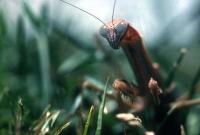
Hungry female praying mantids are more likely to cannibalize.Female praying mantids are notorious for sexual cannibalism – that is, for eating their male partner during mating. However, the possibility that males may also have something to gain from this violent act has never been resolved experimentally. In a paper in the August issue of The American Naturalist, Jonathan Lelito and William Brown (SUNY-Fredonia), study male risk-taking behavior in a praying mantis by altering the risk of cannibalism and observing changes in male behavior. They find that the males are able to assess the risk of cannibalism and become more cautious in the presence of particularly hungry females.
| Full story | 2 Comments | 9314 views |
| Health & Medicine | July 26, 2006 10:10 PM |
Simple models predict that only one strain of an infectious disease can exist at one time, but observation suggests otherwise. In a study in the August issue of The American Naturalist, Ken Eames and Matt Keeling (University of Warwick) use a mathematical model to help explain multiple strains, showing that the way humans interact is all-important. The researchers found that the coexistence of multiple infectious disease strains result from monogamous populations.
| Full story | 0 Comments | 6018 views |
| Biology | July 26, 2006 09:10 PM |
Performance on the dance floor may not always show it, but people are rarely born with two left feet. We have genes that instruct our arms and legs to grow in the right places and point in the right directions. They also provide for the spaces between our fingers and toes and every other formative detail of our limbs.
| Full story | 3 Comments | 6582 views |
| Biology | July 26, 2006 08:10 PM |
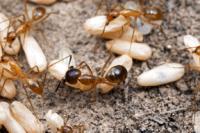
Desert carpetner ants store excess fat and pass it to colony members through lipid-rich oral secretions or unfertilized eggs.In a fascinating new study from the September/October 2006 issue of Physiological and Biochemical Zoology, Daniel A. Hahn (University of Florida) explores the ability of ants to store excess fat and pass it to colony members through lipid-rich oral secretions or unfertilized eggs. For perennial organisms, such as ant colonies, investing heavily in nutrient stores when food availability is high is a potential bet-hedging strategy for dealing with times of famine.
| Full story | 0 Comments | 6190 views |
| Biology | July 26, 2006 07:10 PM |
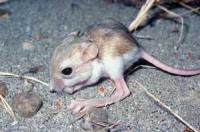
A twenty-seven day old desert kangaroo rat, Dipdomys deserti, learning how to use its cheek pouches.The warm deserts of North America are hopping with multiple species of kangaroo rats and pocket mice despite limited seed resources. Why doesn't one species win out in the rat race? Ecologist Mary Price (University of California, Riverside and University of Arizona) and theoretical biologist John Mittler (University of Washington) teamed up to explore their hunch that coexistence might follow from the propensity of these rodents to store harvested seeds and to steal from one another's caches.
| Full story | 0 Comments | 7531 views |
| Biotechnology | July 26, 2006 06:10 PM |
A major international scientific effort was launched last week to develop and use a radical new approach to boost rice production and avoid potential rice shortages, or even future famine.
| Full story | 0 Comments | 9796 views |
| Microbiology | July 26, 2006 02:08 PM |
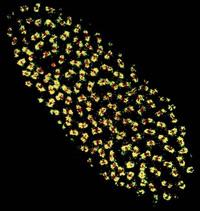
The image shows a fluorescent microscope image of a Drosophila embryo infected with Wolbachia. The embryo is about 1.5 mm long.Scientists have made a major breakthrough in understanding the genetics of the insect parasite that is being targeted by researchers as a way of preventing the spread of malaria.
| Full story | 0 Comments | 7502 views |
| Molecular & Cell Biology | July 26, 2006 12:08 PM |
Researchers at Sunnybrook Health Sciences Centre have made a critical discovery in T cell development bringing immunologists one step closer to enabling the creation of tailored T cell therapy that could one day be used to treat patients with AIDS or other immune system deficiencies.
| Full story | 0 Comments | 6261 views |
| Molecular & Cell Biology | July 26, 2006 10:08 AM |
Cancer researchers have discovered that a recently identified protein critical for repairing damaged genes uses an unusual mechanism to keep its repairs accurate.
| Full story | 0 Comments | 6709 views |
| Health & Medicine | July 25, 2006 11:08 PM |
They sleep together, eat together, and most people find it impossible to tell them apart. Identical twins who grow up together share just about everything, including their genes. But sometimes only one twin will have health problems when genetics predicts both of them should.
| Full story | 0 Comments | 9015 views |
| AIDS & HIV | July 25, 2006 10:08 PM |
The study of 18 HIV-positive subjects shows that HIV in the brain and central nervous system is genetically different from HIV that lives in the blood and peripheral tissues.
| Full story | 0 Comments | 6022 views |
| Environment | July 25, 2006 09:08 PM |
The continent-hopping habits of early primates have long puzzled scientists, and several scenarios have been proposed to explain how the first true members of the group appeared virtually simultaneously on Asia, Europe and North America some 55 million years ago.
| Full story | 0 Comments | 6281 views |
| Microbiology | July 25, 2006 08:08 PM |
Vaccines made with bacteria killed by gamma irradiation, rather than by standard methods of heat or chemical inactivation, may be more effective, say researchers supported by the National Institute of Allergy and Infectious Diseases (NIAID), part of the National Institutes of Health (NIH). Vaccines made from gamma-irradiated bacteria also may not need to be kept cold; an advantage in settings where refrigerating vaccines is impractical or impossible. A report on the research appears in the current issue of the journal Immunity.
| Full story | 0 Comments | 5684 views |
| Health & Medicine | July 25, 2006 07:08 PM |
Super-intense radiation delivered by a robotic arm eradicated lung tumors in some human patients just 3-4 months after treatment, medical physicist Cihat Ozhasoglu, Ph.D. of the University of Pittsburgh Medical Center will report in early August at the 48th Annual Meeting of the American Association of Physicists in Medicine in Orlando. Although it is too early to determine the technique's long-term effectiveness, Ozhasoglu and his colleagues find promise in this new approach to treat lung cancer and other tumors that move during breathing.
| Full story | 0 Comments | 6690 views |
| Environment | July 25, 2006 06:08 PM |
Open-air field trials involving five major food crops grown under carbon-dioxide levels projected for the future are harvesting dramatically less bounty than those raised in earlier greenhouse and other enclosed test conditions – and scientists warn that global food supplies could be at risk without changes in production strategies.
| Full story | 0 Comments | 10185 views |
| Biotechnology | July 25, 2006 05:08 PM |
Although Chinese cotton growers were among the first farmers worldwide to plant genetically modified (GM) cotton to resist bollworms, the substantial profits they have reaped for several years by saving on pesticides have now been eroded.
| Full story | 0 Comments | 10788 views |

| Bioinformatics | July 24, 2006 09:53 PM |
The DNA sequence of Laccaria bicolor, a fungus that forms a beneficial symbiosis with trees and inhabits one of the most ecologically and commercially important microbial niches in North American and Eurasian forests, has been determined by the U.S. Department of Energy DOE Joint Genome Institute (DOE JGI). The complete Laccaria genome sequence was announced July 23 at the Fifth International Conference on Mycorrhiza in Granada, Spain by an international consortium comprised of DOE JGI, Oak Ridge National Laboratory (ORNL), France's National Institute for Agricultural Research (INRA), the University of Alabama in Huntsville (UAH), and Ghent University in Belgium, and additional groups in Germany, Sweden, and France.
| Full story | 0 Comments | 7983 views |

- In some genetic cases of microcephaly, stem cells fail to launch
- Yale team discovers how Zika virus causes fetal brain damage
- Scientists uncover the way a common cell enzyme alerts the body to invading bacteria
- Arctic gives clues on worst mass extinction of life
- Calcium channel blockers caught in the act at atomic level
Search Bio News Net
Free Biology Newsletter
- Flexibility That A.C.A. Lent to Work Force Is Threatened by...International Herald Tribune
- Bacteria Behind Legionnaires’ Disease Found at New York Police StationInternational Herald Tribune
- Prescription Price Crisis? 28 Million Americans See Spike in Drug...MSNBC.com: Health
- Seizing on Opioid Crisis, a Drug Maker Lobbies Hard for...International Herald Tribune
- Republicans are taking a big political risk on health careAP Health News
- Why We're So Divided Over Saving WolvesNational Geographic News