

Researchers at The Wistar Institute have deciphered the structure of the active region of telomerase, an enzyme that plays a major role in the development of nearly all human cancers. The landmark achievement opens the door to the creation of new, broadly effective cancer drugs, as well as anti-aging therapies.

| Molecular & Cell Biology | August 31, 2008 02:23 PM |
Researchers have discovered two new genes that increase the risk of developing inflammatory bowel disease (IBD) in childhood.
| Full story | 0 Comments | 8001 views |

| Microbiology | August 31, 2008 02:23 PM |
Many nursing mothers who have been hospitalized for breast abscesses are afflicted with the "superbug" methicillin-resistant Staphylococcus aureus, or MRSA, but according to new research by UT Southwestern Medical Center physicians, conservative treatment can deal with the problem.
| Full story | 0 Comments | 7323 views |

| Biotechnology | August 30, 2008 11:34 AM |
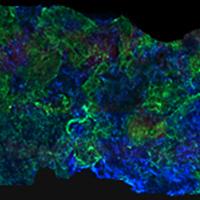
A microscopic image of a 10 mm collagen scaffold containing a uniform distribution of skin cells (blue) seeded on top of a 3-D polylysine gradient (green). Engineers at Georgia Tech have used skin cells to create artificial bones that mimic the ability of natural bone to blend into other tissues such as tendons or ligaments. The artificial bones display a gradual change from bone to softer tissue rather than the sudden shift of previously developed artificial tissue, providing better integration with the body and allowing them to handle weight more successfully. The research appears in the August 26, 2008, edition of the Proceedings of the National Academy of Sciences.
| Full story | 0 Comments | 10033 views |
| Molecular & Cell Biology | August 30, 2008 11:34 AM |
Cells become cancerous mainly because they lose control of their growth. To better understand how this happens, a new study at Ohio State University's Comprehensive Cancer Center looks at four genes that help regulate cell growth in embryos and that contribute to cancer in adults.
| Full story | 0 Comments | 6730 views |

| Biology | August 30, 2008 11:34 AM |
The American Academy of Otolaryngology – Head and Neck Surgery Foundation (AAO-HNSF) will issue the first comprehensive clinical guidelines to help health care practitioners identify patients with cerumen (commonly referred to as earwax) impaction. The guidelines emphasize evidence-based management of cerumen impaction by clinicians, and inform patients of the purpose of ear wax in hearing health.
| Full story | 0 Comments | 7677 views |
| Microbiology | August 30, 2008 11:34 AM |
Scientists funded by the Wellcome Trust are to examine what is preventing the H5N1 avian influenza virus from causing a human pandemic and what mutations are required to realise its deadly potential. The research could hold the key to early identification of a potential influenza pandemic, and to developing drugs and a vaccine.
| Full story | 0 Comments | 6770 views |

| Stem Cell Research | August 30, 2008 11:34 AM |
Johns Hopkins researchers have discovered the earliest form of human blood stem cells and deciphered the mechanism by which these embryonic stem cells replicate and grow. They also found a surprising biological marker that pinpoints these stem cells, which serve as the progenitors for red blood cells and lymphocytes.
| Full story | 0 Comments | 7420 views |
| Biotechnology | August 30, 2008 11:34 AM |
Scientists at the California Institute of Technology (Caltech) have developed a simple process for mass producing molecular tubes of identical--and precisely programmable--circumferences. The technological feat may allow the use of the molecular tubes in a number of nanotechnology applications.
| Full story | 0 Comments | 7134 views |
| Biology | August 30, 2008 11:34 AM |
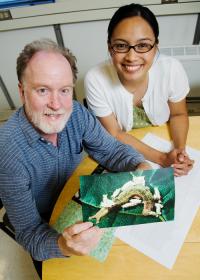
U. of I. entomology professor James Whitfield and doctoral student Josephine Rodriguez led the taxonomic part of a multi-disciplinary study of microgastrine wasps. A tiny wasp that lays its eggs under the skin of unwitting caterpillars belongs to one of the most diverse groups of insects on Earth. Now researchers report that its diversity is even higher than previously thought.
| Full story | 0 Comments | 7850 views |
| Biology | August 28, 2008 04:05 PM |
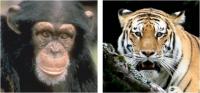
he eyes of some mammals have evolved to point in the same direction. While animals with forward facing eyes lose the ability to see what's behind them, they gain X-ray vision, which makes it possible for them to see through the clutter in the world. Credit: Rensselaer/Changizi The advantage of using two eyes to see the world around us has long been associated solely with our capacity to see in 3-D. Now, a new study from a scientist at Rensselaer Polytechnic Institute has uncovered a truly eye-opening advantage to binocular vision: our ability to see through things.
| Full story | 0 Comments | 13213 views |
| Biology | August 28, 2008 04:05 PM |
Animals "personally" bring their gametes together – seeking out sexual partners, mating, fertilizing, and reproducing. Plants, however, are sessile organisms and require the help of a third party, the pollinator, which can be a bird, mouse or insect that transport pollen to receptive stigmas frequently over large distances. The colors and shapes of flowers as well as their volatile signals and nectar attract and reward the pollinators for their efforts. But not all flower visitors are pollinators, as many come only to steal nectar without transporting pollen or eat flower parts.
| Full story | 0 Comments | 7263 views |
| Biology | August 28, 2008 04:05 PM |
Researchers report the discovery of the first new living species of giant clam in two decades, according to a report to be published online on August 28th in Current Biology, a Cell Press publication. While fossil evidence reveals that the new species, called Tridacna costata, once accounted for more than 80 percent of giant clams in the Red Sea, it now represents less than one percent of giant clams living there.
| Full story | 0 Comments | 8221 views |
| Biology | August 28, 2008 04:05 PM |
A WCS report reveals surprisingly large populations of two globally threatened primates in a protected area in Cambodia.
| Full story | 0 Comments | 8080 views |

| AIDS & HIV | August 28, 2008 04:05 PM |
As antiviral treatment for HIV infection allows patients to live longer, many will be confronted with additional health challenges. A new study shows for the first time that one of these may be significantly increased risk of bone fractures. The report in the September Journal of Clinical Endocrinology and Metabolism finds that fracture prevalence was increased more than 60 percent in those infected with HIV compared to patients without HIV infection.
| Full story | 0 Comments | 6692 views |

| Health & Medicine | August 27, 2008 11:46 AM |
Latest research into dual-purpose contraceptives and non-hormonal contraception will be presented tomorrow at a major scientific conference in Melbourne.
| Full story | 0 Comments | 7781 views |
| Health & Medicine | August 27, 2008 11:46 AM |
Most people would agree that stress increases your risk for illness and this is particularly true for severe long-term stresses, such as caring for a family member with a chronic medical illness. However, we still have a relatively limited understanding of exactly how stress contributes to the risk for illness. In the August 15th issue of Biological Psychiatry, researchers shed new light on one link between stress and illness by describing a mechanism through which stress alters immune function.
| Full story | 0 Comments | 7958 views |

| Environment | August 27, 2008 11:46 AM |
Conservation zones are in the wrong place to protect vulnerable coral reefs from the effects of global warming, an international team of scientists warned today.
| Full story | 0 Comments | 7113 views |
| Environment | August 27, 2008 11:46 AM |
Conservation zones are in the wrong place to protect vulnerable coral reefs from the effects of global warming, an international team of scientists warned today.
| Full story | 0 Comments | 5966 views |
| Molecular & Cell Biology | August 27, 2008 11:46 AM |
A new bioinformatics tool is capable of identifying and correcting abnormal, incomplete and mispredicted protein annotations in public databases. The MisPred tool, described today in the open access journal BMC Bioinformatics, currently uses five principles to identify suspect proteins that are likely to be abnormal or mispredicted.
| Full story | 0 Comments | 6132 views |
| Health & Medicine | August 27, 2008 11:46 AM |
CINCINNATI - Lymphangioleiomyomatosis, or LAM, is a rare but serious lung disease that may cause severe respiratory symptoms in patients. The often-fatal disease has no cure.
| Full story | 0 Comments | 7127 views |
| Biology | August 27, 2008 11:46 AM |
It's no secret that humans are having a huge impact on the life cycles of plants and animals. UC Santa Barbara's Steven D. Gaines and fellow researcher Dov Sax decided to test that theory by studying the world's far-flung islands.
| Full story | 0 Comments | 6506 views |
| Biology | August 27, 2008 11:46 AM |
A new study could explain why "daddy" and "mommy" are often a baby's first words – the human brain may be hard-wired to recognize certain repetition patterns.
| Full story | 0 Comments | 7463 views |
| Health & Medicine | August 27, 2008 11:46 AM |
A "basic science" breakthrough by Queen's University researchers into regulating a single enzyme may lead to new drug therapies that will help prevent heart attacks and strokes.
| Full story | 0 Comments | 6776 views |
| Microbiology | August 26, 2008 01:08 AM |
In 2006, Bluetongue virus – which infects livestock – reached Northern Europe for the first time. Some people thought that the outbreak would be limited to that particular year, as winter was expected to kill off the midges that host and spread the disease, bringing the threat of infection to an end. In actuality, the disease escalated in the following year, spreading to the UK. So, how did the virus survive the winter?
| Full story | 0 Comments | 9604 views |
| Biotechnology | August 26, 2008 01:08 AM |
DNA barcoding is a movement to catalog all life on earth by a simple standardized genetic tag, similar to stores labeling products with unique barcodes. The effort promises foolproof food inspection, improved border security, and better defenses against disease-causing insects, among many other applications.
| Full story | 0 Comments | 8517 views |
| Biology | August 26, 2008 01:08 AM |
Researchers at the Yerkes National Primate Research Center, Emory University, have shown capuchin monkeys, just like humans, find giving to be a satisfying experience. This finding comes on the coattails of a recent imaging study in humans that documented activity in reward centers of the brain after humans gave to charity. Empathy in seeing the pleasure of another's fortune is thought to be the impetus for sharing, a trait this study shows transcends primate species.
| Full story | 0 Comments | 7333 views |
| Biology | August 26, 2008 01:08 AM |
Researchers at the University of Rochester's Eastman School of Music and Department of Brain and Cognitive Sciences have developed a unique test for perfect pitch, and have found surprising results.
| Full story | 0 Comments | 8168 views |
| Health & Medicine | August 25, 2008 12:18 PM |
For the first time in Michigan, a diseased kidney has been surgically removed at Henry Ford Hospital using highly sophisticated 3D robotics through a single incision.
| Full story | 0 Comments | 9975 views |
| Biotechnology | August 25, 2008 12:18 PM |
Researchers from Monash University have designed a nano-sized "trojan horse" particle to ensure healing antioxidants can be better absorbed by the human body.
| Full story | 0 Comments | 8700 views |
| Health & Medicine | August 25, 2008 12:18 PM |
Data from a recent study demonstrate the anti-inflammatory and pathogen protection benefits of Bifidobacterium infantis 35624 a probiotic bacterial strain of human origin. Gastrointestinal benefits of probiotics have been well-documented, but more and more research is revealing that probiotic benefits extend to the entire body. The report was published in the August issue of the Public Library of Science (PLoS) Pathogens.
| Full story | 0 Comments | 9124 views |
| Biology | August 25, 2008 12:18 PM |
The ostentatious, sometimes bizarre qualities that improve a creature's chances of finding a mate may also drive the reproductive separation of populations and the evolution of new species, say two Indiana University Bloomington biologists.
| Full story | 0 Comments | 6590 views |
| Biology | August 24, 2008 12:21 AM |
A group of Yale undergraduates have discovered dozens of potentially beneficial bioactive microorganisms within plants they collected in the Amazon rain forest, including several so genetically distinct that they may be the first members of new taxonomical genera.
| Full story | 0 Comments | 7206 views |
| Microbiology | August 22, 2008 04:15 PM |
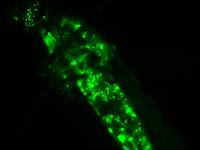
Anopheles gambiae mosquito infected with GFP-expressing AgDNV. Researchers at the Johns Hopkins Bloomberg School of Public Health's Malaria Research Institute have identified a previously unknown virus that is infectious to Anopheles gambiae—the mosquito primarily responsible for transmitting malaria. According to the researchers, the discovered virus could one day be used to pass on new genetic information to An. gambiae mosquitoes as part of a strategy to control malaria, which kills over one million people worldwide each year. The study was published August 22 online in the peer-reviewed open access journal PLoS Pathogens.
| Full story | 0 Comments | 9806 views |
| Biology | August 22, 2008 04:15 PM |
Throughout history, elephants have been thought of as 'different'. Shakespeare, and even Aristotle, described them as walking on inflexible column-like legs. And this myth persists even today. Which made John Hutchinson from The Royal Veterinary College, London, want to find out more about elephants and the way they move. Are they really that different from other, more fleet-footed species? Are their legs as rigid and 'columnar' as people had thought? Traveling to Thailand and several UK zoos, Hutchinson and his team investigated how Asian Elephants move their legs as they walk and run and publishes his results in The Journal of Experimental Biology on August 22 2008 at http://jeb.biologists.org
| Full story | 0 Comments | 7334 views |
| Molecular & Cell Biology | August 22, 2008 04:15 PM |
This press release is available in German.
| Full story | 0 Comments | 7724 views |

| Bioinformatics | August 22, 2008 04:15 PM |
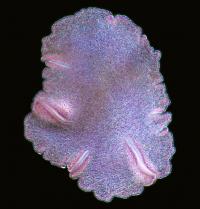
Trichoplax adhaerens. As Aesop said, appearances are deceiving—even in life's tiniest critters. From first detection in the 1880s, clinging to the sides of an aquarium, to its recent characterization by the U.S. Department of Energy Joint Genome Institute (DOE JGI), a simple and primitive animal, Trichoplax adhaerens, appears to harbor a far more complex suite of capabilities than meets the eye. The findings, reported in the August 21 online edition of the journal Nature, establish a group of organisms as a branching point of animal evolution and identify sets of genes, or a "parts list," employed by organisms that have evolved along particular branches.
| Full story | 0 Comments | 10443 views |
| Biology | August 22, 2008 04:15 PM |
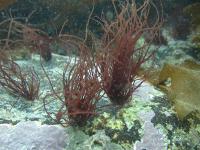
Healthy red algae (Devaleraea ramentacea). It is red, it burns and itches: a sunburn on our skin. However, too much sun is not only bad for humans. Many plants react sensitively to an increased dose of ultraviolet radiation, too. Yet they are dependent on sunlight. With the help of pigments absorbing solar energy and light, plants produce their vitally important building blocks by means of photosynthesis. However, this has its limits: too much sun means an over-abundance of energy and thus the destruction of the sensitive pigments. The result are black spots, pale leaves and rotten parts.
| Full story | 0 Comments | 9226 views |
| Health & Medicine | August 22, 2008 04:15 PM |
Beware of mini-packs and mini-foods, especially if you're a dieter.
| Full story | 0 Comments | 7496 views |
| Health & Medicine | August 20, 2008 08:13 PM |
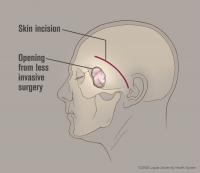
Opening from less invasive brain surgery. Dr. Edward Duckworth is part of a new generation of neurosurgeons who are making brain surgery a lot easier on patients.
| Full story | 0 Comments | 8888 views |

- In some genetic cases of microcephaly, stem cells fail to launch
- Yale team discovers how Zika virus causes fetal brain damage
- Scientists uncover the way a common cell enzyme alerts the body to invading bacteria
- Arctic gives clues on worst mass extinction of life
- Calcium channel blockers caught in the act at atomic level
Search Bio News Net
Free Biology Newsletter
- Flexibility That A.C.A. Lent to Work Force Is Threatened by...International Herald Tribune
- Bacteria Behind Legionnaires’ Disease Found at New York Police StationInternational Herald Tribune
- Prescription Price Crisis? 28 Million Americans See Spike in Drug...MSNBC.com: Health
- Seizing on Opioid Crisis, a Drug Maker Lobbies Hard for...International Herald Tribune
- Republicans are taking a big political risk on health careAP Health News
- Why We're So Divided Over Saving WolvesNational Geographic News