

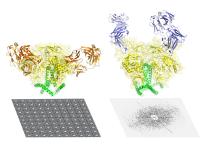
The HIV envelope protein has long been considered one of the most difficult targets in structural biology and of great value for medical science Collaborating scientists at The Scripps Research Institute (TSRI) and Weill Cornell Medical College have determined the first atomic-level structure of the tripartite HIV envelope protein—long considered one of the most difficult targets in structural biology and of great value for medical science.

| AIDS & HIV | October 31, 2013 06:49 PM |
| Full story | 0 Comments | 7180 views |

| Health & Medicine | October 31, 2013 06:49 PM |
A patient in a seemingly vegetative state, unable to move or speak, showed signs of attentive awareness that had not been detected before, a new study reveals. This patient was able to focus on words signalled by the experimenters as auditory targets as successfully as healthy individuals. If this ability can be developed consistently in certain patients who are vegetative, it could open the door to specialised devices in the future and enable them to interact with the outside world.
| Full story | 0 Comments | 5406 views |

| Stem Cell Research | October 31, 2013 06:49 PM |
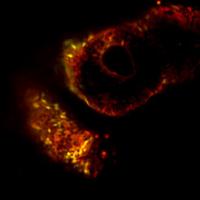
This image shows how human naive iPS derived cells (yellow/green cells) integrate in different tissues of developing host mouse embryo (red cells). One of the obstacles to employing human embryonic stem cells for medical use lies in their very promise: They are born to rapidly differentiate into other cell types. Until now, scientists have not been able to efficiently keep embryonic stem cells in their pristine stem state. The alternative that has been proposed to embryonic stem cells – reprogrammed adult cells called induced pluripotent stem cells (iPS cells) – have similar limitations. Though these can differentiate into many different cell types, they retain signs of "priming," – commitment to specific cell lineages. A team at the Weizmann Institute of Science has now taken a large step toward removing that obstacle: They have created iPS cells that are completely "reset" to the earliest possible state and maintained them in that state. Among other things, this research may, in the future, pave the way toward the ability to grow transplant organs to order.
| Full story | 0 Comments | 6646 views |

| Biology | October 31, 2013 06:49 PM |
Bee colonies consist of a queen bee, lots of female worker bees and some male drones. The gene that determines the sex of the bees is much more complex than has been assumed up until now and has developed over the course of evolution at a very high rate. This is the finding of an international team of scientists under the direction of Dr. Martin Hasselmann of the Institute for Genetics of the University of Cologne. The study has been published in the renowned Oxford journal Molecular Biology and Evolution.
| Full story | 0 Comments | 5789 views |
| Health & Medicine | October 31, 2013 06:49 PM |
A team of international scientists has isolated a very close relative of the Severe Acute Respiratory Syndrome coronavirus (SARS-CoV) from horseshoe bats in China, confirming them as the origin of the virus responsible for the 2002-3 pandemic.
| Full story | 0 Comments | 5319 views |
| Biology | October 30, 2013 08:05 PM |

Get gaming! Scientists found that playing Super Mario can make you brainier, or at least cause increases in the brain regions responsible for spatial orientation, memory formation and strategic planning. Video gaming causes increases in the brain regions responsible for spatial orientation, memory formation and strategic planning as well as fine motor skills. This has been shown in a new study conducted at the Max Planck Institute for Human Development and Charité University Medicine St. Hedwig-Krankenhaus. The positive effects of video gaming may also prove relevant in therapeutic interventions targeting psychiatric disorders.
| Full story | 0 Comments | 8766 views |
| Health & Medicine | October 30, 2013 08:05 PM |
New research on myopia—how it develops, risk and protective factors, and potentially effective measures for prevention and treatment are reported across twenty articles in the November issue of Optometry and Vision Science, official journal of the American Academy of Optometry. The journal is published by Lippincott Williams & Wilkins, a part of Wolters Kluwer Health.
| Full story | 0 Comments | 5007 views |
| Health & Medicine | October 30, 2013 08:05 PM |
Tuberculosis was present in Europe as early as 7000 years ago, according to new research published October 30th in the open-access journal PLOS ONE, by Muriel Masson and colleagues at the University of Szeged.
| Full story | 0 Comments | 4736 views |

| Molecular & Cell Biology | October 29, 2013 07:07 PM |
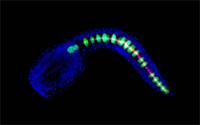
This is an image of an embryo of the sea squirt Ciona. A new study by Weill Cornell Medical College scientists reveals a mechanism through which the expression of genes is controlled – a finding that highlights genetic mutations that can impair the timing of gene expression. Such mutations can affect the co-ordination of key events that are required for stepwise development of an organism, and can also give rise to cancer by turning on genes at the wrong time.
| Full story | 0 Comments | 5568 views |
| Biology | October 29, 2013 07:07 PM |
An international team of scientists, led by physicists from the University of York, has shed important new light on coral skeleton formation.
| Full story | 0 Comments | 5317 views |
| AIDS & HIV | October 29, 2013 07:07 PM |
The key to future HIV treatment could be hidden right in our own genes. Everyone who becomes infected deploys defense strategies, and some even manage to hold the virus at bay without any therapy at all. This immune system struggle leaves its mark within the pathogen itself – genetic mutations that indicate how the virus reacted to its host's attacks. Scientists from EPFL and the Vaud university hospital center (UNIL-CHUV) retraced the entire chain of events in these battles, from the genome of the virus to the genome of the victim. They have created the first map of human HIV resistance. The goal of their research, which has been published in the journal eLife on the 29th of October, is to find new therapeutic targets and to enable individualized treatment strategies.
| Full story | 0 Comments | 5965 views |
| Molecular & Cell Biology | October 28, 2013 07:10 PM |
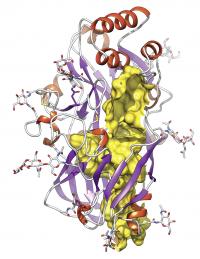
The Bielefeld chemist Michael Schwake and his colleagues have discovered a new protein fold. At its head (the red helices), this protein can bind enzymes and viruses. The protein LIMP-2 is vital for both humans and animals. If it is absent – due, for example, to a hereditary disease – substances of an unknown nature, probably lipids, accumulate in the organism. Up to now, scientists were unsure what the protein looks like and how exactly it functions. Privatdozent [senior lecturer] Dr. Michael Schwake from the Faculty of Chemistry at Bielefeld University (Germany) is doing research on the protein – and thereby preparing the way for future therapies. Together with colleagues in Kiel, Toronto, and Boston, he has now discovered that the protein LIMP 2 possesses a novel protein fold together with a nanomicroscopically small transport tunnel. The researchers have published their findings on Sunday (27 October) in the globally renowned scientific journal Nature.
| Full story | 0 Comments | 5230 views |

| Microbiology | October 28, 2013 07:10 PM |
In a pair of landmark studies that exploit the genetic sequencing of the "missing link" cold virus, rhinovirus C, scientists at the University of Wisconsin-Madison have constructed a three-dimensional model of the pathogen that shows why there is no cure yet for the common cold.
| Full story | 0 Comments | 6813 views |
| Health & Medicine | October 27, 2013 07:05 PM |
Scientists have made a rare discovery that allows them to attribute two types of tumour almost entirely to specific mutations that lie in two related genes.
| Full story | 0 Comments | 6394 views |
| Molecular & Cell Biology | October 27, 2013 07:05 PM |
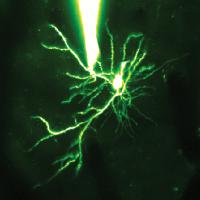
A direct patch-clamp recording from a dendrite of a pyramidal cell in mouse visual cortex in the intact brain. When you look at the hands of a clock or the streets on a map, your brain is effortlessly performing computations that tell you about the orientation of these objects. New research by UCL scientists has shown that these computations can be carried out by the microscopic branches of neurons known as dendrites, which are the receiving elements of neurons.
| Full story | 0 Comments | 5585 views |

| Bioinformatics | October 25, 2013 05:59 PM |
A collaborative team of researchers has used next generation sequencing to identify clinically relevant genetic variants associated with a rare pediatric speech disorder. The findings are published in the September 16, 2013 issue of the Journal of Neurodevelopmental Disorders
| Full story | 0 Comments | 5973 views |
| Health & Medicine | October 25, 2013 05:59 PM |
Researchers at the Ruhr-Universität Bochum (RUB) have developed a new spectroscopic method to support pathologists in diagnosing cancer. In the Journal of Biophotonics and the Analyst they compared conventional procedures for colon cancer identification with a novel method called label-free spectral histopathology. "Contrary to previous methods we no longer have to stain the tissue in order to detect cancer," says Professor Klaus Gerwert from the Protein Research Unit Ruhr within Europe (PURE) at the RUB. "In the future, this will give us the opportunity to classify a tissue sample automatically as being either normal or diseased."
| Full story | 0 Comments | 5613 views |
| Molecular & Cell Biology | October 25, 2013 05:59 PM |
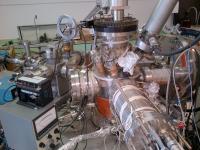
Photograph of the device used for Electron Stimulated Desorption. Every day, all day, our DNA gets beaten up by chemicals and radiation -- but remarkably, most of us stay healthy. Now, an investigation by a team of French and Canadian researchers has produced insights into a little-studied but common radiation threat to DNA: low-energy electrons (LEEs), with energies of 0-15 electron volts.
| Full story | 0 Comments | 6225 views |
| AIDS & HIV | October 23, 2013 07:53 PM |
A 3-year-old Mississippi child born with HIV and treated with a combination of antiviral drugs unusually early continues to do well and remains free of active infection 18 months after all treatment ceased, according to an updated case report published Oct. 23 in the New England Journal of Medicine.
| Full story | 0 Comments | 6727 views |
| Molecular & Cell Biology | October 23, 2013 07:53 PM |
Errors in the human genetic code that arise from mismatched nucleotide base pairs in the DNA double helix can lead to cancer and other disorders. In microbes, such errors provide the basis for adaption to environmental stress. As one of the first responders to these genetic errors, a small protein called MutS – for "Mutator S" – controls the integrity of genomes across a wide range of organisms, from microbes to humans. Understanding the repair process holds importance for an equally impressive range of applications, including synthetic biology, microbial adaption and pathogenesis.
| Full story | 0 Comments | 5501 views |
| Biology | October 22, 2013 06:00 PM |
A chance find by a high school student led to the youngest, smallest and most complete fossil skeleton yet known from the iconic tube-crested dinosaur Parasaurolophus. The discovery, announced today by the Raymond M. Alf Museum of Paleontology at The Webb Schools, shows that the prehistoric plant-eater sprouted its strange headgear before it celebrated its first birthday. Three-dimensional scans of nearly the entire fossil are freely available online, making this the most digitally-accessible dinosaur to date.
| Full story | 0 Comments | 10326 views |
| Molecular & Cell Biology | October 22, 2013 06:00 PM |
Recycling or "scrap press": physicians at the Ruhr-Universität have found out which molecular mechanisms decide about the fate of the import receptor Pex18. Pex18 is responsible for the import of proteins into specific cell components, namely peroxisomes. Two opposing regulatory circuits determine whether the receptor remains active or is broken down after the transport has been completed. "Thus, the picture of the regulation of the protein import into peroxisomes has been completed and integrated to form one single model," says Junior Professor Dr Harald Platta from the RUB Faculty of Medicine. Together with Prof Dr Ralf Erdmann and other colleagues he reports in the journal "Traffic".
| Full story | 0 Comments | 5331 views |

| Environment | October 17, 2013 06:28 PM |

This is the new dragon tree species Dracaena kaweesakii viewed from below showing the rich branching. The newly discovered dragon tree species Dracaena kaweesakii from Thailand is characterized by its extensive branching. The new species reaches an impressive 12 m in both height and crown diameter, and has beautiful soft sword-shaped leaves with white edges and cream flowers with bright orange filaments, all highly distinctive features. The study describing this exciting new species was published in the open access journal Phytokeys by an international team of scientists.
| Full story | 0 Comments | 9701 views |
| Health & Medicine | October 17, 2013 06:28 PM |
A team of researchers from Montreal has found that stroke patients living with Locked-In Syndrome (LIS) who cannot move, swallow or even breathe on their own, can regain a remarkable level of independence with technological help.
| Full story | 0 Comments | 5272 views |
| Biology | October 17, 2013 06:28 PM |
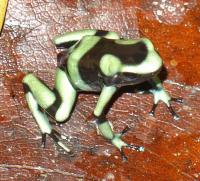
Poison dart frogs like this one, photographed by Louise Rollins-Smith during a trip to Panama in 2010, are threatened by fungal infections that paralyze their immune response. A fungus that is killing frogs and other amphibians around the world releases a toxic factor that disables the amphibian immune response, Vanderbilt University investigators report Oct. 18 in the journal Science.
| Full story | 0 Comments | 8427 views |
| Stem Cell Research | October 17, 2013 06:28 PM |
A source of gut stem cells that can repair a type of inflammatory bowel disease when transplanted into mice has been identified by researchers at the Wellcome Trust-Medical Research Council Cambridge Stem Cell Institute at the University of Cambridge and at BRIC, the University of Copenhagen, Denmark.
| Full story | 0 Comments | 6050 views |
| Microbiology | October 16, 2013 04:41 PM |
The medical, humanitarian and economical impact of viral diseases is devastating to humans and livestock. There are no adequate therapies available against most viral diseases, largely because the mechanisms by which viruses infect cells are poorly known. An interdisciplinary team of researchers from the University of Zurich headed by cell biologist Prof. Urs Greber now presents a method that can be used to display viral DNA in host cells at single-molecule resolution. The method gives unexpected insights into the distribution of viral DNA in cells, and the reaction of cells to viral DNA.
| Full story | 0 Comments | 8008 views |
| Molecular & Cell Biology | October 16, 2013 04:41 PM |
Researchers at NYU Langone Medical Center have discovered a new mechanism by which the deadly Staphylococcus aureus bacteria attack and kill off immune cells. Their findings, published today in the journal Cell Host & Microbe, explain a critical survival tactic of a pathogen that causes more skin and heart infections than any other microbe, and kills more than 100,000 Americans every year.
| Full story | 0 Comments | 6464 views |

| Biotechnology | October 15, 2013 06:48 PM |
Researchers at the University of Illinois at Chicago have identified a protein expressed by human bone marrow stem cells that guides and stimulates the formation of blood vessels.
| Full story | 0 Comments | 8684 views |
| Health & Medicine | October 15, 2013 06:48 PM |
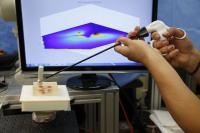
The wireless palpation capsule, held in the gripper of a laparoscope, is tapped against a piece of silicone containing red marbles that simulate hidden tumors. A small, wireless capsule has been developed that can restore the sense of touch that surgeons are losing as they shift increasingly from open to minimally invasive surgery.
| Full story | 0 Comments | 5169 views |
| Health & Medicine | October 15, 2013 06:48 PM |
About a dozen years ago, scientists discovered that a hormone called ghrelin enhances appetite. Dubbed the "hunger hormone," ghrelin was quickly targeted by drug companies seeking treatments for obesity — none of which have yet panned out.
| Full story | 0 Comments | 5423 views |
| Molecular & Cell Biology | October 14, 2013 07:21 PM |
Researchers at the University of California, San Diego School of Medicine have developed a new way to parse and understand how special proteins called "master regulators" read the genome, and consequently turn genes on and off.
| Full story | 0 Comments | 6456 views |
| Biology | October 14, 2013 07:21 PM |
Researchers studying young bonobos in an African sanctuary have discovered striking similarities between the emotional development of the bonobos and that of children, suggesting these great apes regulate their emotions in a human-like way. This is important to human evolutionary history because it shows the socio-emotional framework commonly applied to children works equally well for apes. Using this framework, researchers can test predictions of great ape behavior and, as in the case of this study, confirm humans and apes share many aspects of emotional functioning.
| Full story | 0 Comments | 8761 views |
| Biotechnology | October 10, 2013 06:42 PM |
This new method will be a great step forwards to understanding the resulting processes that control gene regulation.
| Full story | 0 Comments | 8048 views |
| Biology | October 10, 2013 06:42 PM |
Research conducted by the National Geographic Genographic Project, a multiyear global initiative that uses DNA to map the history of human migration, is helping unravel the timing and source of human settlement in Central Europe.
| Full story | 0 Comments | 7130 views |
| Stem Cell Research | October 10, 2013 06:42 PM |
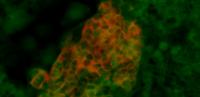
Foregut stem cells (green) differentiated into pancreatic cells expressing insulin. A new method for creating stem cells for the human liver and pancreas, which could enable both cell types to be grown in sufficient quantities for clinical use, has been developed by scientists.
| Full story | 0 Comments | 8049 views |
| Molecular & Cell Biology | October 10, 2013 06:42 PM |
Many viral infections are nipped in the bud by the innate immune response. This involves specific proteins within the infected cell that recognize the virus and trigger a signalling cascade – the so-called interferon response. This activates a protective mechanism in neighbouring cells and often results in the death of the primarily infected cell.
| Full story | 0 Comments | 5858 views |
| Biotechnology | October 9, 2013 05:29 PM |
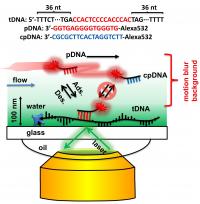
A super-resolution technique developed at Rice University allows fluorescent-labeled probe DNA to pinpoint target DNA sequences in an immobilized strand in ways neither regular nor electron microscopes are able. With high-tech optical tools and sophisticated mathematics, Rice University researchers have found a way to pinpoint the location of specific sequences along single strands of DNA, a technique that could someday help diagnose genetic diseases.
| Full story | 0 Comments | 7213 views |
| Biology | October 9, 2013 05:29 PM |

This is chimpanzee Tushi. Jorg Massen (University of Vienna) and Sonja Koski (University of Zurich) together measured chimpanzee personality in two zoos with behavioural experiments and years of observations of chimpanzee behaviour. They also carefully logged which chimpanzee sat in body contact with whom most. "This is a clear sign of friendship among chimpanzees", explains Jorg Massen. Subsequently, the researchers tested, if those chimpanzees who sit together frequently have similar or different personality types.
| Full story | 0 Comments | 7344 views |
| Biology | October 8, 2013 04:04 PM |
Ants and bees are surprisingly more genetically related to each other than they are to social wasps such as yellow jackets and paper wasps, a team of University of California, Davis, scientists has discovered. The groundbreaking research is available online and will be published Oct. 21 in the print version of the journal Current Biology.
| Full story | 0 Comments | 7852 views |

- In some genetic cases of microcephaly, stem cells fail to launch
- Yale team discovers how Zika virus causes fetal brain damage
- Scientists uncover the way a common cell enzyme alerts the body to invading bacteria
- Arctic gives clues on worst mass extinction of life
- Calcium channel blockers caught in the act at atomic level
Search Bio News Net
Free Biology Newsletter
- Flexibility That A.C.A. Lent to Work Force Is Threatened by...International Herald Tribune
- Bacteria Behind Legionnaires’ Disease Found at New York Police StationInternational Herald Tribune
- Prescription Price Crisis? 28 Million Americans See Spike in Drug...MSNBC.com: Health
- Seizing on Opioid Crisis, a Drug Maker Lobbies Hard for...International Herald Tribune
- Republicans are taking a big political risk on health careAP Health News
- Why We're So Divided Over Saving WolvesNational Geographic News