

Scientists have developed a way to grow iron-oxidizing bacteria using electricity instead of iron, an advance that will allow them to better study the organisms and could one day be used to turn electricity into fuel. The study will be published on January 29 in mBio®, the online open-access journal of the American Society for Microbiology.
Many different tissues and organs form from pluripotent stem cells during embryonic development. To date it had been known that these processes are controlled by transcription factors for specific tissues. Scientists from the Max Planck Institute for Molecular Genetics in Berlin, in collaboration with colleagues at MIT and the Broad Institute in Boston, have now been able to demonstrate that RNA molecules, which do not act as templates for protein synthesis, participate in these processes as well. The scientists knocked down a gene for long non-coding RNA molecules (lncRNA) and thereby disrupted the development of the heart to an extent that was lethal to the embryos. Genesis of the ventral body wall was also impaired. It became apparent that the lncRNA participates in controlling transcription factors that themselves are responsible for controlling tissue- and organogenesis. The lncRNA itself thus acts as a modulating factor in these processes.
| Full story | 0 Comments | 6505 views |

| Molecular & Cell Biology | January 30, 2013 04:45 AM |
Just like a comic book super hero, you could say that the enzyme superoxide dismutase (SOD1) has a secret identity. Since its discovery in 1969, scientists believed SOD1's only role was to protect living cells against damage from free radicals. Now, researchers at the Johns Hopkins Bloomberg School of Public Health have discovered that SOD1 protects cells by regulating cell energy and metabolism. The results of their research were published January 17, 2013, in the journal Cell.
| Full story | 0 Comments | 12223 views |

| Bioinformatics | January 28, 2013 08:46 PM |
The European Commission has chosen the Human Brain Project, in which the Hebrew University of Jerusalem is participating, as one of two Future and Emerging Technologies Flagship topics. The enterprise will receive funding of 1.19 billion euros over the next decade.
| Full story | 0 Comments | 14172 views |
| Molecular & Cell Biology | January 28, 2013 08:46 PM |
When researchers sequence the RNA of cancer cells, they can compare it to normal cells and see where there is more RNA. That can help lead them to the gene or protein that might be triggering the cancer.
| Full story | 0 Comments | 9338 views |
| Bioinformatics | January 22, 2013 07:24 PM |
A novel software tool, developed at The Children's Hospital of Philadelphia, streamlines the detection of disease-causing genetic changes through more sensitive detection methods and by automatically correcting for variations that reduce the accuracy of results in conventional software. The software, called ParseCNV, is freely available to the scientific-academic community, and significantly advances the identification of gene variants associated with genetic diseases.
| Full story | 0 Comments | 7152 views |
| Molecular & Cell Biology | January 22, 2013 07:24 PM |
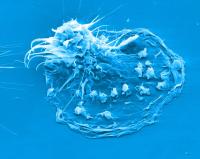
Dendritic cells, shown here in an electron microscopic picture, need antibodies produced by B cells for their maturation. Dendritic cells, or DCs for short, perform a vital role for the immune system: They engulf pathogens, break them down into their component parts, and then display the pieces on their surface. This in turn signals other immune cells capable of recognizing these pieces to help kick-start their own default program for fighting off the invaders. In order to do their job, the DCs are dependent upon the support from a class of immune system molecules, which have never before been associated with dendritic cells: antibodies, best known for their role in vaccinations and diagnostics. Now, scientists at the Helmholtz Centre for Infection Research (HZI) and the Hannover Medical School (MHH) were able to show that antibodies are essential for dendritic cell maturation. The researchers' findings have been published in the renowned scientific journal, Proceedings of the National Academy of Sciences (PNAS).
| Full story | 0 Comments | 10810 views |
| Molecular & Cell Biology | January 21, 2013 06:11 PM |
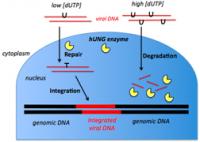
This is an illustration of what happens when viral DNA enters the nucleus of a cell with low dUTP levels (left) versus high dUTP levels (right). A team of researchers based at Johns Hopkins has decoded a system that makes certain types of immune cells impervious to HIV infection. The system's two vital components are high levels of a molecule that becomes embedded in viral DNA like a code written in invisible ink, and an enzyme that, when it reads the code, switches from repairing the DNA to chopping it up into unusable pieces. The researchers, who report the find in the Jan. 21 early edition of the Proceedings of the National Academy of Sciences, say the discovery points toward a new approach to eradicating HIV from the body.
| Full story | 0 Comments | 10747 views |
| Molecular & Cell Biology | January 21, 2013 06:11 PM |
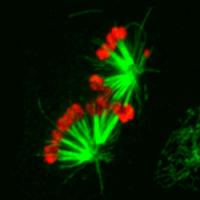
This shows the expression of the chromokinesin NOD (red) stabilizes aberrant interactions between kinetochores and spindle microtubules (green). Tension stabilizes bioriented attachments where each sister chromatid is attached to microtubules. Studies led by cell biologist Thomas Maresca at the University of Massachusetts Amherst are revealing new details about a molecular surveillance system that helps detect and correct errors in cell division that can lead to cell death or human diseases. Findings are reported in the current issue of the Journal of Cell Biology.
| Full story | 0 Comments | 9497 views |

| Biology | January 18, 2013 01:16 PM |
Dogs and wolves are genetically so similar, it's been difficult for biologists to understand why wolves remain fiercely wild, while dogs can gladly become "man's best friend." Now, doctoral research by evolutionary biologist Kathryn Lord at the University of Massachusetts Amherst suggests the different behaviors are related to the animals' earliest sensory experiences and the critical period of socialization. Details appear in the current issue of Ethology.
| Full story | 0 Comments | 18942 views |

| Microbiology | January 18, 2013 01:16 PM |
Scientists have discovered that that the flu virus can essentially tell time, thereby giving scientists the ability to reset the virus' clock and combat it in more effective ways. According to researchers at the Icahn School of Medicine at Mount Sinai, the flu knows how much time it has to multiply, infect other cells, and spread to another human being. If it leaves a cell too soon, the virus is too weak. If it leaves too late, the immune system has time to kill the virus.
| Full story | 0 Comments | 10443 views |
| Molecular & Cell Biology | January 18, 2013 01:16 PM |
Biomedical researchers studying aging and cancer are intensely interested in telomeres, the protective caps on the ends of chromosomes. In a new study, scientists at UC Santa Cruz used a novel technique to reveal structural and mechanical properties of telomeres that could help guide the development of new anti-cancer drugs.
| Full story | 0 Comments | 7433 views |

| Stem Cell Research | January 14, 2013 06:17 PM |
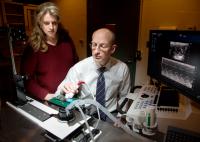
University of Illinois comparative biosciences professor Suzanne Berry-Miller, veterinary clinical medicine professor Robert O’Brien. Researchers have shown that transplanting stem cells derived from normal mouse blood vessels into the hearts of mice that model the pathology associated with Duchenne muscular dystrophy (DMD) prevents the decrease in heart function associated with DMD.
| Full story | 0 Comments | 10596 views |
| Biology | January 14, 2013 06:17 PM |

This is a painting by one of Prof. Inzelberg's Parkinson's patients. Parkinson's experts across the world have been reporting a remarkable phenomenon — many patients treated with drugs to increase the activity of dopamine in the brain as a therapy for motor symptoms such as tremors and muscle rigidity are developing new creative talents, including painting, sculpting, writing, and more.
| Full story | 0 Comments | 12893 views |
| Biology | January 10, 2013 06:59 PM |
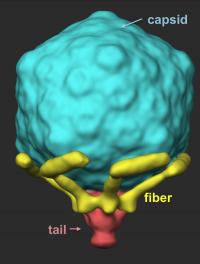
Researchers found that the T7 virus has six tail fibers that are folded back against its capsid. The detailed changes in the structure of a virus as it infects an E. coli bacterium have been observed for the first time, report researchers from The University of Texas at Austin and The University of Texas Health Science Center at Houston (UT Health) Medical School this week in Science Express.
| Full story | 0 Comments | 14010 views |
| Stem Cell Research | January 10, 2013 06:59 PM |
Scientists at the Texas Biomedical Research Institute have for the first time demonstrated that baboon embryonic stem cells can be programmed to completely restore a severely damaged artery. These early results show promise for eventually developing stem cell therapies to restore human tissues or organs damaged by age or disease.
| Full story | 0 Comments | 11146 views |

| Biotechnology | January 7, 2013 06:20 PM |
Chemists at the University of California, Davis, have engineered blue-green algae to grow chemical precursors for fuels and plastics -- the first step in replacing fossil fuels as raw materials for the chemical industry.
| Full story | 0 Comments | 13658 views |
| Biology | January 7, 2013 06:20 PM |
An international team of scientists has described a fossil marine predator measuring 8.6 meters in length (about 28 feet) recovered from the Nevada desert in 2010 as representing the first top predator in marine food chains feeding on prey similar to its own size. A paper with their description will appear the week of January 7, 2013 in the EE (early electronic) issue of Proceedings of the National Academy of Sciences.
| Full story | 0 Comments | 8326 views |
| Biology | January 3, 2013 06:30 PM |
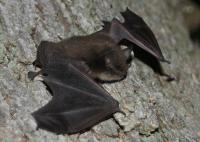
This is a little brown bat (Myotis lucifugus). Much of the DNA that makes up our genomes can be traced back to strange rogue sequences known as transposable elements, or jumping genes, which are largely idle in mammals. But Johns Hopkins researchers report they have identified a new DNA sequence moving around in bats — the first member of its class found to be active in mammals. The discovery, described in a report published in December on the website of the Proceedings of the National Academy of Sciences, offers a new means of studying evolution, and may help in developing tools for gene therapy, the research team says.
| Full story | 0 Comments | 13471 views |
| Biology | January 3, 2013 06:30 PM |
Bigger brains can make animals, well, brainier, but that boost in brain size and ability comes at a price. That's according to new evidence reported on January 3rd in Current Biology, a Cell Press publication, in which researchers artificially selected guppies for large and small brain sizes.
| Full story | 0 Comments | 10561 views |
| Biotechnology | January 3, 2013 06:30 PM |
Researchers at MIT, the Broad Institute and Rockefeller University have developed a new technique for precisely altering the genomes of living cells by adding or deleting genes. The researchers say the technology could offer an easy-to-use, less-expensive way to engineer organisms that produce biofuels; to design animal models to study human disease; and to develop new therapies, among other potential applications.
| Full story | 0 Comments | 9273 views |
| Biology | January 2, 2013 02:35 PM |
Certain plants and animals protect themselves against temperatures below freezing with antifreeze proteins. How the larva of the beetle Dendroides canadensis manages to withstand temperatures down to -30 degrees Celsius is reported by an international team of researchers led by Prof. Dr. Martina Havenith from the Department of Physical Chemistry II at the Ruhr-Universität in the journal PNAS. Together with American colleagues, the RUB-researchers showed that interactions between the antifreeze proteins and water molecules contribute significantly to protection against the cold. Previously, it was assumed that the effect was only achieved through direct contact of the protein with ice crystals. The team obtained the results through a combination of terahertz spectroscopy and molecular dynamics simulations.
| Full story | 0 Comments | 9347 views |

| Health & Medicine | January 2, 2013 02:35 PM |
Taking inspiration from Mother Nature, scientists are reporting an advance toward preventing the tooth sensitivity that affects millions of people around the world. Their report on development of the substance, similar to the adhesive that mussels use to attach to rocks and other surfaces in water, appears in the journal ACS Applied Materials & Interfaces.
| Full story | 0 Comments | 9765 views |

- In some genetic cases of microcephaly, stem cells fail to launch
- Yale team discovers how Zika virus causes fetal brain damage
- Scientists uncover the way a common cell enzyme alerts the body to invading bacteria
- Arctic gives clues on worst mass extinction of life
- Calcium channel blockers caught in the act at atomic level
Search Bio News Net
Free Biology Newsletter
- Flexibility That A.C.A. Lent to Work Force Is Threatened by...International Herald Tribune
- Bacteria Behind Legionnaires’ Disease Found at New York Police StationInternational Herald Tribune
- Prescription Price Crisis? 28 Million Americans See Spike in Drug...MSNBC.com: Health
- Seizing on Opioid Crisis, a Drug Maker Lobbies Hard for...International Herald Tribune
- Republicans are taking a big political risk on health careAP Health News
- Why We're So Divided Over Saving WolvesNational Geographic News