


Human immunodeficiency virus (HIV) may have affected humans for much longer than is currently believed. Alfred Roca, an assistant professor in the College of Agricultural, Consumer and Environmental Sciences at the University of Illinois, thinks that the genomes of an isolated West African human population provide important clues about how the disease has evolved.

| Biology | December 18, 2012 07:17 PM |
In 2010, almost 50 million couples worldwide were unable to have a child after five years of trying. Infertility rates have hardly changed over the past 20 years, according to a study by international researchers published in this week's PLOS Medicine.
| Full story | 0 Comments | 8558 views |
| Biology | December 13, 2012 05:42 PM |
A venomous primate with two tongues would seem safe from the pet trade, but the big-eyed, teddy-bear face of the slow loris (Nycticebus sp.) has made them a target for illegal pet poachers throughout the animal's range in southeastern Asia and nearby islands. A University of Missouri doctoral student and her colleagues recently identified three new species of slow loris. The primates had originally been grouped with another species. Dividing the species into four distinct classes means the risk of extinction is greater than previously believed for the animals but could help efforts to protect the unusual primate.
| Full story | 0 Comments | 12374 views |
| Biology | December 13, 2012 05:42 PM |
A study published by Université Laval researchers and their colleagues from the Canadian Forest Service reveals that the genome of conifers such as spruce, pine, and fir has remained very much the same for over 100 million years. This remarkable genomic stability explains the resemblance between today's conifers and fossils dating back to the days when dinosaurs roamed the Earth. Details of this finding are presented in a recent issue of the journal BMC Biology.
| Full story | 0 Comments | 10687 views |

| Stem Cell Research | December 13, 2012 05:42 PM |
Randomly distributed sticky spots which are integral to the development of stem cells by maximising adhesion and acting as internal scaffolding have been artificially recreated by experts from the University of Sheffield for the first time.
| Full story | 0 Comments | 10216 views |

| Molecular & Cell Biology | December 13, 2012 05:42 PM |
Every time a human or bacterial cell divides it first must copy its DNA. Specialized proteins unzip the intertwined DNA strands while others follow and build new strands, using the originals as templates. Whenever these proteins encounter a break – and there are many – they stop and retreat, allowing a new cast of molecular players to enter the scene.
| Full story | 0 Comments | 11186 views |
| Molecular & Cell Biology | December 11, 2012 06:28 PM |

Thousand of epigenetic switches in the liver control whether genes turn on or off in response to circadian cycles. The figure illustrates daily changes, every six hours, in five different... When it's dark, and we start to fall asleep, most of us think we're tired because our bodies need rest. Yet circadian rhythms affect our bodies not just on a global scale, but at the level of individual organs, and even genes.
| Full story | 0 Comments | 12076 views |

| Bioinformatics | December 11, 2012 04:39 AM |
The Personal Genome Project Canada (PGP-C) launches this week giving Canadians an unprecedented opportunity to participate in a groundbreaking research study about human genetics and health.
| Full story | 0 Comments | 8745 views |

| Environment | December 11, 2012 04:39 AM |
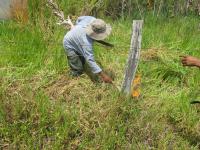
Farmers in many parts of the world, like this one in the Peruvian Amazon, routinely use fire to clear land. Over past decades, many areas of the forested Amazon basin have become a patchwork of farms, pastures and second-growth forest as people have moved in and cleared land--but now many are moving out, in search of economic opportunities in newly booming Amazonian cities. The resulting depopulation of rural areas, along with spreading road networks and increased drought are causing more and bigger fires to ravage vast stretches, say researchers in a new study. The study, focusing on the Peruvian Amazon, is the latest to suggest that land-use changes and other factors, including possibly climate change, are driving increasingly destructive wildfires in many parts of the earth. An interdisciplinary team at Columbia University's Earth Institute will publish the paper this week in the Proceedings of the National Academy of Sciences.
| Full story | 0 Comments | 8201 views |
| Molecular & Cell Biology | December 11, 2012 04:39 AM |
DNA, like houses and cars, needs ongoing maintenance. Rays of ultraviolet sunlight, chemical pollutants and normal biochemical processes in the cell can damage it. Cells routinely repair this damage before making proteins or copying DNA for cell division. The repairs are remarkably accurate in normal cells but cancer cells make far more mistakes in fixing their DNA. Alan Tomkinson, PhD, University of New Mexico Professor of Internal Medicine and Associate Director of Basic Research at the UNM Cancer Center, wants to understand why and how these repair mechanisms go awry in cancer cells. This understanding could lead to new targets for cancer drugs. Dr. Tomkinson recently won a 4-year $1 million grant renewal to continue his 18-year research investigation on DNA ligases, the enzymes that repair DNA strands.
| Full story | 0 Comments | 10760 views |
| Molecular & Cell Biology | December 5, 2012 05:54 PM |
Scientists have discovered 100 million-year-old regions in the DNA of several plant species which could hold secrets about how specific genes are turned 'on' or 'off'.
| Full story | 0 Comments | 11360 views |
| Bioinformatics | December 5, 2012 05:54 PM |
The National Geographic Society today announced the next phase of its Genographic Project — the multiyear global research initiative that uses DNA to map the history of human migration. Building on seven years of global data collection, Genographic shines new light on humanity's collective past, yielding tantalizing clues about humankind's journey across the planet over the past 60,000 years.
| Full story | 0 Comments | 9898 views |
| Molecular & Cell Biology | December 3, 2012 06:39 PM |
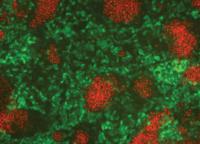
These are differentiating mouse embryonic stem cells (green = mesoderm progenitor cells, red = endoderm progenitor cells). The microRNAs identified in this study block endoderm formation, while enhancing mesoderm formation. An embryo is an amazing thing. From just one initial cell, an entire living, breathing body emerges, full of working cells and organs. It comes as no surprise that embryonic development is a very carefully orchestrated process—everything has to fall into the right place at the right time. Developmental and cell biologists study this very thing, unraveling the molecular cues that determine how we become human.
| Full story | 0 Comments | 11737 views |
| Biology | December 3, 2012 06:39 PM |
Plants grow upward from a tip of undifferentiated tissue called the shoot apical meristem. As the tip extends, stem cells at the center of the meristem divide and increase in numbers. But the cells on the periphery differentiate to form plant organs, such as leaves and flowers. In between these two layers, a group of boundary cells go into a quiescent state and form a barrier that not only separates stem cells from differentiating cells, but eventually forms the borders that separate the plant's organs.
| Full story | 0 Comments | 10445 views |
| Biology | December 3, 2012 06:39 PM |
The ability of male chimpanzees to form coalitions with one another in order to direct aggression at other male chimpanzees has certain benefits. A new study by Ian Gilby at Duke University in North Carolina and his colleagues has further revealed that it may not just be the coalition that is important, but who the coalition is with that determines future success. Their study finds that male chimpanzees with central positions in the coalitionary network were most likely to father offspring and increase in rank. Specifically, those who formed coalitions with males who did not form coalitions with each other were the most successful. Their work is published in the Springer journal Behavioral Ecology and Sociobiology.
| Full story | 0 Comments | 10792 views |

- In some genetic cases of microcephaly, stem cells fail to launch
- Yale team discovers how Zika virus causes fetal brain damage
- Scientists uncover the way a common cell enzyme alerts the body to invading bacteria
- Arctic gives clues on worst mass extinction of life
- Calcium channel blockers caught in the act at atomic level
Search Bio News Net
Free Biology Newsletter
- Flexibility That A.C.A. Lent to Work Force Is Threatened by...International Herald Tribune
- Bacteria Behind Legionnaires’ Disease Found at New York Police StationInternational Herald Tribune
- Prescription Price Crisis? 28 Million Americans See Spike in Drug...MSNBC.com: Health
- Seizing on Opioid Crisis, a Drug Maker Lobbies Hard for...International Herald Tribune
- Republicans are taking a big political risk on health careAP Health News
- Why We're So Divided Over Saving WolvesNational Geographic News