


A team of coral researchers has taken a major stride towards revealing the workings of the mysterious ‘engine’ that drives Australia’s Great Barrier Reef, and corals the world over.

| Biology | August 30, 2007 10:27 PM |
The mating ritual of the honey bee is a mysterious affair, occurring at dizzying heights in zones identifiable only to a queen and the horde of drones that court her. Now a research team led by the University of Illinois has identified an odorant receptor that allows male drones to find a queen in flight. The receptor, on the male antennae, can detect an available queen up to 60 meters away.
| Full story | 0 Comments | 8533 views |

| Bioinformatics | August 30, 2007 09:27 PM |
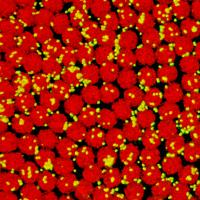
Wolbachia in yellow with host cells in red. Scientists at the University of Rochester and the J. Craig Venter Institute have discovered a copy of the entire genome of a bacterial parasite residing inside the genome of its host species.
| Full story | 0 Comments | 8109 views |

| Microbiology | August 30, 2007 08:27 PM |
University of Illinois at Chicago researchers have identified new sites on the bacterial cell's protein-making machinery where antibiotics can be delivered to treat infections.
| Full story | 0 Comments | 6346 views |
| Biology | August 30, 2007 07:27 PM |
For years, biologists in Africa have known that large mammals – including antelopes and their predators - were disappearing outside reserves. Now a raft of studies, published in the September 2007 issue of the African Journal of Ecology, show that we have moved beyond this. We are losing species from national parks, bastion of biodiversity conservation. Worryingly, this includes the continent’s crown jewels such as Tanzania’s Serengeti National Park.
| Full story | 0 Comments | 6931 views |

| Molecular & Cell Biology | August 30, 2007 06:30 PM |
A cannibalistic process called autophagy spurs dying embryonic stem cells to send "eat me" and "come get me" signals to have their corpses purged, a last gasp that paves the way for normal mammalian development, UT Southwestern Medical Center researchers have found.
| Full story | 0 Comments | 6484 views |

| Health & Medicine | August 30, 2007 06:27 PM |
Thousands of World Trade Center rescue and recovery workers were still suffering serious mental health effects three years after the disaster, the Health Department reported today. New findings released from the World Trade Center Health Registry show that one in eight rescue and recovery workers (12.4%) likely had post-traumatic stress disorder when they were interviewed in 2003 and 2004. The findings were published today in the American Journal of Psychiatry, available online at www.ajp.psychiatryonline.org (direct link: http://ajp.psychiatryonline.org/cgi/reprint/164/9/1385).
| Full story | 0 Comments | 6836 views |

| Biotechnology | August 30, 2007 05:30 PM |
The environmental consequences of transgenic crops are the focus of numerous investigations, such as the one published in the journal PloS ONE, which was carried out by Cristina Faria and her colleagues, under the supervision of Ted Turlings, professor in chemical ecology at the University of Neuchâtel. The researchers observed that most transgenic maize lines were significantly more susceptible to the aphid Rhopalosiphum maidis than their conventional equivalents. "We have studied six lines of Bt maize containing an insecticidal gene derived from the bacteria Bacillus thuringiensis. The toxin produced by these genes is very specific and only affects the caterpillars feeding on the plants, not the aphids. Five of the lines contained up to twice the number of aphids", states Cristina Faria. She does, however, go on to clarify what seems, at a first glance, detrimental to the plant.
| Full story | 0 Comments | 7200 views |
| Biology | August 30, 2007 04:30 PM |
While you may not catch a fly sipping Perrier, the insect has specialized taste cells for carbonated water that probably encourage it to binge on food with growing microorganisms. Yeast and bacteria both produce carbon dioxide (CO2) when they feast, and CO2 dissolves readily in water to produce seltzer or soda water.
| Full story | 0 Comments | 8828 views |
| Health & Medicine | August 30, 2007 02:30 PM |
Smoking tobacco is no longer considered sexy, but it may prove a permanent turn on for some genes. Research published today in the online open access journal BMC Genomics could help explain why former smokers are still more susceptible to lung cancer than those who have never smoked.
| Full story | 0 Comments | 8478 views |
| Microbiology | August 30, 2007 12:30 PM |
With infections increasingly resistant to even the most modern antibiotics, researchers at the Los Angeles Biomedical Research Institute at Harbor-UCLA Medical Center (LA BioMed) report in the September issue of Nature Reviews Microbiology on new clues they have uncovered in immune system molecules that defend against infection.
| Full story | 0 Comments | 6004 views |
| Microbiology | August 30, 2007 10:30 AM |
As summer temperatures cool in the United States, fewer mosquitoes whir around our tiki torches. But mosquitoes swarming around nearly 40 percent of the world’s population will continue to spread a deadly parasitic disease — malaria. Now an interdisciplinary team led by researchers from Rensselaer Polytechnic Institute has found a key link that causes malarial infection in both humans and mosquitoes.
| Full story | 0 Comments | 7653 views |

- In some genetic cases of microcephaly, stem cells fail to launch
- Yale team discovers how Zika virus causes fetal brain damage
- Scientists uncover the way a common cell enzyme alerts the body to invading bacteria
- Arctic gives clues on worst mass extinction of life
- Calcium channel blockers caught in the act at atomic level
Search Bio News Net
Free Biology Newsletter
- Flexibility That A.C.A. Lent to Work Force Is Threatened by...International Herald Tribune
- Bacteria Behind Legionnaires’ Disease Found at New York Police StationInternational Herald Tribune
- Prescription Price Crisis? 28 Million Americans See Spike in Drug...MSNBC.com: Health
- Seizing on Opioid Crisis, a Drug Maker Lobbies Hard for...International Herald Tribune
- Republicans are taking a big political risk on health careAP Health News
- Why We're So Divided Over Saving WolvesNational Geographic News