

Though many spring flowers have bright advertisements offering sweet rewards to honeybees, some common flowers have not-so-sweet or even toxic nectars. Why plants would try to poison the honeybees they wish to attract is a scientific mystery.

| Molecular & Cell Biology | April 1, 2007 09:34 PM |
In the April 1 issue of G&D, a Korean research team led by Dr. Kyong-Tai Kim (Pohang University) describes how melatonin production is coordinated with the body's natural sleep/wake cycles.
| Full story | 0 Comments | 6015 views |

| Health & Medicine | April 1, 2007 08:34 PM |
Scientists at Dana-Farber Cancer Institute have shown in a laboratory study that revving up a crucial set of muscle genes counteracts the damage caused by a form of muscular dystrophy.
| Full story | 0 Comments | 5099 views |
| Health & Medicine | April 1, 2007 07:34 PM |
The testosterone levels of healthy men decline as they get older. As sleep quality and quantity typically decrease with age, objectively measured differences in the amount of sleep a healthy older man gets can affect his level of testosterone in the morning, according to a study published in the April 1st issue of the journal SLEEP.
| Full story | 0 Comments | 6854 views |

| Biology | April 1, 2007 06:34 PM |
Many of us will be familiar with cravings for sweet food, after having overindulged in alcohol the night before. It appears that Egyptian fruit bats also crave particular types of sugar to reduce the effects of ethanol toxicity. Francisco Sanchez from the Ben-Gurion University of the Negev (Israel) will present data demonstrating this on Sunday 1st of April at the Society for Experimental Biology’s Annual Meeting in Glasgow.
| Full story | 0 Comments | 6959 views |
| Molecular & Cell Biology | April 1, 2007 02:26 PM |
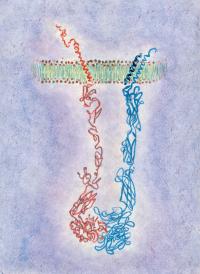
Artist rendering of integrin transmembrane protein. The red portion is the beta subunit; the blue is both the larger alpha subunit and the smaller bound peptide. Proteins, which form much of the molecular machinery required for life, are the targets of most drug molecules. One third of all proteins are membrane proteins – embedded within the cell’s fatty outer layer. While scientists can easily study the other two-thirds using such tools as antibodies, they have not had such methods to investigate the membrane-embedded portions of proteins.
| Full story | 0 Comments | 6797 views |

| Biotechnology | April 1, 2007 12:26 PM |
More than half a million people in the European Union and a million in the United States suffer from disorders in or serious defects of some part of their bone structure. Operations involving grafts or implants, required to mitigate the damage, depend decisively on the materials used.
| Full story | 0 Comments | 6560 views |

| Microbiology | April 1, 2007 10:26 AM |
How is virus as for example HIV and bird flu able to make the cells within a human body work for the purpose of the virus? Researchers at the University of Copenhagen shed new light on this question.
| Full story | 0 Comments | 5879 views |

- In some genetic cases of microcephaly, stem cells fail to launch
- Yale team discovers how Zika virus causes fetal brain damage
- Scientists uncover the way a common cell enzyme alerts the body to invading bacteria
- Arctic gives clues on worst mass extinction of life
- Calcium channel blockers caught in the act at atomic level
Search Bio News Net
Free Biology Newsletter
- Flexibility That A.C.A. Lent to Work Force Is Threatened by...International Herald Tribune
- Bacteria Behind Legionnaires’ Disease Found at New York Police StationInternational Herald Tribune
- Prescription Price Crisis? 28 Million Americans See Spike in Drug...MSNBC.com: Health
- Seizing on Opioid Crisis, a Drug Maker Lobbies Hard for...International Herald Tribune
- Republicans are taking a big political risk on health careAP Health News
- Why We're So Divided Over Saving WolvesNational Geographic News