

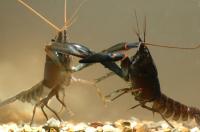
Fighting crayfish Intimidation and threats are common throughout society, whether it’s in the school playground, sporting arena or boardroom. Threatening behaviour is equally widespread among non-human animals. Individuals signal their superior strength to competitors to obtain food, resolve territorial disputes and acquire mates. Current theory insists that signals of strength should be honest. Surprisingly researchers have found that dishonest signals are used routinely during dominance disputes by male Australian crayfish. This work will be presented by Dr Robbie Wilson (University of Queensland) on Monday 2nd April at the Society for Experimental Biology’s Annual Meeting in Glasgow.

| Biology | April 2, 2007 11:24 PM |
| Full story | 0 Comments | 5530 views |

| Health & Medicine | April 2, 2007 10:24 PM |
The National Institute of Allergy and Infectious Diseases (NIAID), part of the National Institutes of Health (NIH), today announced it is awarding $23 million per year for seven years to establish six Centers of Excellence for Influenza Research and Surveillance. Collectively, the centers will expand NIAID’s influenza surveillance program internationally and in the United States, and will bolster influenza research in key areas, including understanding how the virus causes disease and how the human immune system responds to infection with the virus. The goal of the newly created centers is to provide the federal government with important information to inform public health strategies for controlling and lessening the impact of seasonal influenza as well as an influenza pandemic.
| Full story | 0 Comments | 4533 views |

| Environment | April 2, 2007 09:24 PM |
Scientists at MIT have created an ocean model so realistic that the virtual forests of diverse microscopic plants they "sowed" have grown in population patterns that precisely mimic their real-world counterparts.
| Full story | 0 Comments | 4946 views |
| Health & Medicine | April 2, 2007 08:24 PM |
Scientists supported by the National Institute on Drug Abuse (NIDA), part of the National Institutes of Health, have for the first time identified genes that might increase a person’s ability to abstain from smoking. The breakthrough research was conducted by Dr. George Uhl at NIDA’s Intramural Research Program and a team led by Dr. Jed Rose at the Center for Nicotine and Smoking Cessation Research at Duke University Medical Center.
| Full story | 0 Comments | 4045 views |

| Microbiology | April 2, 2007 07:24 PM |
A mathematician at the University of York has been awarded a Research Leadership Award of more than £700,000 by the Leverhulme Trust to study the geometry of viruses.
| Full story | 0 Comments | 4654 views |
| Health & Medicine | April 2, 2007 06:24 PM |
A new medical device in development by University of Cincinnati researchers may sniff out olfactory disorders that could be an early warning of Alzheimer’s disease, Parkinson’s disease and other problems outside the typical sensory loss associated with aging. The Sniff Magnitude Test (SMT), an invention of UC Psychology Professor Robert Frank and Professor Emeritus Robert Gesteland of the UC Department of Cell Biology, is now under further development with the WR Medical Electronics Company in Stillwater, Minn. The company will manufacture and market the test.
| Full story | 1 Comment | 6401 views |

| Molecular & Cell Biology | April 2, 2007 05:24 PM |
Scientists have puzzled for years in understanding how plants pass signals of stress due to lack of water or salinity from chloroplast to nucleus. They know that chloroplasts – the cellular organelles that give plants their green color – have at least three different signals that can indicate a plant is under stress.
| Full story | 0 Comments | 4894 views |
| Health & Medicine | April 2, 2007 04:24 PM |
Fats in our stomach may reduce the protective effects of antioxidants such as vitamin C. Scientists at the University of Glasgow found that in the presence of lipid the ability of antioxidants, such as ascorbic acid (the active component of vitamin C), to protect against the generation of potential cancer-forming compounds in the stomach is less than when no lipids are present. “Our results illustrate how diet can influence gastric biochemistry”, says Emilie Combet, the post-doctoral researcher working on the project, who will be presenting her results at the Society of Experimental Biology’s Annual Main Meeting on Monday 2nd of April.
| Full story | 0 Comments | 5350 views |

- In some genetic cases of microcephaly, stem cells fail to launch
- Yale team discovers how Zika virus causes fetal brain damage
- Scientists uncover the way a common cell enzyme alerts the body to invading bacteria
- Arctic gives clues on worst mass extinction of life
- Calcium channel blockers caught in the act at atomic level
Search Bio News Net
Free Biology Newsletter
- Flexibility That A.C.A. Lent to Work Force Is Threatened by...International Herald Tribune
- Bacteria Behind Legionnaires’ Disease Found at New York Police StationInternational Herald Tribune
- Prescription Price Crisis? 28 Million Americans See Spike in Drug...MSNBC.com: Health
- Seizing on Opioid Crisis, a Drug Maker Lobbies Hard for...International Herald Tribune
- Republicans are taking a big political risk on health careAP Health News
- Why We're So Divided Over Saving WolvesNational Geographic News