


Heavy metals are present in variable amounts in the natural environment in the UK. Dr Jennifer Sneddon (Liverpool John Moores University) will present the results of a pilot study assessing the use of upland sheep wool as a bio-monitoring device for natural levels of heavy metals in the Lake District and Wales at the Society for Experimental Biology’s Annual Meeting in Glasgow (31st March – 2nd April).

| Biology | March 31, 2007 08:26 PM |
With the unappealing prospect of being eaten, one might imagine that during a predator attack it is a case that all fish escape at once in the desperate hurry to escape as quickly as possible. However, new research indicates that this is not the case, and in fact fish in schools escape using a relatively fixed chronological order. This research was carried out at the International Marine Centre (IMC) in Sardinia, Italy, and will be presented at the Annual Meeting of the Society for Experimental Biology in Glasgow (31st March – 4th April).
| Full story | 0 Comments | 5825 views |
| Biology | March 31, 2007 06:26 PM |
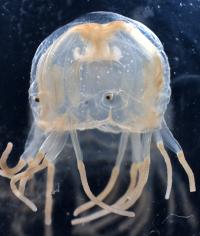
Box jellyfish Box jellyfish are much more active swimmers than other jellyfish – they exhibit strong directional swimming, are able to perform rapid 180 degree turns, and can deftly move in between objects. So how do they manage to manoeuvre the obstacle course that is in the sea bed? Given that they possess an impressive 24 eyes one would think they would be well equipped for this challenge! Dr Anders Garm (Lund University, Sweden) will present data demonstrating that it is one particular sub-set of eyes that performs this job, at the Society of Experimental Biology’s Annual Meeting in Glasgow (31st March – 2nd April).
| Full story | 0 Comments | 11287 views |

| Health & Medicine | March 31, 2007 04:26 PM |
By recognizing sugars, a technique developed by University of Michigan analytical chemist Kristina Hakansson sets the stage for new cancer diagnosis and treatment options.
| Full story | 0 Comments | 5801 views |

| Biotechnology | March 31, 2007 02:26 PM |
DNA-wrapped single-walled carbon nanotubes (SWCNTs) shorter than about 200 nanometers readily enter into human lung cells and so may pose an increased risk to health, according to scientists at the National Institute of Standards and Technology (NIST). The results of their laboratory studies appear in an upcoming issue of Advanced Materials.*
| Full story | 0 Comments | 5884 views |
| Biology | March 31, 2007 12:26 PM |
Biologists at New York University have identified how different species use common genes to control their early development and alter how these genes are used to accommodate their own features. The findings, which were discovered by researchers in Professor Claude Desplan’s and Steve Small’s laboratories in NYU’s Center for Developmental Genetics, offer new insight into the workings of developmental pathways across species. The study is published in the latest issue of the journal Science.
| Full story | 0 Comments | 6119 views |
| Biology | March 31, 2007 10:26 AM |
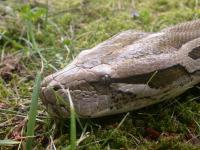
Burmese python. Burmese pythons don’t eat very often, but when they do they like to pig out, ingesting the whole of their prey. There’s very little waste as they are able to digest everything, apart from hair and feathers. Dr Jean-Hervé Lignot (Louis Pasteur University) and Dr Robert K. Pope (Indiana University South Bend) will talk about the implications this has on the way these snakes digest food on Saturday 31st March at the Society for Experimental Biology’s Annual Meeting in Glasgow.
| Full story | 0 Comments | 9817 views |
| Biology | March 31, 2007 12:30 AM |
Researchers at the McKnight Brain Institute of the University of Florida have initiated a project to treat human brain and other diseases by plundering the secrets of regeneration from creatures with remarkable powers of self-renewal, such as salamanders, newts, starfish and flatworms.
| Full story | 0 Comments | 6510 views |

- In some genetic cases of microcephaly, stem cells fail to launch
- Yale team discovers how Zika virus causes fetal brain damage
- Scientists uncover the way a common cell enzyme alerts the body to invading bacteria
- Arctic gives clues on worst mass extinction of life
- Calcium channel blockers caught in the act at atomic level
Search Bio News Net
Free Biology Newsletter
- Flexibility That A.C.A. Lent to Work Force Is Threatened by...International Herald Tribune
- Bacteria Behind Legionnaires’ Disease Found at New York Police StationInternational Herald Tribune
- Prescription Price Crisis? 28 Million Americans See Spike in Drug...MSNBC.com: Health
- Seizing on Opioid Crisis, a Drug Maker Lobbies Hard for...International Herald Tribune
- Republicans are taking a big political risk on health careAP Health News
- Why We're So Divided Over Saving WolvesNational Geographic News