

Freedom of expression is great, but silence is golden – at least when it comes to amoebae, which are intestine-dwelling parasites that cause life-threatening dysentery in many parts of the world. Three years ago, scientists at the Weizmann Institute accidentally discovered a way to silence the expression of a key amoebic gene, one which codes for a toxic protein that kills human intestinal cells infected with this devastating illness. Now the scientists have developed a way to successfully silence the expression of two additional virulence genes in the same amoebae.

| Molecular & Cell Biology | August 30, 2006 10:36 PM |
Research confirming the human body is designed to strongly resist attempts to lose weight will be presented at an international gathering of obesity experts hosted by QUT this week.
| Full story | 1 Comment | 8888 views |

| Environment | August 30, 2006 09:36 PM |
Concentrations of atmospheric ozone -- which protects Earth from the sun's ultraviolet radiation -- are showing signs of recovery in the most important regions of the stratosphere above the mid-latitudes in both the Northern and Southern hemispheres, a new study shows.
| Full story | 0 Comments | 7155 views |
| Environment | August 30, 2006 08:36 PM |
A new study has found that large segments of the Pacific Ocean lack sufficient iron to trigger healthy phytoplankton growth and the absence of the mineral stresses these microscopic ocean plants, triggering them to produce additional pigments that make ocean productivity appear more robust than it really is.
| Full story | 0 Comments | 6524 views |

| Microbiology | August 30, 2006 07:36 PM |
How do some microorganisms manage to exist and even thrive in surroundings ranging from Antarctica to boiling hot springs? A team of scientists from the Weizmann Institute's Plant Sciences Department, led by Prof. Avigdor Scherz, has found that a switch in just two amino acids (the building blocks of protein) can make a difference between functioning best at moderate temperatures and being adapted to living in extreme heat. The results of their research, which recently appeared in Nature, might have implications for future attempts to adjust crops to differing climate conditions or improve enzyme efficiency in industrial processes.
| Full story | 1 Comment | 8307 views |

| Biology | August 30, 2006 06:44 PM |
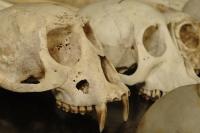
In the foreground, a skull of a Diana monkey. The large hole to the right of the nasal cavity was likely inflicted by an African crowned eagle.A new study suggests that prehistoric birds of prey made meals out of some of our earliest human ancestors.
| Full story | 0 Comments | 8016 views |
| Microbiology | August 30, 2006 04:44 PM |
Bacteria have hair-like protrusions with a sticky protein on the tip that lets them cling to surfaces. The coiled, bungee cord-like structure of the protrusions helps the bacteria hang on tightly, even under rough fluid flow inside the body, researchers report in the journal PLoS Biology.
| Full story | 0 Comments | 6254 views |
| Biology | August 30, 2006 02:44 PM |
Transferring knowledge through a chain of generations is a behavior not exclusive to humans, according to new findings by researchers at the Yerkes National Primate Research Center of Emory University and the University of St. Andrews, Scotland. For the first time, researchers have shown chimpanzees exhibit generational learning behavior similar to that in humans. Unlike previous findings that indicated chimpanzees simply conform to the social norms of the group, this study shows behavior and traditions can be passed along a chain of individual chimpanzees. These findings, based upon behavioral data gathered at the Yerkes Field Station in Lawrenceville, Ga., will publish online in the August 28 early edition of the Proceedings of the National Academy of Sciences.
| Full story | 3 Comments | 7494 views |

| Health & Medicine | August 30, 2006 12:03 PM |
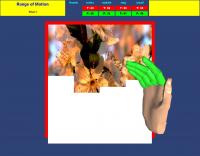
In one exercise, a patient attempts to wipe clean four vertical bars that obscure an image on a computer display. The bars are erased in proportion to each finger's flexing...Engineers at Rutgers, The State University of New Jersey, have modified a popular home video game system to assist stroke patients with hand exercises, producing a technology costing less than $600 that may one day rival systems 10 times as expensive.
| Full story | 0 Comments | 7010 views |

| Biotechnology | August 30, 2006 10:03 AM |
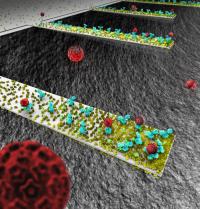
This rendition depicts an array of tiny, diving-boardlike devices called nanocantilevers. The devices are coated with antibodies to capture viruses, which are represented as red spheres.Researchers at Purdue University have made a discovery about the behavior of tiny structures called nanocantilevers that could be crucial in designing a new class of ultra-small sensors for detecting viruses, bacteria and other pathogens.
| Full story | 0 Comments | 5926 views |

- In some genetic cases of microcephaly, stem cells fail to launch
- Yale team discovers how Zika virus causes fetal brain damage
- Scientists uncover the way a common cell enzyme alerts the body to invading bacteria
- Arctic gives clues on worst mass extinction of life
- Calcium channel blockers caught in the act at atomic level
Search Bio News Net
Free Biology Newsletter
- Flexibility That A.C.A. Lent to Work Force Is Threatened by...International Herald Tribune
- Bacteria Behind Legionnaires’ Disease Found at New York Police StationInternational Herald Tribune
- Prescription Price Crisis? 28 Million Americans See Spike in Drug...MSNBC.com: Health
- Seizing on Opioid Crisis, a Drug Maker Lobbies Hard for...International Herald Tribune
- Republicans are taking a big political risk on health careAP Health News
- Why We're So Divided Over Saving WolvesNational Geographic News