

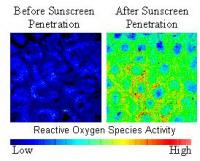
Two-photon fluorescence intensity images of cells deep in the epidermis showing reactive oxygen species activity following sunscreen application to the skin surface.Are sunscreens always beneficial, or can they be detrimental to users? A research team led by UC Riverside chemists reports that unless people out in the sun apply sunscreen often, the sunscreen itself can become harmful to the skin.

| Health & Medicine | August 29, 2006 11:03 PM |
| Full story | 0 Comments | 10007 views |

| Bioinformatics | August 29, 2006 10:03 PM |
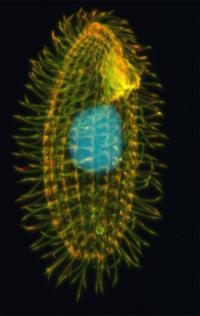
The genome sequence of the single-celled ciliate Tetrahymena thermophila sheds light on early eukaryotic evolution.In an effort to improve our understanding of eukaryotic evolution, a team of over 50 researchers led by Jonathan Eisen sequenced the macronuclear genome of the single-celled ciliate Tetrahymena themophila. Published online this week in the open-access journal PLoS Biology, the authors provide insights into the biology of this organism.
| Full story | 1 Comment | 7727 views |
| Bioinformatics | August 29, 2006 09:03 PM |
If you could peer microscopically into the closest freshwater pond, you'd hesitate before dipping a toe. Amid the murky water, you'd probably notice an oddly furry, pear-shaped organism gliding along--and gobbling up everything in its path.
| Full story | 0 Comments | 5840 views |

| Molecular & Cell Biology | August 29, 2006 08:03 PM |
How are you? In biological terms this question could involve a feedback loop that lets the body check in on itself and then act on that information. Although feedback loops are essential and they abound in biology, they aren't well understood. Feedback loops enable an organ such as the liver to detect if it is injured, ascertain if it is growing and developing normally, and if it needs to regenerate itself. When such loops derail, cancer and other diseases can arise.
| Full story | 0 Comments | 5231 views |

| Biotechnology | August 29, 2006 07:03 PM |
Scientists have found a way to trick cancer cells into committing suicide. The novel technique potentially offers an effective method of providing personalized anti-cancer therapy.Most living cells contain a protein called procaspase-3, which, when activated, changes into the executioner enzyme caspase-3 and initiates programmed cell death, called apoptosis. In cancer cells, however, the signaling pathway to procaspase-3 is broken. As a result, cancer cells escape destruction and grow into tumors.
| Full story | 0 Comments | 9081 views |

| Biology | August 29, 2006 06:03 PM |
Socks in the sock drawer, shirts in the shirt drawer, the time-honored lessons of helping organize one's clothes learned in youth. But what parts of the brain are used to encode such categories as socks, shirts or any other item, and how does such learning take place?
| Full story | 0 Comments | 6899 views |
| Biotechnology | August 29, 2006 04:03 PM |
High-tech laboratory tools, like computers, are often updated publicly as their analytical capabilities expand. In the September issue of the Journal of Molecular Diagnostics, NIH grantees report they have developed a second generation "lab on a silicon chip" called the MitoChip v2.0 that for the first time rapidly and reliably sequences all mitochondrial DNA. Mitochondria, the energy-producing organelles that power our cells, are unique because they are equipped with their own genetic instructions distinct from the DNA stored in the cell nucleus.
| Full story | 0 Comments | 6973 views |
| Molecular & Cell Biology | August 29, 2006 02:03 PM |
A newly discovered enzyme inhibitor, identified by researchers originally looking for biological pest controls, may lead to pain relief for sufferers of arthritis and other inflammatory diseases, say researchers at the University of California, Davis. The finding, hailed by a noted inflammatory disease expert "as the most important discovery in inflammation in more than a decade," may also reduce side effects associated with the painkiller, Vioxx.
| Full story | 0 Comments | 5664 views |
| Molecular & Cell Biology | August 29, 2006 12:03 PM |
Researchers at The Forsyth Institute have confirmed in human gingival tissue that immune cells play a destructive role in periodontal disease. Although researchers had suspected the correlation between bone loss in periodontal (gum) disease and immune cells, this is the first time that this has been confirmed in human tissue samples. With this work, Forsyth scientists and colleagues hope to determine methods for intervening and halting bone loss and thus improving the health outcomes of the estimated 80 million Americans suffering from periodontal disease.
| Full story | 0 Comments | 6622 views |
| Molecular & Cell Biology | August 29, 2006 10:03 AM |
The breakthrough came as Barry Thompson from Stephen Cohen's group at EMBL looked at a recently discovered signaling pathway called "Hippo."
| Full story | 0 Comments | 6645 views |

- In some genetic cases of microcephaly, stem cells fail to launch
- Yale team discovers how Zika virus causes fetal brain damage
- Scientists uncover the way a common cell enzyme alerts the body to invading bacteria
- Arctic gives clues on worst mass extinction of life
- Calcium channel blockers caught in the act at atomic level
Search Bio News Net
Free Biology Newsletter
- Flexibility That A.C.A. Lent to Work Force Is Threatened by...International Herald Tribune
- Bacteria Behind Legionnaires’ Disease Found at New York Police StationInternational Herald Tribune
- Prescription Price Crisis? 28 Million Americans See Spike in Drug...MSNBC.com: Health
- Seizing on Opioid Crisis, a Drug Maker Lobbies Hard for...International Herald Tribune
- Republicans are taking a big political risk on health careAP Health News
- Why We're So Divided Over Saving WolvesNational Geographic News