


A collaboration between researchers at the Salk Institute for Biological Studies and the University of California at Los Angeles captured the genome-wide DNA methylation pattern of the plant Arabidopsis thaliana - the "laboratory rat" of the plant world - in one big sweep.

| Environment | August 31, 2006 10:34 PM |
A NASA-sponsored study shows that by using a new technique, scientists can determine what limits the growth of ocean algae, or phytoplankton, and how this affects Earth's climate.
| Full story | 1 Comment | 8847 views |

| Molecular & Cell Biology | August 31, 2006 09:34 PM |
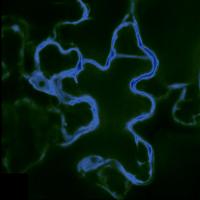
This false-color image shows a cell from the epidermis of an Arabidopsis thaliana plant; the cell has been marked with fluorescent imaging sensors designed to detect the sugar glucose.Scientists at Carnegie's Department of Plant Biology have made the first real-time observations of sugars in the cells of intact and living plant tissues. With the help of groundbreaking imaging techniques, the group has determined that plants maintain extremely low levels of sugar in their roots--as much as 100,000 times lower than previous estimates. The new technology will enable new studies of sugar metabolism in plants, which will inform the effort to engineer higher crop yields for food and biofuel production.
| Full story | 0 Comments | 8527 views |
| Molecular & Cell Biology | August 31, 2006 04:36 PM |
A former astronaut and researcher at the San Francisco VA Medical Center will be traveling to the Cosmodrome space-launch site at Baikonur, Kazakhstan, this Saturday, Sept. 2, 2006, to prepare a crucial experiment designed to demonstrate how human immune response is suppressed in the weightless environment of space.
| Full story | 0 Comments | 7494 views |

| Biology | August 31, 2006 02:36 PM |
A team led by a conservationist from the Bronx Zoo-based Wildlife Conservation Society, working with the Chadian government and the European Union project CURESS near Chad's Zakouma National Park, has discovered 100 slaughtered elephants, most of them missing only their tusks -- a sure sign that poaching is on the upswing just outside of this renowned protected area.
| Full story | 1 Comment | 7200 views |
| Molecular & Cell Biology | August 31, 2006 12:36 PM |
A two-step process appears to regulate cell fate decisions for many types of developing cells, according to researchers from the University of Chicago.
| Full story | 0 Comments | 5724 views |

| Biotechnology | August 31, 2006 10:36 AM |
Researchers are touting the use of liquid crystalline polymers (LCP) as a viable tool for use in devices such as the sought-after lab-on-a-chip technology.
| Full story | 0 Comments | 6569 views |

- In some genetic cases of microcephaly, stem cells fail to launch
- Yale team discovers how Zika virus causes fetal brain damage
- Scientists uncover the way a common cell enzyme alerts the body to invading bacteria
- Arctic gives clues on worst mass extinction of life
- Calcium channel blockers caught in the act at atomic level
Search Bio News Net
Free Biology Newsletter
- Flexibility That A.C.A. Lent to Work Force Is Threatened by...International Herald Tribune
- Bacteria Behind Legionnaires’ Disease Found at New York Police StationInternational Herald Tribune
- Prescription Price Crisis? 28 Million Americans See Spike in Drug...MSNBC.com: Health
- Seizing on Opioid Crisis, a Drug Maker Lobbies Hard for...International Herald Tribune
- Republicans are taking a big political risk on health careAP Health News
- Why We're So Divided Over Saving WolvesNational Geographic News