

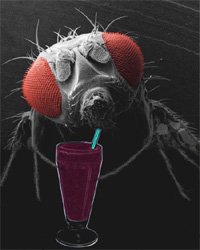
Photo: Partridge et al.In April, the United States Centers for Disease Control and Prevention released a study challenging the conventional wisdom that eating less promotes longevity. Now, in a new study in the premier open access journal PLoS Biology, William Mair, Matthew Piper, and Linda Partridge show that flies can actually live longer without reducing calories by eating proportionally less yeast, supporting the notion that calorie-restriction-induced longevity may not be as universal as once thought.

| Biology | May 31, 2005 08:33 PM |
| Full story | 0 Comments | 6256 views |
| Biology | May 31, 2005 08:32 PM |
You just can't tell where you might find love these days. A team led by a neuroscientist, an anthropologist and a social psychologist found love-related neurophysiological systems inside a magnetic resonance imaging machine. They detected quantifiable love responses in the brains of 17 young men and women who each described themselves as being newly and madly in love.
| Full story | 0 Comments | 7914 views |

| Molecular & Cell Biology | May 31, 2005 08:30 PM |
Scientists have for the first time mapped multiple complex biological interactions in a yeast cell in a simple graphical form, enhancing our understanding of how the networks of interaction by which components of a cell influence one another. New research published in the Open Access journal Journal of Biology shows that such maps can also reveal cryptic interactions and enable accurate predictions about interactions that haven't been observed experimentally.
| Full story | 0 Comments | 6174 views |
| Biology | May 31, 2005 08:29 PM |
Just as disturbance makes a landscape susceptible to invasion by alien plant species, the construction of reservoirs around the globe could be contributing to the accelerating spread of exotic aquatic species, according to a Forum article in the June 2005 issue of BioScience. John A. Havel of Southwest Missouri State University and Carol Eunmi Lee and M. Jake Vander Zanden of the University of Wisconsin survey evidence indicating that the physical and biological properties of reservoirs make them more likely to be invaded by exotic species than natural lakes. The researchers point to cases in which reservoirs are believed to have facilitated the rapid spread of invasive species.
| Full story | 0 Comments | 5661 views |
| Molecular & Cell Biology | May 31, 2005 08:28 PM |
To be published in the June 1 issue of G&D, Dr. Thomas Tuschl and colleagues describe the most comprehensive profile to date of microRNA (miRNA) expression during zebrafish development. The authors cloned 154 distinct miRNAs (10 of which are completely novel) in a developmental and tissue-specific manner.
| Full story | 0 Comments | 6559 views |
| Molecular & Cell Biology | May 31, 2005 08:27 PM |
New research shows that exposure to harmful chemicals and drugs during critical developmental periods early in life may actually "reprogram" the way certain genes respond to the female hormone estrogen. This genetic reprogramming may determine whether people with a genetic predisposition for a disease actually develop the disease.
| Full story | 0 Comments | 5933 views |
| Biology | May 30, 2005 06:57 PM |
The McGill University Health Center (MUHC) in Montreal is pleased to announce the first successful birth in Canada resulting from frozen eggs. A team led by Professor Seang Lin Tan, Chair of the Department of Obstetrics and Gynecology at McGill University and Director of the McGill Reproductive Centre at the MUHC in Montreal confirmed the birth of a healthy baby boy, weighing 3740grams on April 29. "We are the first in-vitro fertilization (IVF) Centre in Canada to achieve this success," says Dr. Tan. "This is fantastic news for both the family and for fertility health research and we would like to congratulate the parents on the birth of their first child."
| Full story | 0 Comments | 7950 views |
| Molecular & Cell Biology | May 30, 2005 06:56 PM |
A research team based at Massachusetts General Hospital (MGH) has identified 80 new genes essential to the process of RNA interference (RNAi), a powerful new research tool for inactivating genes in plants or animals. They used the RNAi process itself to find new genes that participate in the gene-silencing mechanism, which someday may help to fight human disease. The report will appear in the journal Science and is receiving early online release on the Science Express website at http://www.sciencexpress.org.
| Full story | 0 Comments | 5218 views |

| Biotechnology | May 30, 2005 06:54 PM |
Until now it has been impossible to accurately measure the levels of important chemicals in living brain cells in real time and at the level of a single cell. Scientists at the Carnegie Institution's Department of Plant Biology and Stanford University are the first to overcome this obstacle by successfully applying genetic nanotechnology using molecular sensors to view changes in brain chemical levels. The sensors alter their 3-dimensional form upon binding with the chemical, which is then visible via a process known as fluorescence resonance energy transfer, or FRET. In a new study, the nanosensors were introduced into nerve cells to measure the release of the neurotransmitter glutamate--the major brain chemical that increases nerve-cell activity in mammalian brains. It is involved in everything from learning and memory to mood and perception. Too much glutamate is believed to contribute to conditions such as Alzheimer's and Parkinson's disease. The research is published in the May 30-June 3 on-line early edition of the Proceedings of the National Academy of Sciences.
| Full story | 0 Comments | 6012 views |
| Biology | May 30, 2005 06:53 PM |
Mass extinctions seem to occur on Earth roughly every 26 million years, leading some scientists to propose that they may be caused by rare collisions with comets or asteroids. A researcher in Poland thinks it may be possible that extraordinary predators are at fault instead.
| Full story | 1 Comment | 6011 views |

| Stem Cell Research | May 30, 2005 06:50 PM |
Children with a fatal genetic disorder called Krabbe disease can be saved and their brain development preserved if they receive stem cells from umbilical cord blood before symptoms of the disease develop, according to a study published in the May 19, 2005, issue of the New England Journal of Medicine.
| Full story | 0 Comments | 10520 views |

| Microbiology | May 30, 2005 06:49 PM |
In this month's issue of the freely available online journal PLoS Medicine, Dr. Thomas N. Williams and colleagues from Kilifi, Kenya, show that the protection against malaria given by carrying the gene for sickle cell haemoglobin may involve the immune system. Studying a group of children and adults in the Kilifi District of coastal Kenya, they found that this protection increased during childhood up to age 10, and then declined.
| Full story | 0 Comments | 8525 views |
| Biology | May 30, 2005 06:48 PM |
Thinking small in a time when everything was big has helped Queensland researchers to unearth new evidence that climate change, instead of humans, was responsible for wiping out Australian giant marsupials or megafauna 40,000 years ago.
Instead of only excavating 'trophy specimens' such as giant kangaroos and wombats, the researchers from Queensland University of Technology (QUT) and Queensland Museum performed the first systematic analysis of a site in the fossil rich Darling Downs region of south-eastern Queensland.
| Full story | 0 Comments | 5932 views |

| General | May 29, 2005 05:26 PM |
- A Primate Explosion
- Judge Rules Dam Plan Threatens Salmon
- Subliminal Smiles Can Sway You
- 'Corpse Flower' Set to Bloom in San Francisco
| 0 Comments | 5201 views |

| Health & Medicine | May 29, 2005 05:25 PM |
The most accurate estimates of the causes of child deaths to date, published in the March 26, 2005 of THE LANCET, reveal that worldwide more than 70% of the 10.6 million child deaths that occur annually are attributable to six causes: pneumonia (19%), diarrhoea (18%), malaria (8%), neonatal sepsis or pneumonia (10%), preterm delivery (10%), and asphyxia at birth (8%).
| Full story | 0 Comments | 6335 views |
| Molecular & Cell Biology | May 29, 2005 05:24 PM |
A new research study identifies a critical inhibitory step that is a key component of the feedback circuit regulating the balance between neutrophil production and destruction. The research, published in the March issue of Immunity, suggests that the process for disposal of dying neutrophils is actively linked to neutrophil production. A clear understanding of the processes that control neutrophil turnover may contribute to the development of future therapeutics for conditions characterized by abnormal numbers of these critical immune cells.
| Full story | 0 Comments | 10111 views |

| Gene Therapy | May 29, 2005 05:23 PM |
Natural killer (NK) immune system cells can be genetically modified to brandish a powerful "on-switch" that prompts them to aggressively attack and kill leukemic cells. This finding, from researchers at St. Jude Children's Research Hospital, suggests a way to improve the outcome of children who receive treatment for acute lymphoblastic leukemia (ALL) or other blood cancers.
| Full story | 0 Comments | 7228 views |
| Molecular & Cell Biology | May 29, 2005 05:21 PM |
Johns Hopkins researchers have identified the proteins that allow specific brain cells to "change channels," a rare ability that tweaks what can come into the cell. The findings, described in the March 24 issue of Neuron, may let researchers harness the process, perhaps one day using it to protect cells that die in Lou Gehrig's disease.
| Full story | 2 Comments | 10431 views |
| Health & Medicine | May 29, 2005 05:20 PM |
The emergence of cancer as a major cause of death among children in developing regions of the world is not being adequately addressed by national or international health organizations and charities, according to investigators at St. Jude Children’s Research Hospital. This growing rate of pediatric cancer is occurring as the number of children dying from infectious diseases is being reduced through the efforts of the World Health Organization and international charities, the researchers say.
| Full story | 0 Comments | 6757 views |
| Molecular & Cell Biology | May 29, 2005 05:19 PM |
Scientists at Joslin Diabetes Center have found genetic regions that, when defective, allow the immune system to attack the pancreas — the first in a series of mis-steps that lead to type 1 diabetes. Armed with these findings published March 22 in the journal Immunity, the researchers are now trying to hone in on the exact genes involved, in mice and in human patients.
| Full story | 0 Comments | 6091 views |
| Biotechnology | May 29, 2005 05:18 PM |
A new technique might allow women diagnosed with cancer the opportunity to have children when chemotherapy and radiation treatments rob them of their fertility, researchers at the University of Michigan Comprehensive Cancer Center have found.
By having her eggs frozen before she begins cancer treatments, a woman can preserve the hope of one day having a baby.
| Full story | 0 Comments | 6439 views |
| Health & Medicine | May 28, 2005 07:21 PM |
In the first clinical study of a new blood protein associated with prostate cancer, researchers have found that the marker, called EPCA or early prostate cancer antigen, can successfully detect prostate cancer in its earliest stages. At the same time, the marker successfully avoids the problem of false positive results that plagues prostate-specific antigen (PSA) testing.
Study results appear in the May 15, 2005, issue of Cancer Research. The lead author is Robert H. Getzenberg, Ph.D., professor of urology and director of research at the James Buchanan Brady Urological Institute at Johns Hopkins.
| Full story | 0 Comments | 6202 views |
| Health & Medicine | May 28, 2005 06:16 PM |
The US Food and Drug Administration (FDA) was "the single greatest obstacle to doing anything effective" about Vioxx, said FDA drug safety officer David Graham at an unprecedented roundtable of medical whistleblowers sponsored by the Public Library of Science (PLoS) and the Government Accountability Project.
In comments that echoed his now infamous testimony to the US Senate Finance Committee, Graham said that, "Nearly 60,000 people probably died from that drug. That's as many of our soldiers that were killed in the Vietnam war [who] died as a result of Vioxx use. And FDA had the opportunity, the responsibility, to stop that and didn't."
| Full story | 0 Comments | 6204 views |
| Health & Medicine | May 28, 2005 06:15 PM |
The University of North Carolina at Chapel Hill is one of five clinical centers nationwide to receive funds from the National Institutes of Health to study why good medications are sometimes bad for the liver.
During the next seven years, the Drug-Induced Liver Injury Network, or DILIN, will study patients who have suffered severe liver injury caused by prescription and over-the-counter medications, nutritional supplements, alternative medicines and herbals.
| Full story | 0 Comments | 5995 views |
| Health & Medicine | May 28, 2005 06:14 PM |
A team of researchers at Johns Hopkins Medical Institutions in Baltimore, Md., reports that whole-body positron emission tomography/computed tomography (PET/CT) scans may help physicians identify new, unexpected malignant cancerous tumors in patients, according to an article in the May issue of the Society of Nuclear Medicine's Journal of Nuclear Medicine.
| Full story | 0 Comments | 6351 views |
| Microbiology | May 28, 2005 06:12 PM |
With the unusual opportunity that human leprosy infections provide for study of human immune responses, scientists have discovered how the body's early warning system prompts a rapid immune response by two separate armies of defensive cells. The finding helps explain why, when threatened by microbes like the leprosy bug, this initial defense sometimes succeeds in limiting the damage, but in other cases yields to a dangerous, spreading infection.
| Full story | 0 Comments | 5718 views |
| Biotechnology | May 27, 2005 07:14 PM |
A new method to identify DNA mutations may shepherd in an era of small, portable, electronic devices for the rapid screening and identification of genes that harbor disease.
Joseph Wang, director of the Center for Bioelectronics and Biosensors at the Biodesign Institute at ASU, led a team effort that successfully merged work in the fields of biosensors, electronics, and nanotechnology to fashion nanocrystals that can act as “DNA biosensors” by electronically recognizing subtle mutations in the DNA. This creates enormous potential for applications such as the diagnosis and treatment of genetic diseases, detection of infectious agents and reliable forensic analysis.
| Full story | 0 Comments | 5833 views |

| Microarray | May 27, 2005 07:13 PM |
A multicenter comparison of equipment that can analyze the expression of thousands of genes at once to create a genetic "fingerprint," suggests these different microarray technologies are more alike than once thought.
Published in the May 2005 issue of Nature Methods, the study provides new hope that the mounds of information generated by these systems might actually be comparable, even though many different systems are used by many different laboratories.
| Full story | 0 Comments | 5404 views |

| Environment | May 27, 2005 07:11 PM |
Forest landowners can greatly increase the survival rate of pine tree seedlings by changing when and how they plant, according to research conducted here.
"There's been too many (reforestation) failures over the last decade or so," said Dr. Eric Taylor, Texas Cooperative Extension forestry specialist.
"Some landowners have had to replant two, three or even four years in a row because of poor seedling survival."
| Full story | 0 Comments | 5111 views |
| Molecular & Cell Biology | May 27, 2005 07:09 PM |
A Burnham Institute study has found that a protein known for its role in gene regulation has another important function, that of initiating DNA repair. The study, published in the May 27th edition of Molecular Cell, points to new targets for treatment of cancer.
Ze'ev Ronai, Ph.D., Director of the Institute's Signal Transduction Program, and his colleagues found that the protein ATF2 ("Activating Transcription Factor-2") is activated by a protein kinase called ATM ("Ataxia-Telangiectasia Mutated), which stimulates DNA repair. ATF2's role in regulating expression of proteins that control cell cycle and programmed cell death is well established. The current study is the first to demonstrate ATF2's role in DNA repair, an intracellular process that prevents formation of genetic mutations, including those that lead to cancer.
| Full story | 0 Comments | 5379 views |
| Health & Medicine | May 27, 2005 07:06 PM |
Following the recent deadly outbreak of equine herpes virus at Churchill Downs, home of the Kentucky Derby, a Cornell University virologist says his preliminary research indicates that vaccines containing weakened live viruses, called modified live vaccines (MLV), appear to be more effective in preventing horse herpes than other more widely used vaccines.
| Full story | 0 Comments | 7265 views |
| Microarray | May 27, 2005 07:04 PM |
Technology for analyzing gene expression must be standardized among laboratories and across platforms around the world to support this age of human genome exploration, an Oregon Health & Science University researcher says.
Otherwise, scientists using DNA microarrays, also known as gene chips, risk having their research results called into question, said Peter Spencer, Ph.D., professor of neurology in the OHSU School of Medicine.
| Full story | 0 Comments | 4991 views |
| Molecular & Cell Biology | May 27, 2005 07:02 PM |
All cells are encased within a protective lipid membrane. The membrane is studded with many hundreds of different proteins that transport nutrients, ions, and water into and out of the cell. Such membrane proteins also help cells recognize each other in the body, and make the nervous system work. Scientists at Stockholm University have now mapped out nearly all of the membrane proteins in the enteric bacterium Escherichia coli. Their study is published this week in Science magazine.
| Full story | 0 Comments | 5744 views |
| Biotechnology | May 27, 2005 06:59 PM |
Biomedical engineers at Duke University's Pratt School of Engineering have created a new three-dimensional ultrasound cardiac imaging probe. Inserted inside the esophagus, the probe creates a picture of the whole heart in the time it takes for current ultrasound technology to image a single heart cross section.
| Full story | 0 Comments | 6683 views |
| Environment | May 26, 2005 06:56 PM |
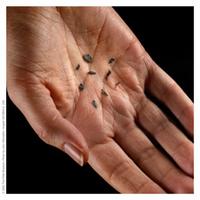
Nine tiny fossil leaves of conifers and extinct seed ferns from Båga Formation, Denmark, used to reconstruct the carbon dioxide levels in the atmosphere about 183 million years ago. The fossil leaves, which were extracted from rock by washing the rocks in acids, are more resistant than rock to acid.
Photo by John Weinstein; courtesy of The Field MuseumStudying climate change is incredibly complex, yet retracing climate change and the causes behind those changes is the only way to understand the effects of burning massive amounts of fossil fuels today.
Over the course of geological time, the amount of carbon trapped in land and the oceans has waxed and waned. So has the amount of carbon dioxide in the atmosphere. These fluctuations correlate closely with changes in global temperatures. Therefore, studying the flow of carbon between land, water and atmosphere through geological ages can shed light on issues surrounding today's global warming.
New research described in the May 26 issue of Nature provides some missing pieces in the puzzle depicting the global carbon cycle over geological time. During what geologists call "oceanic anoxic events," it has long been suggested that a large amount of the greenhouse gas carbon dioxide is removed from the atmosphere by millions of microscopic organisms that dwell in the oceans. They do this by trapping carbon in their bodies. When they die, their bodies rain down to the ocean depths and are buried by sediment, locking away the trapped carbon from the atmosphere for million of years.
| Full story | 0 Comments | 6676 views |
| Molecular & Cell Biology | May 26, 2005 06:55 PM |
Researchers from the National Institutes of Health have discovered the critical sequence of events by which insulin stimulates the entry of glucose into fat cells.
The study, appearing in the May 9 Journal of Cell Biology, was conducted by researchers from the National Institute of Child Health and Human Development and the National Institute of Diabetes and Digestive and Kidney Diseases.
| Full story | 0 Comments | 7513 views |
It's a cloudless July afternoon in Etosha National Park in northern Namibia, and ecologist Caitlin O'Connell-Rodwell is scanning the horizon for elephants. "It's so fantastic here," she says. "We're constantly seeing elephants, rhinos, zebras, ostriches--it's the Garden of Eden."
A research associate in the Stanford University School of Medicine, O'Connell-Rodwell has come to one of Africa's premiere wildlife sanctuaries to explore the mysterious and complex world of elephant communication. She and her colleagues are part of a scientific revolution that began nearly two decades ago with the stunning revelation that elephants communicate over long distances using low-pitched sounds that are barely audible to humans.
| Full story | 0 Comments | 5707 views |
| Microbiology | May 26, 2005 06:51 PM |
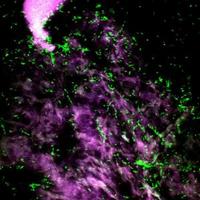
Microscopic fluorescent green Campylobacter cells on chicken skin. (Photo by Anna Bates)Reducing the pathogenic bacterium Campylobacter on poultry farms and in processing plants begins with finding its sources, one of which is the birds' lungs, Agricultural Research Service (ARS) scientists report.
Microbiologists Mark Berrang and Richard Meinersmann and animal physiologist Richard J. Buhr at the ARS Richard B. Russell Agricultural Research Center in Athens, Ga., studied Campylobacter before and after chicken carcasses were scalded to remove feathers, an integral step in poultry processing.
| Full story | 0 Comments | 6113 views |
| Biotechnology | May 26, 2005 06:50 PM |
The risk of receiving blood contaminated with variant Creutzfeldt-Jakob (vCJD) prions may no longer be a concern for the thousands of people who require a transfusion. Pall Corporation (NYSE: PLL) announced today the Council of Europe (CE) marking of its Leukotrap® Affinity Prion Reduction Filter System. It is the first and only technology that removes infectious prions that may be the causative agent of vCJD from red cells, the most commonly transfused blood component. Variant CJD, a fatal neurodegenerative disease, is the human form of Bovine Spongiform Encephalopathy (BSE), also known as Mad Cow Disease. The CE mark means the new prion reduction filter meets pan-European essential requirements for safety of medical devices.
| Full story | 0 Comments | 7596 views |
| Biology | May 26, 2005 06:49 PM |
What does it take to fathom a proverb – catch the figurative meaning of "an apple doesn't fall far from the tree"?
According to research led by V. S. Ramachandran, director of the Center for Brain and Cognition at the University of California, San Diego, a region of the brain known as the angular gyrus is probably at least partly responsible for the human ability to understand metaphor.
| Full story | 0 Comments | 6316 views |

- In some genetic cases of microcephaly, stem cells fail to launch
- Yale team discovers how Zika virus causes fetal brain damage
- Scientists uncover the way a common cell enzyme alerts the body to invading bacteria
- Arctic gives clues on worst mass extinction of life
- Calcium channel blockers caught in the act at atomic level
Search Bio News Net
Free Biology Newsletter
- Flexibility That A.C.A. Lent to Work Force Is Threatened by...International Herald Tribune
- Bacteria Behind Legionnaires’ Disease Found at New York Police StationInternational Herald Tribune
- Prescription Price Crisis? 28 Million Americans See Spike in Drug...MSNBC.com: Health
- Seizing on Opioid Crisis, a Drug Maker Lobbies Hard for...International Herald Tribune
- Republicans are taking a big political risk on health careAP Health News
- Why We're So Divided Over Saving WolvesNational Geographic News