


Northwestern Medicine scientists have identified a component of the herpesvirus that "hijacks" machinery inside human cells, allowing the virus to rapidly and successfully invade the nervous system upon initial exposure.

| Bioinformatics | March 28, 2013 07:11 PM |
The genome of the western painted turtle (Chrysemys picta bellii) one of the most widespread, abundant and well-studied turtles in the world, is published this week in Genome Biology. The data show that, like turtles themselves, the rate of genome evolution is extremely slow; turtle genomes evolve at a rate that is about a third that of the human genome and a fifth that of the python, the fastest lineage analyzed.
| Full story | 0 Comments | 7614 views |

| AIDS & HIV | March 28, 2013 07:11 PM |
Human cells have an intrinsic capacity to destroy HIV. However, the virus has evolved to contain a gene that blocks this ability. When this gene is removed from the virus, the innate human immune system destroys HIV by mutating it to the point where it can no longer survive.
| Full story | 0 Comments | 9449 views |

| Health & Medicine | March 28, 2013 07:11 PM |
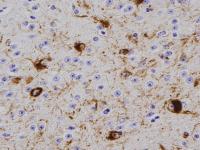
This shows lewy bodies. Brown spots are immunostaining using an antibody specifically recognizing an abnormal form of alpha-synuclein. Clumps of α-synuclein protein in nerve cells are hallmarks of many degenerative brain diseases, most notably Parkinson's disease.
| Full story | 0 Comments | 8728 views |
| Bioinformatics | March 25, 2013 05:51 PM |
In a collaborative study published online in Nature Genetics, researchers from Cardiff University, BGI, International Wildlife Consultants, Ltd., and Abu Dhabi Falcon Hospital, have completed the genome sequencing and analysis of two iconic falcons, the peregrine (Falco peregrinus) and saker (Falco cherrug). The work provides an invaluable resource for the deep understanding of the adaptive evolution in raptors and the genetic basis of their wide distribution.
| Full story | 0 Comments | 8342 views |
| Health & Medicine | March 25, 2013 05:51 PM |
About 1 in 4 deaths in the United States are due to cancer, but primary tumors are rarely fatal. Instead, it's when tumors metastasize that cancer becomes so deadly. To help patients and physicians make treatment decisions, teams of researchers have been working on various methods to detect cancer's spread – via the bloodstream – before secondary tumors develop. Now, one team reports a nearly perfect method for separating breast cancer cells from blood. They describe their proof-of-concept device in a paper accepted for publication in Biomicrofluidics, a journal of the American Institute of Physics.
| Full story | 0 Comments | 9661 views |

| Biology | March 21, 2013 08:05 PM |
System-wide networks of proteins are indispensable for organisms. Function and evolution of these networks are among the most fascinating research questions in biology. Bioinformatician Thomas Rattei, University of Vienna, and physicist Hernan Makse, City University New York (CUNY), have reconstructed ancestral protein networks. The results are of high interest not only for evolutionary research but also for the interpretation of genome sequence data. Recently, the researchers published their paper in the renowned journal PLOS ONE.
| Full story | 0 Comments | 7660 views |
The discovery of the Rosetta Stone resolved a longstanding puzzle, permitting the translation of Egyptian hieroglyphs into Ancient Greek.
| Full story | 0 Comments | 8652 views |
| Biology | March 19, 2013 05:56 PM |
Teamwork has been fundamental in humanity's greatest achievements but scientists have found that working together has its evolutionary roots in our nearest primate relatives – chimpanzees.
| Full story | 0 Comments | 14873 views |
| Biology | March 15, 2013 06:26 AM |
A University of Florida researcher has described a new genus and species of extinct saber-toothed cat from Polk County, Fla., based on additional fossil acquisitions of the animal over the last 25 years.
| Full story | 0 Comments | 10607 views |

| Biotechnology | March 15, 2013 06:26 AM |
Collaborators from Mayo-Illinois Alliance for Technology Based Healthcare have developed a new, single molecule test for detecting methylated DNA. Methylation -- the addition of a methyl group of molecules to a DNA strand -- is one of the ways gene expression is regulated. The findings appear in the current issue of Scientific Reports (Nature Publishing Group).
| Full story | 0 Comments | 7919 views |
| Bioinformatics | March 12, 2013 07:47 PM |
HeLa cells are the world's most commonly used human cell lines, and have served as a standard for understanding many fundamental biological processes. In a study published today in G3: Genes, Genomes and Genetics online, scientists at the European Molecular Biology Laboratory in Heidelberg, announce they have successfully sequenced the genome of a HeLa cell line. It provides a high-resolution genomic reference that reveals the striking differences between the HeLa genome and that of normal human cells. The study could improve the way HeLa cells are used to model human biology.
| Full story | 0 Comments | 9244 views |
Despite many remarkable discoveries in the field of neuroscience during the past several decades, researchers have not been able to fully crack the brain's "neural code." The neural code details how the brain's roughly 100 billion neurons turn raw sensory inputs into information we can use to see, hear and feel things in our environment.
| Full story | 0 Comments | 6296 views |
| Biotechnology | March 7, 2013 06:04 PM |
An assistant professor at the University of California, Riverside's Bourns College of Engineering has recently received a $360,000 grant to better organize enzymes on electrodes to create nanoscale devices that more efficiently convert the chemical energy of sugars and complex carbohydrates in to electricity.
| Full story | 0 Comments | 12714 views |

| Environment | March 5, 2013 06:43 PM |

This shows lions in Phinda Private Game Reserve, South Africa.
A new report published today concludes that nearly half of Africa's wild lion populations may decline to near extinction over the next 20-40 years without urgent conservation measures. The plight of many lion populations is so bleak, the report concludes that fencing them in - and fencing humans out - may be their only hope for survival.
| Full story | 0 Comments | 16923 views |

| Molecular & Cell Biology | March 5, 2013 06:43 PM |
Isolation of DNA from some organisms is a routine procedure. For example, you can buy a kit at your local pharmacy or grocery store that allows you to swab the inside of your cheek and send the sample for DNA sequencing. However, for other organisms, DNA extraction is much more problematic. Researchers at Desert Botanical Garden in Phoenix, Arizona, have developed a novel procedure that greatly simplifies genomic DNA isolation from cactus tissue.
| Full story | 0 Comments | 10282 views |
| AIDS & HIV | March 4, 2013 05:07 PM |
A two-year-old child born with HIV infection and treated with antiretroviral drugs beginning in the first days of life no longer has detectable levels of virus using conventional testing despite not taking HIV medication for 10 months, according to findings presented today at the Conference on Retroviruses and Opportunistic Infections (CROI) in Atlanta.
| Full story | 0 Comments | 12190 views |
| Biology | March 3, 2013 02:42 PM |
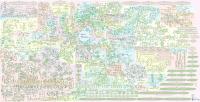
An international consortium of university researchers has produced the most comprehensive virtual reconstruction of human metabolism to date. Building on earlier pioneering work by researchers at the University of California, San Diego, an international consortium of university researchers has produced the most comprehensive virtual reconstruction of human metabolism to date. Scientists could use the model, known as Recon 2, to identify causes of and new treatments for diseases like cancer, diabetes and even psychiatric and neurodegenerative disorders. Each person's metabolism, which represents the conversion of food sources into energy and the assembly of molecules, is determined by genetics, environment and nutrition.
| Full story | 0 Comments | 9993 views |
| Health & Medicine | March 3, 2013 02:42 PM |
A shortage of a protein called TDP-43 caused muscle wasting and stunted nerve cells. This finding supports the idea that malfunction of this protein plays a decisive role in ALS and FTD. The study is published in the "Proceedings of the National Academy of Sciences of the USA" (PNAS).
| Full story | 0 Comments | 7887 views |

- In some genetic cases of microcephaly, stem cells fail to launch
- Yale team discovers how Zika virus causes fetal brain damage
- Scientists uncover the way a common cell enzyme alerts the body to invading bacteria
- Arctic gives clues on worst mass extinction of life
- Calcium channel blockers caught in the act at atomic level
Search Bio News Net
Free Biology Newsletter
- Flexibility That A.C.A. Lent to Work Force Is Threatened by...International Herald Tribune
- Bacteria Behind Legionnaires’ Disease Found at New York Police StationInternational Herald Tribune
- Prescription Price Crisis? 28 Million Americans See Spike in Drug...MSNBC.com: Health
- Seizing on Opioid Crisis, a Drug Maker Lobbies Hard for...International Herald Tribune
- Republicans are taking a big political risk on health careAP Health News
- Why We're So Divided Over Saving WolvesNational Geographic News