

Mammalian females ovulate periodically over their reproductive lifetimes, placing significant demands on their ovaries for egg production. Whether mammals generate new eggs in adulthood using stem cells has been a source of scientific controversy. If true, these "germ-line stem cells" might allow novel treatments for infertility and other diseases. However, new research from Carnegie's Lei Lei and Allan Spradling demonstrates that adult mice do not use stem cells to produce new eggs. Their work is published by the Proceedings of the National Academy of Sciences the week of April 29.

| Molecular & Cell Biology | April 29, 2013 06:58 PM |
When a mouse smells a cat, it instinctively avoids the feline or risks becoming dinner. How? A Northwestern University study involving olfactory receptors, which underlie the sense of smell, provides evidence that a single gene is necessary for the behavior.
| Full story | 0 Comments | 9440 views |

| Biology | April 29, 2013 06:58 PM |
Nesting green sea turtles are benefiting from marine protected areas by using habitats found within their boundaries, according to a U.S. Geological Survey study that is the first to track the federally protected turtles in Dry Tortugas National Park.
| Full story | 0 Comments | 9609 views |

| Health & Medicine | April 24, 2013 04:20 PM |
Scientists in Mainz and Aachen have discovered a new mechanism that controls egg cell fertility and that might have future therapeutic potential. It was revealed by Professor Dr. Walter Stöcker of the Institute of Zoology at Johannes Gutenberg University Mainz (JGU) that the blood protein fetuin-B plays an important and previously unknown role in the fertilization of oocytes. Fetuin-B, first identified in the year 2000, is formed in the liver and secreted into the blood stream. During a joint research project with researchers at RWTH Aachen University headed by Professor Dr. Willi Jahnen-Dechent of the Helmholtz Institute for Biomedical Engineering, it was discovered that fetuin-B contributes to egg cell fertility by regulating the hardening of the protective zona pellucida of oocytes. The findings have recently been published in the scientific journal Developmental Cell.
| Full story | 0 Comments | 7741 views |
| Molecular & Cell Biology | April 24, 2013 04:20 PM |
Researcher Johan Jakobsson and his colleagues have now published their results in Nature Communications.
| Full story | 0 Comments | 8505 views |
| Health & Medicine | April 23, 2013 06:17 PM |
Scientists from King's College London have identified patterns of epigenetic changes involved in autism spectrum disorder (ASD) by studying genetically identical twins who differ in autism traits. The study, published in Molecular Psychiatry, is the largest of its kind and may shed light on the biological mechanism by which environmental influences regulate the activity of certain genes and in turn contribute to the development of ASD and related behaviour traits.
| Full story | 0 Comments | 7564 views |
| Molecular & Cell Biology | April 23, 2013 06:17 PM |
For a long time, scientists have dreamt of converting undesirable white fat cells into brown fat cells and thus simply have excess pounds melt away. Researchers at the University of Bonn have now gotten a step closer to this goal: They decoded a "toggle switch" in mice which can significantly stimulate fat burning. The results are now being presented in the scientifc journal "Nature Communications".
| Full story | 0 Comments | 9627 views |
| Molecular & Cell Biology | April 22, 2013 03:56 PM |
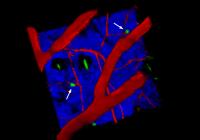
These is a false color image of the skin showing newly discovered immune cells, which have a potential link to allergic skin diseases like eczema. Sydney researchers have discovered a new type of immune cell in skin that plays a role in fighting off parasitic invaders such as ticks, mites, and worms, and could be linked to eczema and allergic skin diseases.
| Full story | 0 Comments | 9965 views |

| Bioinformatics | April 17, 2013 06:18 PM |
An historic fish, with an intriguing past, now has had its genome sequenced, providing a wealth of information on the genetic changes that accompanied the adaptation from an aquatic environment to land. A team of international researchers led by Chris Amemiya, PhD, Director of Molecular Genetics at the Benaroya Research Institute at Virginia Mason (BRI) and Professor of Biology at the University of Washington, will publish "The African coelacanth genome provides insights into tetrapod evolution" April 18 as the cover article in Nature. The coelacanth genome was sequenced by the Genome Center at the Broad Institute of MIT and Harvard, and analyzed by an international consortium of experts.
| Full story | 0 Comments | 8660 views |
| Health & Medicine | April 17, 2013 06:18 PM |
Atherosclerosis – sometimes called "hardening of the arteries" – is a leading cause of death and morbidity in Western countries. A cell-permeable peptide containing the NF-ĸB nuclear localization sequence (NLS) shows promise as a potential agent in controlling the development of atherosclerotic disease. This study is published in the May 2013 issue of The American Journal of Pathology.
| Full story | 0 Comments | 7105 views |
| Molecular & Cell Biology | April 15, 2013 07:22 PM |
Researchers at the Stanford University School of Medicine have succeeded in transforming skin cells directly into oligodendrocyte precursor cells, the cells that wrap nerve cells in the insulating myelin sheaths that help nerve signals propagate.
| Full story | 0 Comments | 8687 views |
| Health & Medicine | April 15, 2013 07:22 PM |
A review of published research has found no evidence that drugs, herbal products or vitamin supplements help prevent cognitive decline in healthy older adults.
| Full story | 0 Comments | 8539 views |
| Biology | April 11, 2013 02:04 PM |
The sensation of having a physical body is not as self-evident as one might think. Almost everyone who has had an arm or leg amputated experiences a phantom limb: a vivid sensation that the missing limb is still present. A new study by neuroscientists at the Karolinska Institutet in Sweden shows that it is possible to evoke the illusion of having a phantom hand in non-amputated individuals.
| Full story | 0 Comments | 10241 views |

| Biotechnology | April 11, 2013 02:04 PM |
In a classic case of turning an enemy into a friend, scientists have engineered a protein from flesh-eating bacteria to act as a molecular "superglue" that promises to become a disease fighter. And their latest results, which make the technology more versatile, were the topic of a report here today at the 245th National Meeting & Exposition of the American Chemical Society, the world's largest scientific society.
| Full story | 0 Comments | 10273 views |
| Biology | April 11, 2013 02:04 PM |
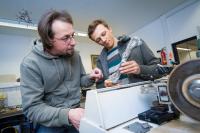
In the laboratory are Dr. Koen Stein (right) and Olaf Dülfer, University of Bonn from the Steinmann-Institute. An international team of researchers, including a paleontologist from the University of Bonn, have proven dinosaur embryos to be the oldest ever found. The specimens of Lufengosaurus discovered in China lived during the lower Jurassic about 200 to 190 million years ago. Based on the bone tissue, Dr. Koen Stein was able to show that the fossils must have been in a very early stage of development. The rapid growth and high reproductive rate of these Chinese dinosaurs is astounding. The results are now being presented in the renowned scientific journal "Nature".
| Full story | 0 Comments | 8881 views |
| Biology | April 8, 2013 06:07 PM |
The vocal lip-smacks that geladas use in friendly encounters have surprising similarities to human speech, according to a study reported in the Cell Press journal Current Biology on April 8th. The geladas, which live only in the remote mountains of Ethiopia, are the only nonhuman primate known to communicate with such a speech-like, undulating rhythm. Calls of other monkeys and apes are typically one or two syllables and lack those rapid fluctuations in pitch and volume.
| Full story | 0 Comments | 9877 views |
| Molecular & Cell Biology | April 8, 2013 06:07 PM |
Researchers at Lund University in Sweden have discovered a new protein that controls the presence of the Vel blood group antigen on our red blood cells. The discovery makes it possible to use simple DNA testing to find blood donors for patients who lack the Vel antigen and need a blood transfusion.
| Full story | 0 Comments | 9256 views |
| Biology | April 4, 2013 07:40 PM |
Researchers at the University of Leeds may have solved a key puzzle about how objects from space could have kindled life on Earth.
| Full story | 0 Comments | 10050 views |

| AIDS & HIV | April 4, 2013 07:40 PM |
Observing the evolution of a particular type of antibody in an infected HIV-1 patient, a study spearheaded by Duke University, including analysis from Los Alamos National Laboratory, has provided insights that will enable vaccination strategies that mimic the actual antibody development within the body.
| Full story | 0 Comments | 9086 views |

| Stem Cell Research | April 2, 2013 05:23 PM |
Preparations are underway for the first known human trial to use embryonic-like stem cells collected from adult cells to grow bone.
| Full story | 0 Comments | 10962 views |
| Biology | April 2, 2013 05:23 PM |
Glowing bacteria inside squids use light and chemical signals to control circadian-like rhythms in the animals, according to a study to be published on April 2 in mBio®, the online open-access journal of the American Society for Microbiology. The Hawaiian bobtail squid, Euprymna scolopes, houses a colony of Vibrio fischeri bacteria in its light organ, using the bacteria at night as an antipredatory camouflage while it ventures out to hunt. The results of the study show that, in addition to acting as a built-in lamp, the bacteria also control when the squid expresses a gene that entrains, or synchronizes, circadian rhythms in animals.
| Full story | 0 Comments | 7684 views |

- In some genetic cases of microcephaly, stem cells fail to launch
- Yale team discovers how Zika virus causes fetal brain damage
- Scientists uncover the way a common cell enzyme alerts the body to invading bacteria
- Arctic gives clues on worst mass extinction of life
- Calcium channel blockers caught in the act at atomic level
Search Bio News Net
Free Biology Newsletter
- Flexibility That A.C.A. Lent to Work Force Is Threatened by...International Herald Tribune
- Bacteria Behind Legionnaires’ Disease Found at New York Police StationInternational Herald Tribune
- Prescription Price Crisis? 28 Million Americans See Spike in Drug...MSNBC.com: Health
- Seizing on Opioid Crisis, a Drug Maker Lobbies Hard for...International Herald Tribune
- Republicans are taking a big political risk on health careAP Health News
- Why We're So Divided Over Saving WolvesNational Geographic News