

New research published online in the FASEB Journal suggests that a specific enzyme, called 5-lipoxygenase, plays a key role in cell death induced by microgravity environments, and that inhibiting this enzyme will likely help prevent or lessen the severity of immune problems in astronauts caused by spaceflight. Additionally, since space conditions initiate health problems that mimic the aging process on Earth, this discovery may also lead to therapeutics that extend lives by bolstering the immune systems of the elderly.

| Molecular & Cell Biology | April 30, 2012 05:12 PM |
University of Iowa biologists have advanced the knowledge of human neurodevelopmental disorders by finding that a lack of a particular group of cell adhesion molecules in the cerebral cortex -- the outermost layer of the brain where language, thought and other higher functions take place -- disrupts the formation of neural circuitry.
| Full story | 0 Comments | 8609 views |
| Molecular & Cell Biology | April 30, 2012 05:12 PM |
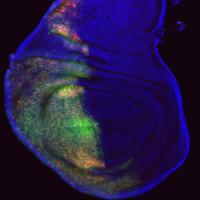
Polycomb repressive complex 2 (PRC2) was originally discovered in fruit flies as a transcriptional repressor. Historically, fly and human Polycomb proteins were considered textbook exemplars of transcriptional repressors, or proteins that silence the process by which DNA gives rise to new proteins. Now, work by a team of researchers at the Stowers Institute for Medical Research challenges that dogma.
| Full story | 0 Comments | 7076 views |

| Health & Medicine | April 27, 2012 03:26 AM |
Boston, MA—Berries are good for you, that's no secret. But can strawberries and blueberries actually keep your brain sharp in old age? A new study by researchers at Brigham and Women's Hospital (BWH) finds that a high intake of flavonoid rich berries, such as strawberries and blueberries, over time, can delay memory decline in older women by 2.5 years. This study is published by Annals of Neurology, a journal of the American Neurological Association and Child Neurology Society, on April 26, 2012.
| Full story | 0 Comments | 12427 views |

| Biotechnology | April 27, 2012 03:26 AM |
A research team at Karolinska Institutet in Sweden has succeeded in describing the structure and function of the outermost layer of the skin – the stratum corneum – at a molecular level. This opens the way not only for the large-scale delivery of drugs via the skin, but also for a deeper understanding of skin diseases.
| Full story | 0 Comments | 9043 views |
| Health & Medicine | April 27, 2012 03:26 AM |
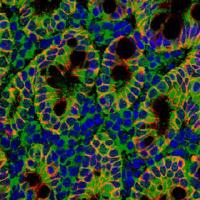
Green indicates the presence of inflammatory messenger substances (chemokines) in the bowel tissue. Yoghurt has been valued for centuries for its health-promoting effects. These effects are thought to be mediated by the lactic acid bacteria typically contained in yoghurt. Evidence from recent scientific studies show that some bacterial strains actually have a probiotic effect and can thus prevent disease. A team of biologists and nutrition scientists working with Prof. Dirk Haller from the Technische Universitaet Muenchen (TUM) has now discovered the mechanisms at work behind this protective effect (Cell Host & Microbe).
| Full story | 0 Comments | 7611 views |

| Biology | April 27, 2012 03:26 AM |
A team led by psychology professor Ian Spence at the University of Toronto reveals that playing an action videogame, even for a relatively short time, causes differences in brain activity and improvements in visual attention.
| Full story | 0 Comments | 12486 views |
| Biology | April 27, 2012 03:26 AM |
They say you can't teach an old dog new tricks. Fortunately, this is not always true. Researchers at the Netherlands Institute for Neuroscience have now discovered how the adult brain can adapt to new situations. The Dutch researchers' findings are published on Wednesday in the prestigious journal Neuron. Their study may be significant in the treatment of neurodevelopmental disorders such as epilepsy, autism and schizophrenia.
| Full story | 0 Comments | 7956 views |
| Biology | April 27, 2012 03:25 AM |
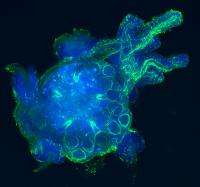
This image shows extensive histamine containing cells in metamorphic all competent sea urchin larvae (Strongylocentrotus purpuratus). Now that hay fever season has started, sufferers are well aware of the effect of histamines. However it is easy to forget that histamine is also a neurotransmitter involved in controlling memories, regulating sleep, and controlling secretion of gastric acid. New research published in BioMed Central's open access journal BMC Developmental Biology shows that for the purple sea urchin (Strongylocentrotus purpuratus) histamine is also responsible for controlling metamorphosis from a free swimming larval form to the spiny adult living on the sea floor.
| Full story | 0 Comments | 8815 views |

| Stem Cell Research | April 25, 2012 04:36 PM |
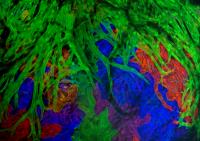
The growth of the zebrafish heart from embryo to adult is tracked using colored cardiac muscle clones, each containing many cellular progeny of a single cardiac muscle cell. Just a handful of cells in the embryo are all that's needed to form the outer layer of pumping heart muscle in an adult zebrafish.
| Full story | 0 Comments | 8910 views |
| Biology | April 25, 2012 04:36 PM |

This is the first know camera trap photo of an Amur leopard in China. The first-known camera trap photos of an Amur leopard in China have recently been taken by protected area staff in Hunchun Amur Tiger National Nature Reserve in Jilin Province according to the Wildlife Conservation Society. Coupled with Jilin Province's recent announcement of a survey estimating 8-11 leopards across that northern province, the photographs suggest that leopards may be returning to China.
| Full story | 0 Comments | 8550 views |
| Health & Medicine | April 25, 2012 04:36 PM |
There are lots of ways to treat a heart attack – CPR, aspirin, clot-busters and more. Now CU medical school researchers have found a new candidate: Intense light.
| Full story | 0 Comments | 8880 views |
| Biotechnology | April 24, 2012 06:45 PM |
Toxic prions in the brain can be detected with self-illuminating polymers. The originators, at Linköping University in Sweden, has now shown that the same molecules can also render the prions harmless, and potentially cure fatal nerve-destroying illnesses.
| Full story | 0 Comments | 10059 views |
| Molecular & Cell Biology | April 24, 2012 06:45 PM |
Once considered unimportant "junk DNA," scientists have learned that non-coding RNA (ncRNA) — RNA molecules that do not translate into proteins — play a crucial role in cellular function. Mutations in ncRNA are associated with a number of conditions, such as cancer, autism, and Alzheimer's disease.
| Full story | 0 Comments | 8972 views |
| Biotechnology | April 23, 2012 06:15 PM |
Researchers from the Georgia Institute of Technology and University of California San Francisco have advanced scientists' ability to view a clear picture of a single cellular structure in motion. By identifying molecules using compressed sensing, this new method provides needed spatial resolution plus a faster temporal resolution than previously possible.
| Full story | 0 Comments | 7148 views |
| Stem Cell Research | April 23, 2012 06:15 PM |
Researchers at Lund University have discovered a new stem cell in the adult brain. These cells can proliferate and form several different cell types - most importantly, they can form new brain cells. Now the researchers hope to put the discovery to use to develop methods that can repair diseases and injury to the brain.
| Full story | 0 Comments | 10816 views |
| Health & Medicine | April 23, 2012 06:15 PM |
Whether surgeons slice with a traditional scalpel or cut away with a surgical laser, most medical operations end up removing some healthy tissue, along with the bad. This means that for delicate areas like the brain, throat, and digestive tract, physicians and patients have to balance the benefits of treatment against possible collateral damage.
| Full story | 0 Comments | 6668 views |
| Health & Medicine | April 23, 2012 06:15 PM |
Obstructive sleep apnea (OSA) is a disorder in which there are recurring episodes of upper airway collapse during sleep with ongoing effort to breathe. OSA is estimated to affect 1 in 5 adults in America. The serious nature of the problem was captured in a landmark study which found that middle-age and older men with even mild levels of OSA were in danger of increased risk of stroke and death. While a link between OSA and stroke is clear, OSA's effect on the cerebral (brain) vessels is not. In an effort to shed light on this relationship, researchers in Texas have developed a novel model that mimics OSA in humans. Their model has found that after just 30 days of OSA exposure cerebral vessel function is altered, which could lead to stroke.
| Full story | 0 Comments | 6064 views |
| Biotechnology | April 23, 2012 06:15 PM |
A team of scientists from Johns Hopkins and elsewhere have developed nano-devices that successfully cross the brain-blood barrier and deliver a drug that tames brain-damaging inflammation in rabbits with cerebral palsy.
| Full story | 0 Comments | 7097 views |
| Biotechnology | April 19, 2012 06:47 PM |
The latest advance in solid-state nanopore sensors – devices that are made with standard tools of the semiconductor industry yet can offer single-molecule sensitivity for label-free protein screening – expands their bag of tricks through bionanotechnology. Researchers at the Technische Universitaet Muenchen have enhanced the capabilities of solid-state nanopores by fitting them with cover plates made of DNA. These nanoscale cover plates, with central apertures tailored to various "gatekeeper" functions, are formed by so-called DNA origami – the art of programming strands of DNA to fold into custom-designed structures with specified chemical properties. The results are published in Angewandte Chemie International Edition.
| Full story | 0 Comments | 7346 views |
| Biotechnology | April 19, 2012 06:47 PM |
Chinese scientists from BGI, the world's largest genomics organization, together with the Institute of Genetics and Developmental Biology, Chinese Academy of Sciences (CAS), and Shihezi University, Xinjiang province, made a significant breakthrough in animal cloning. The world's first transgenic sheep produced with a simplified technique, handmade cloning, was successfully born at 12:16pm, March 26, 2012, in Xinjiang Uygur Autonomous Region, China. The project was also supported by the Animal Science Academy of Xinjiang.
| Full story | 0 Comments | 11097 views |

| Microbiology | April 19, 2012 06:47 PM |
A new study presented today at the International Liver Congress™ 2012 demonstrates that the gut microbiota has a profound systemic effect on bile acid metabolism.(1)
| Full story | 0 Comments | 8806 views |
Living systems owe their existence to a pair of information-carrying molecules: DNA and RNA. These fundamental chemical forms possess two features essential for life: they display heredity—meaning they can encode and pass on genetic information, and they can adapt over time, through processes of Darwinian evolution.
| Full story | 0 Comments | 7802 views |

| Environment | April 18, 2012 04:09 PM |
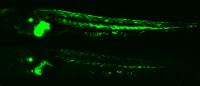
Understanding the damage that pollution causes to both wildlife and human health is set to become much easier thanks to a new green-glowing zebrafish. Understanding the damage that pollution causes to both wildlife and human health is set to become much easier thanks to a new green-glowing zebrafish. Created by a team from the University of Exeter, the fish makes it easier than ever before to see where in the body environmental chemicals act and how they affect health.
| Full story | 0 Comments | 10451 views |
| Molecular & Cell Biology | April 18, 2012 04:09 PM |
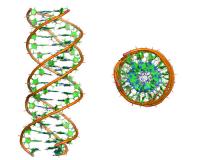
This is a simulation of a triple DNA helix structure side view and viewed from above. A team of researchers at the Institute for Research in Biomedicine (IRB Barcelona) and the Barcelona Supercomputing Center (BSC) have managed for the first time to extract trustworthy structural information from a triple helix DNA in gas phase, that is to say in conditions in which DNA is practically in a vacuum. The study appears today in the Journal of the American Chemical Society (JACS), one of the journals with greatest impact in chemistry.
| Full story | 0 Comments | 9074 views |
| Molecular & Cell Biology | April 18, 2012 04:09 PM |
Scientific insights that expand on the teachings of Mendel, Watson and Crick, and underpinnings of the Human Genome Project are moving drug companies along the path to development of new medicines based on deeper insights into how factors other than the genetic code influence health and disease. That's the topic of the cover story in the current edition of Chemical & Engineering News (C&EN), the weekly newsmagazine of the American Chemical Society (ACS), the world's largest scientific society.
| Full story | 0 Comments | 7478 views |
| Health & Medicine | April 18, 2012 04:09 PM |
An artificial connection between the brain and muscles can restore complex hand movements in monkeys following paralysis, according to a study funded by the National Institutes of Health.
| Full story | 0 Comments | 7343 views |
| Biology | April 18, 2012 04:09 PM |
The longstanding mystery of how selective hearing works – how people can tune in to a single speaker while tuning out their crowded, noisy environs – is solved this week in the journal Nature by two scientists from the University of California, San Francisco (UCSF).
| Full story | 0 Comments | 10242 views |
| Molecular & Cell Biology | April 17, 2012 06:16 PM |
Scientists who developed a technology for identifying and targeting unique protein receptor ZIP Codes on the cellular surface have found a way to penetrate the outer membrane and deliver engineered particles - called iPhage - to organelles inside the cell.
| Full story | 0 Comments | 7073 views |
| Molecular & Cell Biology | April 17, 2012 06:16 PM |
Flowering is the most crucial act that plants undergo, as the fruits of such labor include crops on which the world depends, and seeds from which the next generation grows.
| Full story | 0 Comments | 8319 views |
| Environment | April 16, 2012 06:15 PM |
There are winners and losers among corals under the accumulating impacts of climate change, according to a new scientific study.
| Full story | 0 Comments | 7619 views |
| Biology | April 16, 2012 06:15 PM |
The eggs laid by two African bird species have evolved different color patterns over a period of just 40 years, according to new research published in The American Naturalist. The quick change appears to be driven by an unwanted guest in the nest.
| Full story | 0 Comments | 7178 views |
| Biology | April 16, 2012 06:14 PM |
Shrinkage of the hippocampus occurs with age and is caused by the cumulative effect of various factors. Hippocampal atrophy is a recognized biological marker of Alzheimer's disease, so it is vital that researchers determine the cause of this process.
| Full story | 0 Comments | 7890 views |
| Biotechnology | April 16, 2012 06:14 PM |
Wake Forest Baptist Medical Center researchers seeking a successful treatment for traumatic brain injury have found that the size and extent of damaged tissue can be reduced by using a new device to prevent cell death.
| Full story | 0 Comments | 6163 views |
| Stem Cell Research | April 12, 2012 03:50 PM |
What happens to a stem cell at the molecular level that causes it to become one type of cell rather than another? At what point is it committed to that cell fate, and how does it become committed? The answers to these questions have been largely unknown. But now, in studies that mark a major step forward in our understanding of stem cells' fates, a team of researchers from the California Institute of Technology (Caltech) has traced the stepwise developmental process that ensures certain stem cells will become T cells—cells of the immune system that help destroy invading pathogens.
| Full story | 0 Comments | 8138 views |
| Biology | April 12, 2012 03:50 PM |
Abandoned army bunkers along the Jordan River have become a habitat for 12 indigenous bat species, three of which are already designated as endangered and two that are on the critical list. The bats were recently identified by a group of Tel Aviv University researchers who were granted access to the bunkers, spread out along a 60-mile-long stretch of land between the Sea of Galilee in the north of Israel to the Dead Sea's northern edge.
| Full story | 0 Comments | 7740 views |
| Health & Medicine | April 12, 2012 03:50 PM |
A team of researchers at Case Western Reserve University School of Medicine have identified a new mechanism by which colon cancer develops. By focusing on segments of DNA located between genes, or so-called "junk DNA," the team has discovered a set of master switches, i.e., gene enhancer elements, that turn "on and off" key genes whose altered expression is defining for colon cancers. They have coined the term Variant Enhancer Loci or "VELs," to describe these master switches.
| Full story | 0 Comments | 7444 views |
| Biotechnology | April 11, 2012 04:46 PM |
Ainhoa Lejardi, a materials engineer at the University of the Basque Country (UPV/EHU), has taken a step forward in the development of new polymer materials. Biomaterials are being increasingly used in medicine and need to have a great variety of properties so that they can be used in all types of therapeutic applications. A task into which this researcher has put much effort, because she has opened up a door to the possibility of creating new materials from the PVA polymer and modifying its properties in order to come up with more applications for biomedicine. Her thesis is entitled Polimero biodegradakor berrien lorpena eta ezaugarritzea (Obtaining and characterising of new biodegradable polymers). She has also had articles published on this in the Polymer and Macromolecules journals, among others.
| Full story | 0 Comments | 6604 views |

| Bioinformatics | April 11, 2012 04:46 PM |
Chromosomes are strands of DNA that contain the blueprint of all living organisms. Humans have 23 pairs of chromosomes that instruct how genes are regulated during development of the human body. While scientists have developed an understanding of the one-dimensional structure of DNA, until today, little was known about how different parts of DNA are folded next to each other inside the nucleus.
| Full story | 0 Comments | 9199 views |
| Biology | April 11, 2012 04:46 PM |
The theory that pigeons' famous skill at navigation is down to iron-rich nerve cells in their beaks has been disproved by a new study published in Nature.
| Full story | 0 Comments | 7771 views |

- In some genetic cases of microcephaly, stem cells fail to launch
- Yale team discovers how Zika virus causes fetal brain damage
- Scientists uncover the way a common cell enzyme alerts the body to invading bacteria
- Arctic gives clues on worst mass extinction of life
- Calcium channel blockers caught in the act at atomic level
Search Bio News Net
Free Biology Newsletter
- Flexibility That A.C.A. Lent to Work Force Is Threatened by...International Herald Tribune
- Bacteria Behind Legionnaires’ Disease Found at New York Police StationInternational Herald Tribune
- Prescription Price Crisis? 28 Million Americans See Spike in Drug...MSNBC.com: Health
- Seizing on Opioid Crisis, a Drug Maker Lobbies Hard for...International Herald Tribune
- Republicans are taking a big political risk on health careAP Health News
- Why We're So Divided Over Saving WolvesNational Geographic News