

Our ability to "read" DNA has made tremendous progress in the past few decades, but the ability to understand and alter the genetic code, that is, to "rewrite" the DNA-encoded instructions, has lagged behind. A new Weizmann Institute study advances our understanding of the genetic code: It proposes a way of effectively introducing numerous carefully planned DNA segments into genomes of living cells and of testing the effects of these changes. The study is being reported in the June issues of Nature Biotechnology and Nature Genetics.

| Health & Medicine | May 31, 2012 06:35 PM |
Scientists at Aarhus University, Denmark in collaboration with the biotech company Cytoguide now publish a key to use glucocorticoid steroids in a kind of intelligent medicine that specifically hits the relevant cells. Data are based on rodent studies but if this principle is translated to humans it may greatly improve todays hazardous treatment with this type of potent steroids.
| Full story | 0 Comments | 7818 views |

| Molecular & Cell Biology | May 31, 2012 06:35 PM |
Researchers at Dana-Farber/Children's Hospital Cancer Center have devised a strategy to directly activate a natural "death" protein, triggering the self-destruction of cells. They say the development could represent a new paradigm for designing cancer drugs.
| Full story | 0 Comments | 7099 views |

| AIDS & HIV | May 30, 2012 05:23 AM |
Scientists have identified a new HIV-suppressing protein in the blood of people infected with the virus. In laboratory studies, the protein, called CXCL4 or PF-4, binds to HIV such that it cannot attach to or enter a human cell. The research was led by Paolo Lusso, M.D., Ph.D., chief of the Section of Viral Pathogenesis in the Laboratory of Immunoregulation at the National Institute of Allergy and Infectious Diseases (NIAID), part of NIH.
| Full story | 0 Comments | 9206 views |

| Biology | May 30, 2012 05:23 AM |
The tuatara, an iconic New Zealand reptile, chews its food in a way unlike any other animal on the planet – challenging the widespread perception that complex chewing ability is closely linked to high metabolism.
| Full story | 0 Comments | 8209 views |
| Biology | May 30, 2012 05:23 AM |
They're tiny creatures with glossy, chocolate-brown hair, out-sized ears and wings. They gobble mosquitoes and other insect pests during the summer and hibernate in caves and mines when the weather turns cold. They are little brown bats, and a deadly disease called white-nose syndrome is threatening their very existence.
| Full story | 0 Comments | 6950 views |

| Biotechnology | May 28, 2012 06:31 PM |
The transfusion of red blood cells (RBC) is a critical component in the treatment of a number of acute and chronic medical problems. Indeed, approximately 75 million units of whole blood (~34 million liters) are annually collected worldwide for processing and eventual transfusion. Despite this massive collection effort, the need for blood constantly exceeds availability due to a combination of collection, manufacturing, storage and biological (i.e., immunological) issues. The immunological issues can often be the most clinically vexing as the RBC has ~300 blood group antigens that could potentially result in alloimmunization and, in rare cases, prevent life saving transfusions. Currently, there are limited options to either prevent blood group alloimmunization or to cost-effectively treat patients with severe alloimmunization.
| Full story | 0 Comments | 7009 views |
| Biology | May 28, 2012 06:31 PM |
It took some 10 million years for Earth to recover from the greatest mass extinction of all time, latest research has revealed.
| Full story | 0 Comments | 9800 views |
| Biotechnology | May 28, 2012 06:31 PM |
An international research team has manufactured a new protein that can combat deadly flu epidemics.
| Full story | 0 Comments | 8307 views |
| Molecular & Cell Biology | May 24, 2012 06:57 PM |
Quantum physics and plant biology seem like two branches of science that could not be more different, but surprisingly they may in fact be intimately tied.
| Full story | 0 Comments | 7804 views |
| Biology | May 24, 2012 06:57 PM |
Marine scientists studying life around deep-sea vents have discovered that some hardy species can survive the extreme change in pressure that occurs when a research submersible rises to the surface. The team's findings, published in Conservation Biology, reveal how a species can be inadvertently carried by submersibles to new areas, with potentially damaging effects on marine ecosystems.
| Full story | 0 Comments | 8526 views |

| Stem Cell Research | May 24, 2012 06:57 PM |
Stem cells are essential building blocks for all organisms, from plants to humans. They can divide and renew themselves throughout life, differentiating into the specialized tissues needed during development, as well as cells necessary to repair adult tissue.
| Full story | 0 Comments | 9163 views |
| Biology | May 24, 2012 06:57 PM |
A hundred years ago wild elephants on the Malay Peninsular could be counted in their thousands — now there are less than 1500. Over the last century around 50 per cent of forest cover in Peninsular Malaysia has been lost.
| Full story | 0 Comments | 7807 views |
| Biotechnology | May 23, 2012 07:51 PM |
The latest episode in the American Chemical Society's (ACS') award-winning Global Challenges/Chemistry Solutions podcast series describes a simple, inexpensive dip-and-dry treatment can convert ordinary silk into a fabric that kills disease-causing bacteria — even the armor-coated spores of microbes like anthrax — in minutes.
| Full story | 0 Comments | 7589 views |
| Molecular & Cell Biology | May 23, 2012 07:51 PM |
Researchers have shown in mice how immune cells in the brain target and remove unused connections between brain cells during normal development. This research, supported by the National Institutes of Health, sheds light on how brain activity influences brain development, and highlights the newly found importance of the immune system in how the brain is wired, as well as how the brain forms new connections throughout life in response to change.
| Full story | 0 Comments | 6278 views |
| Stem Cell Research | May 23, 2012 07:51 PM |
University of Michigan researchers have proven that a special surface, free of biological contaminants, allows adult-derived stem cells to thrive and transform into multiple cell types. Their success brings stem cell therapies another step closer.
| Full story | 0 Comments | 7476 views |

| Environment | May 23, 2012 07:51 PM |
Climate variability associated with El Niño was associated with higher mortality for eggs and hatchlings of the critically endangered leatherback turtle, an effect that could be worsened by continuing global climate change, according to research published May 23 in the open access journal PLoS ONE.
| Full story | 0 Comments | 6616 views |

| Microbiology | May 22, 2012 05:06 PM |
Researchers have uncovered what makes one particular strain of methicillin-resistant Staphylococcus aureus (MRSA) so proficient at picking up resistance genes, such as the one that makes it resistant to vancomycin, the last line of defense for hospital-acquired infections. They report their findings in mBio®, the online open-access journal of the American Society for Microbiology, on Tuesday May 22.
| Full story | 0 Comments | 9036 views |
| Health & Medicine | May 22, 2012 05:06 PM |

Associate Professor Daniel Janies, Ph.D., an expert in computational genomics at the Wexner Medical Center at The Ohio State University, is working with software engineers at the Ohio Supercomputer Center A biomedical informatics researcher who tracks dangerous viruses as they spread around the globe has restructured his innovative tracking software to promote even wider use of the program around the world.
| Full story | 0 Comments | 6790 views |
| Biotechnology | May 22, 2012 05:06 PM |
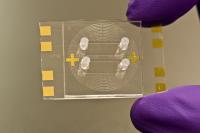
This microfluidic chip invented at UC Davis uses DNA, coated on the gold spots, to test for gamma interferon -- a test for latent TB infection. Biomedical engineers at UC Davis have developed a microfluidic chip to test for latent tuberculosis. They hope the test will be cheaper, faster and more reliable than current testing for the disease.
| Full story | 0 Comments | 6812 views |
| Health & Medicine | May 21, 2012 04:57 PM |
A new multi-university study reports that differences in bacterial colonization of the infant gut in formula-fed and breast-fed babies lead to changes in the expression of genes involved in the infant's immune system.
| Full story | 0 Comments | 7676 views |
| Microbiology | May 21, 2012 04:57 PM |
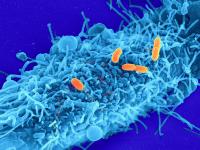
This image shows bacterial infection of host cells: Pathogens of the type Salmonella typhimurium (orange) establish contact to a human host cell (blue). The plague, bacterial dysentery, and cholera have one thing in common: These dangerous diseases are caused by bacteria which infect their host using a sophisticated injection apparatus. Through needle-like structures, they release molecular agents into their host cell, thereby evading the immune response. Researchers at the Max Planck Institute for Biophysical Chemistry in Göttingen in cooperation with colleagues at the Max Planck Institute for Infection Biology in Berlin and the University of Washington in Seattle (USA) have now elucidated the structure of such a needle at atomic resolution. Their findings might contribute to drug tailoring and the development of strategies which specifically prevent the infection process.
| Full story | 0 Comments | 7567 views |
| Biology | May 17, 2012 07:20 PM |
Next Mother's Day, say it with an evolved model of logistical efficiency — a flower. A new discovery about how nature's icons of romance manage the distribution of sperm among female gametes with industrial precision helps explain why the delicate beauties have reproduced prolifically enough to dominate the earth.
| Full story | 0 Comments | 8778 views |
| Molecular & Cell Biology | May 17, 2012 07:19 PM |
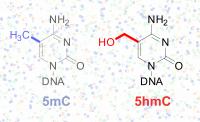
This image shows the differences in chemical structure of the
5-methylcytosine (5mC) base (left) from the 5-hydroxymethylcytosine
(5hmC) base in DNA against a background of DNA sequencing imagery. Imagine reading an entire book, but then realizing that your glasses did not allow you to distinguish "g" from "q." What details did you miss?
| Full story | 0 Comments | 8619 views |
| Biology | May 17, 2012 07:19 PM |
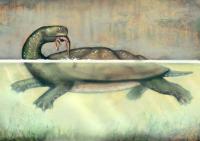
This is a reconstruction of Carbonemys preying upon a small crocodylomorph. Picture a turtle the size of a Smart car, with a shell large enough to double as a kiddie pool. Paleontologists from North Carolina State University have found just such a specimen – the fossilized remains of a 60-million-year-old South American giant that lived in what is now Colombia.
| Full story | 0 Comments | 11000 views |
One-letter switches in the DNA code occur much more frequently in human genomes than anticipated, but are often only found in one or a few individuals.
| Full story | 0 Comments | 11096 views |
| Biology | May 15, 2012 09:27 PM |
Researchers at the University of California, Santa Cruz, who pioneered the use of satellite tags to monitor the migrations of elephant seals have compiled one of the largest datasets available for any marine mammal species, revealing their movements and diving behavior at sea in unprecedented detail.
| Full story | 0 Comments | 7736 views |
| Biology | May 14, 2012 06:37 PM |
A male robin will be more diligent in caring for its young if the eggs its mate lays are a brighter shade of blue.
| Full story | 0 Comments | 11477 views |
| Health & Medicine | May 14, 2012 06:37 PM |
A study has identified microRNA-3151 as a new independent prognostic marker in certain patients with acute leukemia. The study involves patients with acute myeloid leukemia and normal-looking chromosomes (CN-AML).
| Full story | 0 Comments | 7138 views |
| Biotechnology | May 10, 2012 04:41 PM |
Imagine being able to control genetic expression by flipping a light switch. Researchers at North Carolina State University are using light-activated molecules to turn gene expression on and off. Their method enables greater precision when studying gene function, and could lead to targeted therapies for diseases like cancer.
| Full story | 0 Comments | 9593 views |
| Biology | May 10, 2012 04:41 PM |
A research team involving Yale University and the University of Colorado Boulder has developed a first public demonstration version of its "Map of Life," an ambitious Web-based endeavor designed to show the distribution of all living plants and animals on the planet.
| Full story | 0 Comments | 8189 views |
| Molecular & Cell Biology | May 9, 2012 03:57 PM |

Colored patches represent parallelogram outlines around pairs of triangles that have formed chiral super-structures. Parallelograms having different "handedness " and orientations are color-coded and superimposed over each other. The overwhelming majority of proteins and other functional molecules in our bodies display a striking molecular characteristic: They can exist in two distinct forms that are mirror images of each other, like your right hand and left hand. Surprisingly, each of our bodies prefers only one of these molecular forms.
| Full story | 0 Comments | 9551 views |
| Molecular & Cell Biology | May 9, 2012 03:57 PM |
Scientists from Queen Mary, University of London have found a new therapeutic target to combat inflammation.
| Full story | 0 Comments | 7491 views |
| Environment | May 9, 2012 03:57 PM |
Scientists at the University of Liverpool have found that genetic information on the Antarctic octopus supports studies indicating that the West Antarctic Ice Sheet could have collapsed during its history, possibly as recently as 200,000 years ago.
| Full story | 0 Comments | 7555 views |
| Biology | May 9, 2012 03:56 PM |
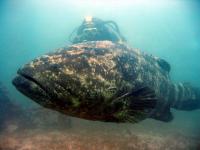
The critically endangered Atlantic goliath grouper, Epinephelus itajara, is from the subtropical and tropical Atlantic. Groupers, a family of fishes often found in coral reefs and prized for their quality of flesh, are facing critical threats to their survival. As part of the International Union for Conservation of Nature (IUCN) Species Survival Commission, a team of scientists has spent the past ten years assessing the status of 163 grouper species worldwide. They report that 20 species (12%) are at risk of extinction if current overfishing trends continue, and an additional 22 species (13%) are Near Threatened. These findings were published online on April 28 in the journal Fish and Fisheries.
| Full story | 0 Comments | 8858 views |
| Biology | May 8, 2012 05:29 PM |
Researchers at Auburn University have reported the discovery a new trapdoor spider species from a well-developed housing subdivision in the heart of the city of Auburn, Alabama. Myrmekiaphila tigris, affectionately referred to as the Auburn Tiger Trapdoor spider, is named in honor of Auburn University's costumed Tiger mascot, Aubie.
| Full story | 0 Comments | 10671 views |
| Health & Medicine | May 8, 2012 05:29 PM |
University of British Columbia researchers have found a potential way to develop universal flu vaccines and eliminate the need for seasonal flu vaccinations.
| Full story | 0 Comments | 8321 views |
| Biology | May 7, 2012 04:46 PM |
New research indicates that domestic horses originated in the steppes of modern-day Ukraine, southwest Russia and west Kazakhstan, mixing with local wild stocks as they spread throughout Europe and Asia. The research was published today, 07 May, in the journal PNAS.
| Full story | 0 Comments | 9812 views |
| Health & Medicine | May 7, 2012 04:46 PM |
A new study finds that fetal exposure to the plastic additive bisphenol A, or BPA, alters mammary gland development in primates. The finding adds to the evidence that the chemical can be causing health problems in humans and bolsters concerns about it contributing to breast cancer.
| Full story | 0 Comments | 6474 views |
| Health & Medicine | May 7, 2012 04:46 PM |
Antipsychotic medications are increasingly prescribed in the US, but they can cause serious side effects including rapid weight gain, especially in children. In the first study of its kind, researchers at Zucker Hillside Hospital and the Feinstein Institute for Medical Research identified a gene that increases weight gain in those treated with commonly-used antipsychotic drugs. These findings were published in the May issue of Archives of General Psychiatry.
| Full story | 0 Comments | 7243 views |

- In some genetic cases of microcephaly, stem cells fail to launch
- Yale team discovers how Zika virus causes fetal brain damage
- Scientists uncover the way a common cell enzyme alerts the body to invading bacteria
- Arctic gives clues on worst mass extinction of life
- Calcium channel blockers caught in the act at atomic level
Search Bio News Net
Free Biology Newsletter
- Flexibility That A.C.A. Lent to Work Force Is Threatened by...International Herald Tribune
- Bacteria Behind Legionnaires’ Disease Found at New York Police StationInternational Herald Tribune
- Prescription Price Crisis? 28 Million Americans See Spike in Drug...MSNBC.com: Health
- Seizing on Opioid Crisis, a Drug Maker Lobbies Hard for...International Herald Tribune
- Republicans are taking a big political risk on health careAP Health News
- Why We're So Divided Over Saving WolvesNational Geographic News