

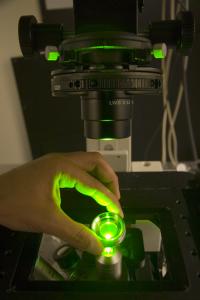
DNA microarrays can be easily interrogated with only the naked eye using a new electrostatic imaging technique developed in the laboratory of Jay Groves, a chemist with Berkeley Lab, UC Berkeley and HHMI. Credit: Photo Michael Barnes, UC Berkeley Chemistry Department The dream of personalized medicine — in which diagnostics, risk predictions and treatment decisions are based on a patient's genetic profile — may be on the verge of being expanded beyond the wealthiest of nations with state-of-the-art clinics. A team of researchers with the U.S. Department of Energy's Lawrence Berkeley National Laboratory (Berkeley Lab) has invented a technique in which DNA or RNA assays — the key to genetic profiling and disease detection — can be read and evaluated without the need of elaborate chemical labeling or sophisticated instrumentation. Based on electrostatic repulsion — in which objects with the same electrical charge repel one another — the technique is relatively simple and inexpensive to implement, and can be carried out in a matter of minutes.

| Microarray | June 30, 2008 05:56 PM |
| Full story | 0 Comments | 11976 views |

| Molecular & Cell Biology | June 30, 2008 05:56 PM |
Eleven years ago, Dr. Mary Estes of Baylor College of Medicine and her colleagues discovered the first viral enterotoxin, rotavirus NSP4, a toxic protein that affects the intestines, causing diarrhea.
| Full story | 0 Comments | 6359 views |
| Molecular & Cell Biology | June 30, 2008 05:56 PM |
Scientists in Sydney have identified a process, a synergistic encounter between two molecules, that may account for the extreme allergic reactions some people experience. By silencing at least one of these molecules, it may be possible to treat allergies.
| Full story | 0 Comments | 6025 views |

| AIDS & HIV | June 30, 2008 05:56 PM |
The widespread use of highly active antiretroviral therapy may reduce the incidence of HIV in individuals and populations but has been overlooked by public health as a prevention strategy, write Dr. Julio Montaner and colleagues in CMAJ.
| Full story | 0 Comments | 6874 views |

| Biotechnology | June 30, 2008 10:38 AM |
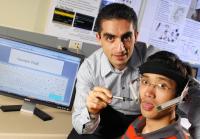
Georgia Tech assistant professor Maysam Ghovanloo (left) points to a small magnet attached to graduate student Xueliang Huo's tongue that allows him to operate a computer mouse and powered wheelchair. Credit: Georgia Tech Photo: Gary Meek A new assistive technology developed by engineers at the Georgia Institute of Technology could help individuals with severe disabilities lead more independent lives.
| Full story | 0 Comments | 8219 views |
| Molecular & Cell Biology | June 30, 2008 10:38 AM |
To survive tough times, cells sometimes resort to a form of self-cannibalism called autophagy. But as Hashimoto et al. reveal, autophagy can have a down side, destroying the pancreas by prematurely activating a digestive enzyme.
| Full story | 0 Comments | 7025 views |

- In some genetic cases of microcephaly, stem cells fail to launch
- Yale team discovers how Zika virus causes fetal brain damage
- Scientists uncover the way a common cell enzyme alerts the body to invading bacteria
- Arctic gives clues on worst mass extinction of life
- Calcium channel blockers caught in the act at atomic level
Search Bio News Net
Free Biology Newsletter
- Flexibility That A.C.A. Lent to Work Force Is Threatened by...International Herald Tribune
- Bacteria Behind Legionnaires’ Disease Found at New York Police StationInternational Herald Tribune
- Prescription Price Crisis? 28 Million Americans See Spike in Drug...MSNBC.com: Health
- Seizing on Opioid Crisis, a Drug Maker Lobbies Hard for...International Herald Tribune
- Republicans are taking a big political risk on health careAP Health News
- Why We're So Divided Over Saving WolvesNational Geographic News