

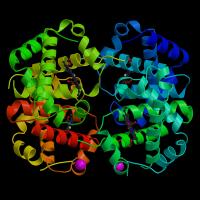
Hemoglobin (PDB ID 4hhb), one of the earliest structures deposited in the archive. Today, there are dozens of structures of hemoglobin in the PDB, showing the process of oxygen binding and revealing the molecular details of sickle cell anemia. Credit: Protein Data Bank and David Goodsell The Protein Data Bank (PDB) based at Rutgers, The State University of New Jersey, and the University of California-San Diego (UCSD) this month reached a significant milestone in its 37-year history. The 50,000th molecule structure was released into its archive, joining other structures vital to pharmacology, bioinformatics and education.

| Bioinformatics | April 8, 2008 11:11 PM |
| Full story | 0 Comments | 6394 views |

| Biology | April 8, 2008 10:11 PM |
Pretending to be dead is an effective self-defense strategy adopted by young fire ant workers under attack from neighboring colonies. This tactic makes them four times more likely to survive aggression than older workers who fight back. As a result, these young workers are able to contribute to brood care and colony growth to ensure the survival and fitness of their queen. These findings (1) by Dr. Deby Cassill from the Biology Department at USF Petersburg in Florida and her team from USF Tampa in Florida, have just been reported online in Naturwissenschaften, a Springer publication.
| Full story | 0 Comments | 5992 views |

| Biotechnology | April 8, 2008 09:11 PM |
An enzyme from a microbe that lives inside a cow’s stomach is the key to turning corn plants into fuel, according to Michigan State University scientists.
| Full story | 0 Comments | 7689 views |

| Microbiology | April 8, 2008 08:11 PM |
Scientists from UCL (University College London) have identified a key difference between people who can fight the Hepatitis B virus (HBV) off successfully and those who fail to do so – that a group of cells important in controlling the disease are triggered to ‘commit suicide’ in patients who are chronically infected. This discovery provides an important new focus for developing therapies or vaccines that boost the body’s ability to manage this infection.
| Full story | 0 Comments | 8538 views |

| Molecular & Cell Biology | April 8, 2008 06:41 PM |
By increasing production of a blood pressure-regulating enzyme in mice, researchers have found they can enhance the mouse immune system's ability to sense tumor growth.
| Full story | 0 Comments | 6741 views |

| Environment | April 8, 2008 05:41 PM |
NOAA scientists are now flying through springtime Arctic pollution to find out why the region is warming - and summertime sea ice is melting - faster than predicted. Some 35 NOAA researchers are gathering with government and university colleagues in Fairbanks, Alaska, to conduct the study through April 23.
| Full story | 0 Comments | 5575 views |

| Health & Medicine | April 8, 2008 04:41 PM |
Leukaemia – cancer of blood or bone marrow – is caused by mutations that allow defective blood cells to accumulate and displace healthy blood. To devise effective therapies it is crucial to know which mutations cause leukaemia and which cell type gives rise to leukaemic cells. Researchers from the European Molecular Biology Laboratory (EMBL) in Italy, the EMBL-European Bioinformatics Institute, UK, and the Universities of Harvard, USA, and Lund, Sweden, have now used genetic engineering to introduce a mutation found in human leukaemia patients into mice. In the current issue of Cancer Cell they report that the mutation causes leukaemia by triggering innate genetic programmes that allow white blood cells to proliferate uncontrollably. The findings have implications for the way leukaemia should be treated.
| Full story | 0 Comments | 8353 views |
| Health & Medicine | April 8, 2008 02:41 PM |
Green tea is high in the antioxidant EGCG (epigallocatechin-3- gallate) which helps prevent the body’s cells from becoming damaged and prematurely aged. Studies have suggested that the combination of green tea and EGCG may also be beneficial by providing protection against certain types of cancers, including breast cancer. A new study conducted by researchers at the University of Mississippi researchers now finds that consuming EGCG significantly inhibits breast tumor growth in female mice. These results bring us one step closer to better understanding the disease and potentially new and naturally occurring therapies.
| Full story | 0 Comments | 7509 views |
| Health & Medicine | April 8, 2008 12:41 PM |
Despite the fact that millions of Americans are believed to have lost their sense of smell (hyposmia), no effective method exists to treat many of these people. That is due in part to the fact that the causes of smell loss are varied and complex, ranging from chronic allergies, viral infection, head injury, or no apparent reason at all. Some seven percent of Americans have lost their sense of smell and with it their ability to enjoy the fragrance of flowers, foods and beverages. For individuals whose smell loss relates the biochemistry of two common proteins, there is some good news. A team of researchers has found that a drug used long ago to help asthmatics can benefit some with smell loss.
| Full story | 0 Comments | 8143 views |
| Environment | April 8, 2008 10:41 AM |
Contaminated seaweeds in Sydney Harbour could be threatening the small animals that feed on them, according to a new study revealing that the harbour's seaweeds have the world's highest levels of copper and lead contamination.
| Full story | 0 Comments | 5635 views |

- In some genetic cases of microcephaly, stem cells fail to launch
- Yale team discovers how Zika virus causes fetal brain damage
- Scientists uncover the way a common cell enzyme alerts the body to invading bacteria
- Arctic gives clues on worst mass extinction of life
- Calcium channel blockers caught in the act at atomic level
Search Bio News Net
Free Biology Newsletter
- Flexibility That A.C.A. Lent to Work Force Is Threatened by...International Herald Tribune
- Bacteria Behind Legionnaires’ Disease Found at New York Police StationInternational Herald Tribune
- Prescription Price Crisis? 28 Million Americans See Spike in Drug...MSNBC.com: Health
- Seizing on Opioid Crisis, a Drug Maker Lobbies Hard for...International Herald Tribune
- Republicans are taking a big political risk on health careAP Health News
- Why We're So Divided Over Saving WolvesNational Geographic News