

One day it may be possible to mimic the tactics used by parasites to trick the body into accepting transplanted tissues or organs.

| Stem Cell Research | April 9, 2008 10:50 PM |
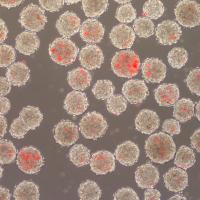
Fluorescence microscopy image overlaid with phase image to display incorporation of microspheres (red stain) in embryoid bodies (gray circles). New research shows that delivering molecules via biodegradable microspheres enhances the efficiency and purity of stem cell differentiation. Credit: Image courtesy of Todd McDevitt Embryonic stem cell therapies have been proposed for regenerative medicine and tissue replacement after injury or disease. However, the inability of stem cells to efficiently develop into the desired specific cell type – such as muscle, skin, blood vessels, bone or neurons – now limits the potential clinical utility of this therapy.
| Full story | 0 Comments | 6446 views |

| Biology | April 9, 2008 09:50 PM |
One of the world's great wildlife spectacles is under way across Australia: as many as two million migratory shorebirds of 36 species are gathering around Broome before an amazing 10,000-kilometre annual flight to their northern hemisphere breeding grounds.
| Full story | 0 Comments | 5255 views |

| Health & Medicine | April 9, 2008 08:50 PM |
Repeatedly stimulating the mouse brain with methamphetamine depresses important areas of the brain, and those changes can only be undone by re-introducing the drug, according to research at the University of Washington and other institutions. The study, which appears in the April 10 issue of the journal Neuron, provides one of the most in-depth views of the mechanisms of methamphetamine addiction, and suggests that withdrawal from the drug may not undo the changes the stimulant can cause in the brain.
| Full story | 0 Comments | 11223 views |
| Health & Medicine | April 9, 2008 07:49 PM |
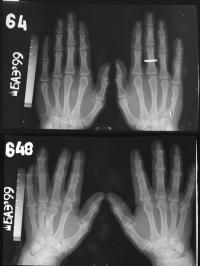
Two x-rays used in Dr. Kalichman's research. The hands of a 22-year-old man at top are compared with the hands of a 74-year-old man at bottom. The two men were not related Credit: AFTAU Perhaps the aging process can’t be stopped. But it can be predicted, and new research from Tel Aviv University indicates that people may live longer and lead healthier lives as a result.
| Full story | 0 Comments | 7046 views |

| Molecular & Cell Biology | April 9, 2008 06:49 PM |
Contrary to the currently accepted model of T-cell development, researchers at the University of Pennsylvania School of Medicine have found that juvenile cells on their way to becoming mature immune cells can develop into either T cells or other blood-cell types versus only being committed to the T-cell path. The findings appear in this week’s issue of Nature, and have implications for better understanding how T-cell leukemias and other disorders arise.
| Full story | 0 Comments | 6176 views |
| Molecular & Cell Biology | April 9, 2008 05:50 PM |
The extraordinary action of a new cellular therapy came to light as a result of powerful PET and SPECT imaging in a recent study reported in the April issue of the Journal of Nuclear Medicine. Researchers in Germany were able to observe the repair action of circulating progenitor cells (CPCs), immature blood-derived cells capable of developing into adult stem cells, as they successfully preserved healthy heart tissue and corrected blood flow imbalance within the heart.
| Full story | 0 Comments | 5377 views |
| Biology | April 9, 2008 05:49 PM |
University of Delaware researchers, in collaboration with U.S. and international colleagues, have found a new type of molecule--a kind of “micro-switch”--that can turn off genes in rice, which is the primary source of food for more than half the world's population. The discovery is reported in the March 25 issue of the Proceedings of the National Academy of Sciences of the United States of America.
| Full story | 0 Comments | 5240 views |
| Molecular & Cell Biology | April 9, 2008 02:11 PM |
The Human Genome Project revealed that only a small fraction of the 3 billion “letter” DNA code actually instructs cells to manufacture proteins, the workhorses of most life processes. This has raised the question of what the remaining part of the human genome does. How much of the rest performs other biological functions, and how much is merely residue of prior genetic events"
| Full story | 0 Comments | 6196 views |

| Biotechnology | April 9, 2008 01:11 PM |
The spiraling use of corn for food and fuel is creating heightened concerns about contamination of this staple crop with deadly aflatoxin. Produced by certain fungi that grow on corn, this contaminant is a known human carcinogen that especially threatens food safety in the developing world and can potentially cause the loss of hundreds of millions of dollars in the United States each year.
| Full story | 0 Comments | 6875 views |
| Molecular & Cell Biology | April 9, 2008 12:11 PM |
In the April issue of Cell Metabolism, a publication of Cell Press, researchers report the discovery of a critical early player in the path that turns cells to fat. Given that obesity—defined as an excess amount of body fat relative to lean body mass—is a major health concern in the United States and an increasing problem in the developing world, such a fuller understanding of the molecular processes governing fat tissue formation could ultimately hold clinical importance, according to the researchers.
| Full story | 0 Comments | 5794 views |
| Biology | April 9, 2008 10:11 AM |
A research team from the Department of Genetics, Physical Anthropology & Animal Physiology in the Faculty of Science and Technology at the Leioa campus of the University of the Basque Country (UPV/EHU), and led by Ms Concepción de la Rúa, has reconstructed the history of the evolution of human population and answered questions about history, using DNA extracted from skeleton remains.
| Full story | 0 Comments | 6026 views |

- In some genetic cases of microcephaly, stem cells fail to launch
- Yale team discovers how Zika virus causes fetal brain damage
- Scientists uncover the way a common cell enzyme alerts the body to invading bacteria
- Arctic gives clues on worst mass extinction of life
- Calcium channel blockers caught in the act at atomic level
Search Bio News Net
Free Biology Newsletter
- Flexibility That A.C.A. Lent to Work Force Is Threatened by...International Herald Tribune
- Bacteria Behind Legionnaires’ Disease Found at New York Police StationInternational Herald Tribune
- Prescription Price Crisis? 28 Million Americans See Spike in Drug...MSNBC.com: Health
- Seizing on Opioid Crisis, a Drug Maker Lobbies Hard for...International Herald Tribune
- Republicans are taking a big political risk on health careAP Health News
- Why We're So Divided Over Saving WolvesNational Geographic News