


For a quarter century, GenBank has helped advance scientific discovery worldwide. Established by the National Institutes of Health (NIH) in 1982, the database of nucleic acid sequences is one of the key tools that scientists use to conduct biomedical and biologic research. Since its creation, GenBank has grown at an exponential rate, doubling in size every 18 months. In celebration of this vital resource and its contribution to science over the last 25 years, the National Center for Biotechnology Information, National Library of Medicine (NLM), NIH, is holding a two-day conference on GenBank.

| Biotechnology | April 7, 2008 10:41 PM |
Researchers have made a breakthrough in the development of "green gasoline," a liquid identical to standard gasoline yet created from sustainable biomass sources like switchgrass and poplar trees.
| Full story | 0 Comments | 8357 views |

| Stem Cell Research | April 7, 2008 09:41 PM |
‘Mother cells’ which produce the neurons affected by Parkinson’s disease have been identified by scientists, according to new research published in the journal Glia.
| Full story | 0 Comments | 7055 views |

| Molecular & Cell Biology | April 7, 2008 08:41 PM |
The neurotransmitter acetylcholine is an essential chemical communicator, carrying impulses from neurons to skeletal muscle cells and many parts of the nervous system. Now researchers at the University of Illinois have painstakingly mapped the interior of a key component of the relay system that allows acetylcholine to get its message across. Their findings, which appear in the current issue of Nature Structure & Molecular Biology, reveal how the muscle nicotinic acetylcholine receptor responds to a burst of acetylcholine on the surface of a cell.
| Full story | 0 Comments | 5234 views |

| Biology | April 7, 2008 07:41 PM |
The battle of the sexes may begin in the womb, researchers from Tel Aviv University believe. And it may have troubling consequences — a male twin can compromise the health of his twin sister before she is born.
| Full story | 0 Comments | 6357 views |
| Biology | April 7, 2008 06:41 PM |
Researchers have confirmed the first case of complete lunglessness in a frog, according to a report in the April 8th issue of Current Biology, a publication of Cell Press. The aquatic frog Barbourula kalimantanensis apparently gets all the oxygen it needs through its skin.
| Full story | 0 Comments | 7135 views |

| Health & Medicine | April 7, 2008 05:41 PM |
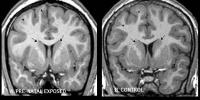
The brain image at left is from a subject exposed to alcohol, cigarettes, cocaine and marijuana in utero, while the image at right is from a same-age, same-sex control with none of these exposures. Note that the cortical gray matter appears thinner in the exposed brain than in the control (black arrowheads). In addition, the subcortical gray matter appears fuller and more robust in the control brain (see arrows near top of image) than in the exposed brain. Credit: Courtesy Christopher Watson and Michael Rivkin, MD, Children's Hospital Boston Although behavioral studies clearly indicate that exposure to drugs, alcohol and tobacco in utero is bad for a baby’s developing brain, specific anatomic brain effects have been hard to tease out in humans. Often users don’t limit themselves to one substance, and demographic factors like poverty can also influence brain development.
| Full story | 0 Comments | 7284 views |

- In some genetic cases of microcephaly, stem cells fail to launch
- Yale team discovers how Zika virus causes fetal brain damage
- Scientists uncover the way a common cell enzyme alerts the body to invading bacteria
- Arctic gives clues on worst mass extinction of life
- Calcium channel blockers caught in the act at atomic level
Search Bio News Net
Free Biology Newsletter
- Flexibility That A.C.A. Lent to Work Force Is Threatened by...International Herald Tribune
- Bacteria Behind Legionnaires’ Disease Found at New York Police StationInternational Herald Tribune
- Prescription Price Crisis? 28 Million Americans See Spike in Drug...MSNBC.com: Health
- Seizing on Opioid Crisis, a Drug Maker Lobbies Hard for...International Herald Tribune
- Republicans are taking a big political risk on health careAP Health News
- Why We're So Divided Over Saving WolvesNational Geographic News