


Giant panda. Cardiff University is contributing to the first genome project to assist conservation efforts for an endangered species.

| Bioinformatics | April 1, 2008 10:52 PM |
| Full story | 0 Comments | 7162 views |

| Environment | April 1, 2008 09:52 PM |
The rapid growth of China’s industrial and transportation infrastructure is helping to establish non-native species throughout that country and “setting the stage for potentially rampant environmental damage,” according to an article in the April 2008 issue of BioScience. The article, by a Chinese-US team, describes how more than 400 alien plants and animals are now considered invasive in China, including some that are causing serious harm even though they were first documented in the country only a few years ago.
| Full story | 0 Comments | 6039 views |

| Biotechnology | April 1, 2008 08:52 PM |
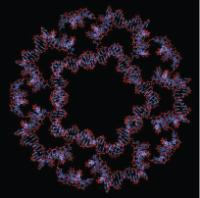
Can 20 trisoligonucleotides with 20×3 individual sequences be programmed to self-assemble into a DNA dodecahedron? The answer is yes if one starts from a new generation of trisoligonucleotides based on C3h-symmetric linkers with proper flexibility. The resulting dodecahedron has C1 symmetry and may facilitate the construction of multimodular scaffolds in the future. Credit: (C) Wiley-VCH For quite some time, DNA, the stuff our genes are made of, has also been considered the building material of choice for nanoscale objects. A team led by Günter von Kiedrowski at the Ruhr University in Bochum has now made a dodecahedron (a geometric shape with twelve surfaces) from DNA building blocks. As reported in the journal Angewandte Chemie, these objects are formed in a self-assembly process from 20 individual trisoligonucleotides, building blocks consisting of a “branching junction” and three short DNA strands.
| Full story | 0 Comments | 6380 views |
| Biotechnology | April 1, 2008 07:52 PM |
Researchers from the Nano Machine Center at the California NanoSystems Institute at UCLA have developed a novel type of nanomachine that can capture and store anticancer drugs inside tiny pores and release them into cancer cells in response to light.
| Full story | 0 Comments | 7348 views |

| Health & Medicine | April 1, 2008 06:52 PM |
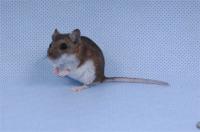
A deer mouse (Peromyscus maniculatus). Researchers studying deer mice have discovered evidence to support what mothers everywhere have long suspected: the immune system needs food to function properly. In an article titled “Food Restriction Compromises Immune Memory in Deer Mice (Peromyscus maniculatus) By Reducing Spleen-Derived Antibody-Producing B-Cell Numbers,” Lynn Martin and coauthors find that reduced food intake leads to a decline in immune function in their subjects. The findings, which will be published in the May/June 2008 issue of Physiological and Biochemical Zoology, could have profound implications for human health.
| Full story | 0 Comments | 5621 views |

| Biology | April 1, 2008 05:52 PM |
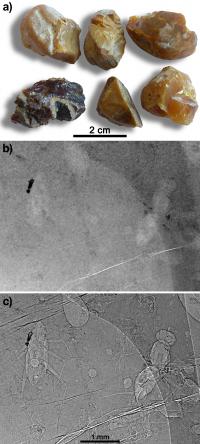
a) Opaque amber blocs from Charente-Maritime. b) radiography of a bloc with inclusions in absorption mode. c) the same radiograph in propagation phase contrast mode with 990 mm of propagation distance (pixel size: 5 µm). Credit: M. Lak, P. Tafforeau, D. Néraudeau (ESRF Grenoble et UMR CNRS 6118 Rennes). Paleontologists from the University of Rennes (France) and the ESRF have found the presence of 356 animal inclusions in completely opaque amber from mid-Cretaceous sites of Charentes (France). The team used the X-rays of the European light source to image two kilogrammes of the fossil tree resin with a technique that allows rapid survey of large amounts of opaque amber. At present this is the only way to discover inclusions in fully opaque amber.
| Full story | 0 Comments | 6763 views |
| Biotechnology | April 1, 2008 04:52 PM |
As gas prices continue to soar to record highs, motorists are crying out for an alternative that won’t cramp their pocketbooks.
| Full story | 0 Comments | 8488 views |
| Health & Medicine | April 1, 2008 04:23 PM |
Chest compressions alone, or Hands-Only Cardiopulmonary Resuscitation (CPR), can save lives and can be used to help an adult who suddenly collapses, according to a new American Heart Association scientific statement.
| Full story | 0 Comments | 6857 views |

| Molecular & Cell Biology | April 1, 2008 03:52 PM |
Your friend can eat whatever she wants and still fit into her prom dress, but you gain five pounds if you just look at that chocolate cake. Before you sign up for Weight Watchers and that gym membership, though, you may want to look at some recent research from Tel Aviv University and save yourself a few hundred dollars.
| Full story | 0 Comments | 5912 views |
| Health & Medicine | April 1, 2008 02:23 PM |
New research shows cerebral microbleeds, which are lesions in the brain, are more common in people over 60 than previously thought. The study is published in the April 1, 2008, issue of Neurology®, the medical journal of the American Academy of Neurology.
| Full story | 0 Comments | 6619 views |
| Health & Medicine | April 1, 2008 12:23 PM |
Fasting for two days protects healthy cells against chemotherapy, according to a study appearing online the week of Mar. 31 in PNAS Early Edition.
| Full story | 0 Comments | 7019 views |
| Health & Medicine | April 1, 2008 10:23 AM |
Satisfactory sexual intercourse for couples lasts from 3 to 13 minutes, contrary to popular fantasy about the need for hours of sexual activity, according to a survey of U.S. and Canadian sex therapists.
| Full story | 0 Comments | 9516 views |

- In some genetic cases of microcephaly, stem cells fail to launch
- Yale team discovers how Zika virus causes fetal brain damage
- Scientists uncover the way a common cell enzyme alerts the body to invading bacteria
- Arctic gives clues on worst mass extinction of life
- Calcium channel blockers caught in the act at atomic level
Search Bio News Net
Free Biology Newsletter
- Flexibility That A.C.A. Lent to Work Force Is Threatened by...International Herald Tribune
- Bacteria Behind Legionnaires’ Disease Found at New York Police StationInternational Herald Tribune
- Prescription Price Crisis? 28 Million Americans See Spike in Drug...MSNBC.com: Health
- Seizing on Opioid Crisis, a Drug Maker Lobbies Hard for...International Herald Tribune
- Republicans are taking a big political risk on health careAP Health News
- Why We're So Divided Over Saving WolvesNational Geographic News