

One day soon patients may spit in a cup, instead of bracing for a needle prick, when being tested for cancer, heart disease or diabetes. A major step in that direction is the cataloguing of the “complete” salivary proteome, a set of proteins in human ductal saliva, identified by a consortium of three research teams, according to an article published today in the Journal of Proteome Research. Replacing blood draws with saliva tests promises to make disease diagnosis, as well as the tracking of treatment efficacy, less invasive and costly.

| Biology | March 25, 2008 05:19 PM |
Scientists at Harvard University have found that a common class of freshwater invertebrate animals called bdelloid rotifers are extraordinarily resistant to ionizing radiation, surviving and continuing to reproduce after doses of gamma radiation much greater than that tolerated by any other animal species studied to date.
| Full story | 0 Comments | 6957 views |
| Biology | March 25, 2008 04:54 PM |
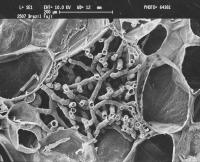
Scanning Electron Micrograph of Fuji apples showing extensive branching of callus hairs. A UK scientist has discovered clumps of previously-unreported callus hairs growing in the flesh of mature apples of Fuji and closely-related varieties, which may have storage implications for commercial growers.
| Full story | 0 Comments | 6885 views |

| Molecular & Cell Biology | March 25, 2008 04:54 PM |
"The blood froze in my veins" or "My blood curdled" – these common figures of speech can be taken literally, according to the latest studies. Indeed, more literally than some of us would like. For it turns out that intense fear and panic attacks can really make our blood clot and increase the risk of thrombosis or heart attack.
| Full story | 0 Comments | 7281 views |

| Bioinformatics | March 25, 2008 04:54 PM |
75% of all animal species in the world are insects. The largest group within insects are beetles (400,000 species). Beetles can be very beautiful and colorful, but many beetle species are also serious agricultural pests that can destroy food plants like potatoes (the Colorado potato beetle) and threaten large areas of forest. Altogether, insect pests cause U.S. $ 26 billion in losses to U.S. agriculture yearly and beetles are responsible for a substantial part of this.
| Full story | 0 Comments | 7245 views |
| Molecular & Cell Biology | March 25, 2008 04:54 PM |
Discovery that a specific gene is integral to both fungal invasion of corn and development of a potentially deadly toxin in the kernels may lead to ways to control the pathogen and the poison.
| Full story | 0 Comments | 7577 views |

| Environment | March 25, 2008 04:19 PM |
Can organic cropping systems be as productive as conventional systems" The answer is an unqualified, “Yes” for alfalfa or wheat and a qualified “Yes most of the time” for corn and soybeans according to research reported by scientists at the University of Wisconsin-Madison and agricultural consulting firm AGSTAT in the March-April 2008 issue of Agronomy Journal.
| Full story | 0 Comments | 6405 views |

| Health & Medicine | March 25, 2008 03:19 PM |
It is well established that Id1, a gene normally produced only in embryonic development, is reactivated in many 'solid' cancers, or carcinomas.
| Full story | 0 Comments | 4798 views |

| Microbiology | March 25, 2008 02:19 PM |
Scientists from The Forsyth Institute and King’s College, London have released a new tool for the research community, the Human Oral Microbiome Database, which provides descriptions of the approximately 600 microbes (bacteria) that are most commonly found in people’s mouths. Most bacteria living in the mouth are thought to be important for maintaining the health of teeth and gums, as well as for general human health. A smaller number are potentially disease causing. The database, which can be found at www.homd.org, will help scientists studying the role of specific microbes in human health and disease.
| Full story | 0 Comments | 6511 views |

| AIDS & HIV | March 25, 2008 01:19 PM |
The advent of effective medications for treating HIV dramatically improved the outlook for both adults and children infected with HIV who had access to treatment, but the optimal timing for starting treatment remains controversial, particularly in children. A debate article in this week's PLoS Medicine lays out the case for deferred treatment against the case for early initiation of treatment in children infected with HIV.
| Full story | 0 Comments | 5968 views |
| Molecular & Cell Biology | March 25, 2008 12:19 PM |
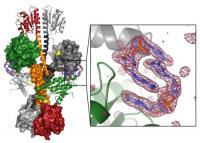
Tetrameric assembly of the response regulator diguanylate cyclase WspR from Pseudomonas aeruginosa. The inset shows a close-up of cyclic di-GMP bound to the inhibitory site Bacteria are particularly harmful to human health when they band together to form a biofilm—a sheet composed of many individual bacteria glued together—because this can allow them to escape from both antibiotics and the immune system of their host. It is thought that most chronic infections are caused by bacterial biofilms, and a paper published in this week’s PLoS Biology explores the signalling system that causes bacteria to team up in this way.
| Full story | 0 Comments | 7686 views |

- In some genetic cases of microcephaly, stem cells fail to launch
- Yale team discovers how Zika virus causes fetal brain damage
- Scientists uncover the way a common cell enzyme alerts the body to invading bacteria
- Arctic gives clues on worst mass extinction of life
- Calcium channel blockers caught in the act at atomic level
Search Bio News Net
Free Biology Newsletter
- Flexibility That A.C.A. Lent to Work Force Is Threatened by...International Herald Tribune
- Bacteria Behind Legionnaires’ Disease Found at New York Police StationInternational Herald Tribune
- Prescription Price Crisis? 28 Million Americans See Spike in Drug...MSNBC.com: Health
- Seizing on Opioid Crisis, a Drug Maker Lobbies Hard for...International Herald Tribune
- Republicans are taking a big political risk on health careAP Health News
- Why We're So Divided Over Saving WolvesNational Geographic News