

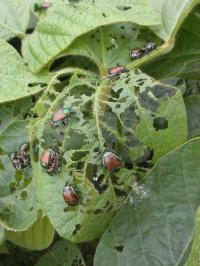
Plant defenses go down as carbon dioxide levels go up, the researchers found. Soybeans grown at elevated CO2 levels attract many more adult Japanese beetles than plants grown at current... Atmospheric carbon dioxide levels are rising at an alarming rate, and new research indicates that soybean plant defenses go down as CO2 goes up. Elevated CO2 impairs a key component of the plant’s defenses against leaf-eating insects, according to the report.

| Environment | March 24, 2008 07:38 PM |
| Full story | 0 Comments | 8610 views |

| Biology | March 24, 2008 07:38 PM |
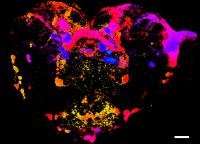
This depth-encoded image shows serotonin clusters in the brain of the drosophila, a type of fruit fly. Before swatting at one of those pesky flies that come out as the days lengthen and the temperature rises, one should probably think twice. A University of Missouri researcher has found, through the study of Drosophila (a type of fruit fly), that by manipulating levels of certain compounds associated with the “circuitry” of the brain, key genes related to memory can be isolated and tested. The results of the study may benefit human patients suffering from Parkinson’s disease and could eventually lead to discoveries in the treatment of depression.
| Full story | 0 Comments | 6934 views |
| Biology | March 24, 2008 07:38 PM |
Corn has long been known as the primary food crop in prehistoric North and Central America. Now it appears it may have been an important part of the South American diet for much longer than previously thought, according to new research by University of Calgary archaeologists who are cobbling together the ancient history of plant domestication in the New World.
| Full story | 0 Comments | 6166 views |

| Molecular & Cell Biology | March 24, 2008 07:38 PM |
Looking for answers in the bright light of day, rather than the confined beam of a street light at night. That’s how University of Michigan researcher Sofia Merajver, M.D., Ph.D., describes the power of a new mathematical model that could have far-reaching impact on how scientists study cellular signaling pathways.
| Full story | 0 Comments | 5887 views |

| Health & Medicine | March 24, 2008 07:38 PM |
Male infants in developed nations are more likely to die than female infants, a fact that is partially responsible for men’s shorter lifespans, reveals a new study by researchers from University of Pennsylvania and University of Southern California.
| Full story | 0 Comments | 7515 views |
| Molecular & Cell Biology | March 24, 2008 04:55 PM |
Mankind triumphed in a recent 'competition' against nature when scientists succeeded in creating a new type of enzyme for a reaction for which no naturally occurring enzyme has evolved. This achievement opens the door to the development of a variety of potential applications in medicine and industry.
| Full story | 0 Comments | 6617 views |
| Biology | March 24, 2008 03:55 PM |
Over two hundred million humans depend for their subsistence on the fact that coral has an addiction to ‘junk food’ - and orders its partners, the symbiotic algae, to make it.
| Full story | 0 Comments | 7558 views |

| Microbiology | March 24, 2008 02:55 PM |
Researchers at the University of Washington have uncovered how the bacterium Staphylococcus aureus, including the notorious MRSA (methicillin-resistant Staph aureus) “superbug” strains, resists our body's natural defenses against infection. The work, which was featured on the cover of the March 21 issue of Science, could lead to new ways to fight the bacteria.
| Full story | 0 Comments | 7455 views |

| AIDS & HIV | March 24, 2008 01:55 PM |
Nearly half of all HIV-positive African adults who become infected with Salmonella die from what otherwise would be a seven-day bout of diarrhea. Now, UC Davis School of Medicine scientists have discovered how salmonella becomes lethal for AIDS patients. Their findings also implicate a mechanism by which HIV evades the powerful drugs used to treat AIDS.
| Full story | 0 Comments | 5154 views |
| Molecular & Cell Biology | March 24, 2008 12:55 PM |
When faced with cancer, the immune system dispatches cells, called T cells, to kill the tumor. But these killer cells often fail to completely eliminate the tumor because they’re deactivated by a distinct population of T cells known as regulatory T cells. Past attempts to get rid of these regulatory T cells have largely failed, in part because they share many features with the killer T cells, making it difficult to eliminate one population without also eliminating the other.
| Full story | 0 Comments | 5383 views |

- In some genetic cases of microcephaly, stem cells fail to launch
- Yale team discovers how Zika virus causes fetal brain damage
- Scientists uncover the way a common cell enzyme alerts the body to invading bacteria
- Arctic gives clues on worst mass extinction of life
- Calcium channel blockers caught in the act at atomic level
Search Bio News Net
Free Biology Newsletter
- Flexibility That A.C.A. Lent to Work Force Is Threatened by...International Herald Tribune
- Bacteria Behind Legionnaires’ Disease Found at New York Police StationInternational Herald Tribune
- Prescription Price Crisis? 28 Million Americans See Spike in Drug...MSNBC.com: Health
- Seizing on Opioid Crisis, a Drug Maker Lobbies Hard for...International Herald Tribune
- Republicans are taking a big political risk on health careAP Health News
- Why We're So Divided Over Saving WolvesNational Geographic News