

Scientists at Jefferson’s Kimmel Cancer Center in Philadelphia have found that a signaling protein that is key to prostate cancer cell growth is turned on in nearly all recurrent prostate cancers that are resistant to hormone therapy. If the findings hold up, the protein, called Stat5, may be a specific drug target against an extremely difficult-to-treat cancer.

| Molecular & Cell Biology | December 29, 2007 03:54 PM |
A research team at Weill Cornell Medical College in New York City has identified two genes that may be crucial to the production of an immune system cytokine called interleukin-10 (IL-10).
| Full story | 0 Comments | 6822 views |

| Health & Medicine | December 29, 2007 03:54 PM |
Laser surgery to correct vision problems has been in use since the early 1990s. Photorefractive Keratotomy (PRK) is typically used to correct low to moderate myopia, while laser in-situ keratomileusis (LASIK) is preferred for high myopia corrections. Although over 18 million LASIK procedures have been performed worldwide, there is still some controversy regarding the maximum correction possible and efficacy with this technique. In an article published in the January 2008 issue of the American Journal of Ophthalmology, researchers from Miguel Hernandez University, Medical School, Alicante, Spain; and Ankara University School of Medicine, Ankara, Turkey; report on a study of high myopia patients ten years after LASIK surgery. The findings show that LASIK for myopia over -10 D is a safe and effective procedure in the long-term.
| Full story | 0 Comments | 6809 views |
| Molecular & Cell Biology | December 29, 2007 03:54 PM |
For over 10 years, Wafik S. El-Deiry, MD, PhD, Professor of Medicine, Genetics, and Pharmacology at the University of Pennsylvania School of Medicine, has been pursuing a cancer-targeting molecule called TRAIL and its molecular partners. TRAIL is normally produced by immune cells and curtails tumor spread by binding to a specialized receptor on a tumor’s surface.
| Full story | 0 Comments | 6599 views |
| Molecular & Cell Biology | December 27, 2007 09:35 PM |
Genome rearrangements, resulting in variations in the numbers of copies of genes, occur when the cellular process that copies DNA during cell division stalls and then switches to a different genetic “template,” said researchers at Baylor College of Medicine in Houston in a report that appears today in the journal Cell.
| Full story | 0 Comments | 6915 views |

| Microarray | December 27, 2007 09:35 PM |
Scientists who study cancer may be prone to drawing simplistic conclusions from the powerful molecular tools now available because they don’t appreciate how complex the data is that is being generated, said a team of Georgetown University Medical Center (GUMC) researchers in the January issue of Nature Reviews Cancer.
| Full story | 0 Comments | 10354 views |

| Environment | December 27, 2007 09:35 PM |
The loss of deep-sea species poses a severe threat to the future of the oceans, suggests a new report publishing early online on December 27th and in the January 8th issue of Current Biology, a publication of Cell Press. In a global-scale study, the researchers found some of the first evidence that the health of the deep sea, as measured by the rate of critical ecosystem processes, increases exponentially with the diversity of species living there.
| Full story | 0 Comments | 7639 views |

| Biology | December 27, 2007 09:35 PM |
When it comes to choosing a place to live, male chimpanzees in the wild don’t stray far from home, according to a new report in the Dec. 27th Current Biology, a publication of Cell Press. The researchers found that adult male chimps out on their own tend to follow in their mother’s footsteps, spending their days in the same familiar haunts where they grew up. Male chimpanzees are generally very social, but how they use space when they are alone might be critical to their survival, the researchers said.
| Full story | 0 Comments | 6157 views |
| Microarray | December 27, 2007 09:35 PM |
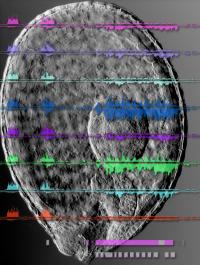
The image shows a growth-arrested embryo from a mutant Arabidopsis plant that contains a genetic lesion in a gene encoding an essential part of the exosome. The embryo is overlaid on a genome browser image of tiling expression data from an intergenic region that exhibits strong upregulation of a cluster of novel tandem repeat-associated, exosome-regulated transcripts. Cells keep a close watch over the transcriptome – the totality of all parts of the genome that are expressed in any given cell at any given time. Researchers at the Salk Institute for Biological Studies and the University of Missouri-Kansas City teamed up to peel back another layer of transcriptional regulation and gain new insight into how genomes work.
| Full story | 0 Comments | 11658 views |
| Health & Medicine | December 26, 2007 10:37 PM |
University of California, San Diego researchers have proven in animal studies that fibrosis in the liver can be not only stopped, but reversed. Their discovery, to be published in PLoS Online on December 26, opens the door to treating and curing conditions that lead to excessive tissue scarring such as viral hepatitis, fatty liver disease, cirrhosis, pulmonary fibrosis, scleroderma and burns.
| Full story | 0 Comments | 9306 views |
| Biology | December 26, 2007 10:37 PM |
Animals and insects communicate through an invisible world of scents. By exploiting infrared technology, researchers at Rockefeller University just made that world visible. With the ability to see smells, these scientists now show that when fly larvae detect smells with both olfactory organs they find their way toward a scented target more accurately than when they detect them with one.
| Full story | 0 Comments | 6886 views |
| Biology | December 26, 2007 10:37 PM |
The research field has grown from grapheme-colour synaesthesia to include other forms of synaesthesia in which flavours are evoked by music or words (lexical-gustatory synaesthesia), space structures by time units, colours by music, etc. Experts on Experimental Psychology from the University of Granada are studying this phenomenon. The results of this research have been published by the following scientific journals, among others: Cortex, Experimental Brain Research and Consciousness and Cognition.
| Full story | 0 Comments | 8094 views |
| Biology | December 26, 2007 10:37 PM |
Up to 20 meters long and weighing as much as 20 tons, its enormous size gives the whale shark (Rhincodon typus) its name. Known as the ‘gentle giant’ for its non-predatory behavior, this fish, with its broad, flattened head and minute teeth, eats tiny zooplankton, sieving them through a fine mesh of gill-rakers. Listed as a rare species, relatively little is known about whale sharks, which live in tropical and warm seas, including the western Atlantic and southern Pacific. However, a new study combines computer-assisted photographic identification with ecotourism to study the rare species and suggests whale shark populations in Ningaloo, Western Australia are healthy. The study appears in the Ecological Society of America’s January issue of Ecological Applications.
| Full story | 0 Comments | 7429 views |
| Biology | December 22, 2007 05:02 PM |
In the early 1990s, federal agencies in the West were asked to implement the Northwest Forest Plan. Part of that task involved an inventory and conservation plan for more than 300 rare species believed to be associated with old-growth forests. Debates arose among the agency leads regarding how to begin this daunting task and how best to carry it out.
| Full story | 0 Comments | 6226 views |

| Stem Cell Research | December 22, 2007 03:02 PM |
Stem cells -- popularly known as a source of biological rejuvenation -- may play harmful roles in the body, specifically in the growth and spread of cancer. Amongst the wildly dividing cells of a tumor, scientists have located cancer stem cells. Physician-scientists from Weill Cornell Medical College are studying these cells with hopes of combating malignant cancers in the brain.
| Full story | 0 Comments | 8861 views |
| Environment | December 22, 2007 01:02 PM |
If world leaders do not immediately engage in a race against time to save the Earth's coral reefs, these vital ecosystems will not survive the global warming and acidification predicted for later this century. That is the conclusion of a group of marine scientists from around the world in a major new study published in the journal Science on Dec. 13.
| Full story | 0 Comments | 7171 views |

| Microbiology | December 22, 2007 11:02 AM |
Cornell researchers are using advanced genetic techniques to better understand the relationship between the bacteria that cause tuberculosis and the human immune system defense cells that engulf them.
| Full story | 0 Comments | 7139 views |
How do many plants ship sugars from their leaves to flowers, roots, fruits and other parts of their structure? Using genetic engineering techniques, Cornell researchers have finally proven a long-standing theory of how this occurs.
| Full story | 0 Comments | 7827 views |

| Biotechnology | December 21, 2007 08:08 PM |
Researchers from the Universities of Warwick, Edinburgh, Dundee and the Czech Republic’s Institute of Biophysics have discovered a new light-activated platinum-based compound that is up to 80 times more powerful than other platinum-based anti-cancer drugs and which can use “light activation” to kill cancer cells in much more targeted way than similar treatments.
| Full story | 0 Comments | 8462 views |
| Microbiology | December 21, 2007 07:08 PM |
A cluster of antiviral genes in humans has likely battled retroviral invasions for millions of years. New research by Sara Sawyer, Ph.D., a postdoctoral research fellow in the Basic Sciences Division at Fred Hutchinson Cancer Center, now finds that in addition to the previously identified TRIM5 gene that can defend against retroviruses like HIV, a related gene right next door, called TRIM22, may have participated in antiviral defense.
| Full story | 0 Comments | 6793 views |
| Microbiology | December 21, 2007 06:08 PM |
Scientists have genetically engineered a mosquito to release a sea-cucumber protein into its gut which impairs the development of malaria parasites, according to research out today (21 December) in PLoS Pathogens. Researchers say this development is a step towards developing future methods of preventing the transmission of malaria.
| Full story | 0 Comments | 7395 views |
| Biotechnology | December 21, 2007 05:08 PM |
A new study in Artificial Organs tested the effects of a wound dressing created with hair follicular cells. The findings reveal that skin substitutes using living hair cells can increase wound healing.
| Full story | 0 Comments | 9420 views |
| Biology | December 21, 2007 04:08 PM |
Plant leaves and surfaces are teeming with microbial life, yet the insects that feed on plants lack adaptive immune systems to fend off any intruding microorganisms they eat along with their greens. Now research published in the online open access journal, BMC Biology shows how food-borne bacteria affect an insect’s immune system.
| Full story | 0 Comments | 6481 views |
| Biology | December 21, 2007 03:08 PM |
The melodious sound of a songbird may appear effortless, but his elocutions are actually the result of rigorous training undergone in youth and maintained throughout adulthood. His tune has virtually “crystallized” by maturity. The same control is seen in the motor performance of top athletes and musicians. Yet, subtle variations in highly practiced skills persist in both songbirds and humans. Now, scientists think they know why.
| Full story | 1 Comment | 6136 views |
| Molecular & Cell Biology | December 20, 2007 11:46 PM |
In 2007, researchers were dazzled by the degree to which genomes differ from one human to another and began to understand the role of these variations in disease and personal traits. Science and its publisher, AAAS, the nonprofit science society, recognize “Human Genetic Variation” as the Breakthrough of the Year, and identify nine other of the year’s most significant scientific accomplishments in the 21 December issue.
| Full story | 0 Comments | 7538 views |
| Biology | December 20, 2007 10:46 PM |
Most modern-day groups of beetles have been around since the time of the dinosaurs and have been diversifying ever since, says new research out in Science today (Friday 21 December 2007).
| Full story | 0 Comments | 8881 views |
| Health & Medicine | December 20, 2007 09:46 PM |
University of Michigan scientists and their colleagues have helped characterize a previously unknown link in the chain of biochemical reactions implicated in some forms of heart disease.
| Full story | 0 Comments | 6473 views |
| Molecular & Cell Biology | December 20, 2007 08:46 PM |
The veil has finally been lifted on an enzyme that is critical to the process of DNA transcription and replication, and is a prime target of antibacterial and anticancer drugs. Researchers with the U.S. Department of Energy’s Lawrence Berkeley National Laboratory (Berkeley Lab) and the University of California (UC) at Berkeley have produced the first three-dimensional structural images of a DNA-bound Type II topoisomerase (topo II) that is responsible for untangling coiled strands of the chromosome during cell division.
| Full story | 0 Comments | 6785 views |
| Stem Cell Research | December 20, 2007 07:46 PM |
UC Irvine scientists have found a new way to sort stem cells that should be quicker, easier and more cost-effective than current methods. The technique could in the future expedite therapies for people with conditions ranging from brain and spinal cord damage to Alzheimer’s and Parkinson’s diseases.
| Full story | 0 Comments | 6581 views |
| Biology | December 20, 2007 06:46 PM |
Biologists at the University of California, San Diego have discovered a gene in plants that disrupts fertilization only when mutations in the gene are present in both the female and male reproductive cells.
| Full story | 0 Comments | 6989 views |
| Stem Cell Research | December 20, 2007 05:46 PM |
In a groundbreaking experiment published in Cloning & Stem Cells, scientists from International Stem Cell (ISC) Corp. derived four unique embryonic stem cell lines that open the door for the creation of therapeutic cells that will not provoke an immune reaction in large segments of the population. The stem cell lines are “HLA-homozygous,” meaning that they have a simple genetic profile in the critical areas of the DNA that code for immune rejection. The lines could serve to create a stem cell bank as a renewable source of transplantable cells for use in cell therapy to replace damaged tissues or to treat genetic and degenerative diseases.
| Full story | 0 Comments | 7022 views |
| Biology | December 20, 2007 04:46 PM |
Velcro, Superglue and Post-It Notes… Three things that started out as obscure inventions but are now indispensable for everyday life. So what will the next idea to stick with modern society look like" The answer may lie in the tiny toes of a humble lizard, according to a University of Calgary biologist who is trying to figure out how geckos can cling to virtually any surface, including glass.
| Full story | 0 Comments | 7265 views |
| Biology | December 20, 2007 03:46 PM |
Thailand’s Western Forest Complex – a 6,900 square mile (18,000 square kilometers) network of parks and wildlife reserves – can potentially support some 2,000 tigers, making it one of the world’s strongholds for these emblematic big cats, according to a new study by Thailand’s Department of National Park, Wildlife, and Plant Conservation and the New York-based Wildlife Conservation Society. The study, which appears in latest issue of the journal Oryx, says that to make these numbers a reality, better enforcement to safeguard both tigers and their prey from poachers is critical.
| Full story | 0 Comments | 7401 views |
| Biology | December 19, 2007 05:45 PM |

A curious bear investigates the smell of blood near a wire hair snag. Locks of hair from more than 400 grizzly bears are stored at Montana State University, waiting to tell the tale of genetic diversity in the Yellowstone Ecosystem.
| Full story | 0 Comments | 7646 views |
| Health & Medicine | December 19, 2007 04:45 PM |
Methods to identify a patient with a Do Not Resuscitate (DNR) order are incredibly varied across hospitals, ranging from written documentation practices to the use of color-coded wristbands. According to a new study in the Journal of Hospital Medicine, a national effort to standardize color-coded wristbands, likely around a few specific indications (e.g., DNR status, allergy, fall risk, etc.), would remove current practice variations and the associated potential for errors.
| Full story | 0 Comments | 6922 views |
| Biology | December 19, 2007 03:45 PM |
Scientists long have focused on how climate and vegetation allowed human ancestors to evolve in Africa. Now, University of Utah geologists are calling renewed attention to the idea that ground movements formed mountains and valleys, creating environments that favored the emergence of humanity.
| Full story | 0 Comments | 6903 views |
| Biology | December 19, 2007 02:45 PM |
No human can survive longer than a few minutes underwater, and even a well-trained Olympic swimmer needs frequent gulps of air. Our brains need a constant supply of oxygen, particularly during exercise.
| Full story | 0 Comments | 7214 views |
| Biotechnology | December 19, 2007 12:45 PM |
An international team of researchers led by Mayo Clinic have designed a technique that uses the body’s own cells and a virus to destroy cancer cells that spread from primary tumors to other parts of the body through the lymphatic system. In addition, their study shows that this technology could be the basis for a new cancer vaccine to prevent cancer recurrence.
| Full story | 0 Comments | 7761 views |
| Health & Medicine | December 19, 2007 10:45 AM |
By using a combination of inexpensive infection control measures, hospitals around the world could prevent half the new cases of extensively drug resistant tuberculosis (XDR TB), according to a new study in The Lancet by researchers at Yale School of Medicine.
| Full story | 0 Comments | 5950 views |
| Molecular & Cell Biology | December 18, 2007 06:17 PM |
Scientists at Washington University School of Medicine in St. Louis have found definitive proof that some of the bacteria that plague women with urinary tract infections (UTIs) are entrenched inside human bladder cells.
| Full story | 0 Comments | 8318 views |

- In some genetic cases of microcephaly, stem cells fail to launch
- Yale team discovers how Zika virus causes fetal brain damage
- Scientists uncover the way a common cell enzyme alerts the body to invading bacteria
- Arctic gives clues on worst mass extinction of life
- Calcium channel blockers caught in the act at atomic level
Search Bio News Net
Free Biology Newsletter
- Flexibility That A.C.A. Lent to Work Force Is Threatened by...International Herald Tribune
- Bacteria Behind Legionnaires’ Disease Found at New York Police StationInternational Herald Tribune
- Prescription Price Crisis? 28 Million Americans See Spike in Drug...MSNBC.com: Health
- Seizing on Opioid Crisis, a Drug Maker Lobbies Hard for...International Herald Tribune
- Republicans are taking a big political risk on health careAP Health News
- Why We're So Divided Over Saving WolvesNational Geographic News