

Babies can be exposed to methamphetamine or "crystal meth" while in the womb, reveals an analysis of hair samples, published ahead of print in the Fetal and Neonatal Edition of Archives of Disease in Childhood.

| Biotechnology | October 31, 2006 10:49 PM |
A research center newly created by the University of California, Berkeley, and Lawrence Berkeley National Laboratory (LBNL) aims to put light-sensitive switches in the body's cells that can be flipped on and off as easily as a remote control operates a TV.
| Full story | 0 Comments | 6610 views |

| Microbiology | October 31, 2006 09:49 PM |
Researchers at the University of Warwick are examining a way of using bacteria to manufacture a new suite of potential anti-cancer drugs that are difficult to create synthetically on a lab bench.
| Full story | 0 Comments | 7295 views |

| Molecular & Cell Biology | October 31, 2006 08:49 PM |
In the first large-scale analysis of proteins in the brains of individuals addicted to cocaine, researchers have uncovered novel proteins and mechanisms that may one day lead to new treatment options to fight addiction.
| Full story | 0 Comments | 6148 views |
| Microbiology | October 31, 2006 07:49 PM |
A new variant of the bird flu virus H5N1 emerged in late 2005 and replaced most of the previous variants across a large part of southern China, despite an ongoing program to vaccinate poultry, according to researchers at the University of Hong Kong in collaboration with scientists at St. Jude Children's Research Hospital.
| Full story | 0 Comments | 6026 views |

| Biology | October 31, 2006 06:49 PM |
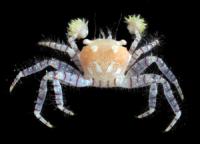
This crab was collected during a three-week expedition to the Northwestern Hawaiian Island National Monument. Joel Martin, NHMLAC, NOAA A three-week scientific expedition to French Frigate Shoals in the Northwestern Hawaiian Islands Marine National Monument returned to Honolulu on Sunday with the discovery of many new species and a better understanding of marine biodiversity in the Hawaiian Archipelago.
| Full story | 0 Comments | 9864 views |
| Microbiology | October 31, 2006 05:49 PM |
By combining the four bacterial surface proteins that generate the strongest immune response in mice, researchers at the University of Chicago have created a vaccine that significantly protects immunized animals from multiple disease-causing, drug-resistant strains of Staphylococcus aureus, the most common cause of hospital-acquired infections and a rapidly spreading source of community-associated illness.
| Full story | 0 Comments | 6053 views |
| Microbiology | October 31, 2006 04:25 PM |
Mayo Clinic Cancer Center has opened a new clinical study using a vaccine strain of the measles virus to attack recurrent glioblastoma multiforme, a largely untreatable brain tumor. This is the second of several pending molecular medicine studies in patients using measles to kill cancer.
| Full story | 0 Comments | 8170 views |

| Health & Medicine | October 31, 2006 02:25 PM |
Researchers at UT Southwestern Medical Center have for the first time described how multiple copies of a gene are responsible for metastases in early-stage breast cancer and poor prognosis for patients.
| Full story | 0 Comments | 5829 views |
| Molecular & Cell Biology | October 31, 2006 12:25 PM |
University of California, San Diego biologists have discovered that disruptions in genes they call Tweedles make fruit flies short and stout like Tweedledee and Tweedledum in Alice in Wonderland. They report in this week's issue of the journal Proceedings of the National Academy of Sciences that a defective TweedleD protein in the outer coat of fly larvae makes them appear compressed.
| Full story | 0 Comments | 6043 views |
| Molecular & Cell Biology | October 31, 2006 10:25 AM |
Spectrin and ankyrin are two essential proteins acting like bricks and mortar to shape and fortify cell membranes. But distinguishing which protein is the brick and which is the mortar has turned out to be difficult. New evidence suggests that spectrin can do both jobs at once.
| Full story | 0 Comments | 5952 views |
| Health & Medicine | October 30, 2006 11:25 PM |
A new study that takes a rare look at the physiological, social and emotional dynamics of day-to-day experiences in real-life settings shows that when older adults go to bed lonely, sad or overwhelmed, they have elevated levels of cortisol shortly after waking the next morning.
| Full story | 0 Comments | 7517 views |
| Biology | October 30, 2006 10:25 PM |
We all have tastes we love, and tastes we hate. And yet, our "taste" for certain flavors and foods can change over time, as we get older or we get tired of eating the same old thing.
| Full story | 0 Comments | 9545 views |
| Molecular & Cell Biology | October 30, 2006 09:25 PM |
A team of MIT engineers has identified two key physical processes that lend spider silk its unrivaled strength and durability, bringing closer to reality the long-sought goal of spinning artificial spider silk.
| Full story | 0 Comments | 6863 views |
| Health & Medicine | October 30, 2006 08:25 PM |
Duke University engineers have shown that a three-dimensional ultrasound scanner they developed can successfully guide a surgical robot.
| Full story | 0 Comments | 7998 views |
| Biotechnology | October 30, 2006 07:25 PM |
David Grewell picked up the little plastic model of a molecule he keeps in his office. He scrunched the model's folding pieces into a ball. That's about the shape of a soy or corn protein, said Grewell, an Iowa State University assistant professor of agricultural and biosystems engineering. Then he unfolded the model into a long, straight loop. That's what happens when researchers add some glycerin – a byproduct of biodiesel production – and some water to the molecule. And that's how biorenewable, biodegradable plastics can be made from the proteins in Iowa crops.
| Full story | 0 Comments | 7825 views |
| Microbiology | October 30, 2006 06:25 PM |
A team of scientists has reconstructed the DNA sequence of a 5-million-year-old retrovirus and shown that it is able to produce infectious particles. The retrovirus--named Phoenix--is the ancestor of a large family of mobile DNA elements, some of which may play a role in cancer. The study, which is the first to generate an infectious retrovirus from a mobile element in the human genome, is considered a breakthrough for the field of retrovirus research. The findings are reported in Genome Research.
| Full story | 0 Comments | 7767 views |
| Health & Medicine | October 30, 2006 05:36 PM |
Diabetes is a growing health problem. Giving antioxidants is recognised as one way of helping people with diabetes to control their blood sugar levels.
| Full story | 0 Comments | 7658 views |
| Health & Medicine | October 30, 2006 04:36 PM |
A test using cultured cells provides an effective way to screen drugs against Huntington's disease and shows that two compounds – memantine and riluzole – are most effective at keeping cells alive under conditions that mimic the disorder, UT Southwestern Medical Center researchers report.
| Full story | 0 Comments | 5893 views |
| Biology | October 30, 2006 12:36 PM |
With their spindly legs, long necks and bright plumage, flamingos are a curiosity of nature. Now a new discovery by a team of Ohio University researchers reveals an anatomical oddity that helps flamingos eat: erectile tissue.
| Full story | 0 Comments | 6548 views |
| Molecular & Cell Biology | October 29, 2006 09:22 PM |
A research team has identified a key enzyme responsible for triggering a chain of events that results in allergic reaction, according to new study findings published online this week in Nature Immunology.
| Full story | 0 Comments | 6357 views |
| Biology | October 28, 2006 04:44 PM |
To predict where a bumblebee will carry its pollen next, you have to literally think like one.
| Full story | 0 Comments | 9008 views |
| Microbiology | October 28, 2006 12:44 PM |
Scientists have discovered a bacterial "switch gene" in two groups of microscopic plankton common in the oceans. The gene helps determine whether certain marine plankton convert a sulfur compound to one that rises into the atmosphere, where it can affect the earth's temperature, or remain in the sea, where it can be used as a nutrient.
| Full story | 0 Comments | 8097 views |
| Molecular & Cell Biology | October 27, 2006 10:44 PM |
With the research support from the University of Wisconsin-Milwaukee, a Wisconsin biotech company has found that a compound from a protein found in jellyfish is neuro-protective and may be effective in treating neurodegenerative diseases.
| Full story | 0 Comments | 7249 views |
| Molecular & Cell Biology | October 27, 2006 09:44 PM |
The full family tree of the species known as social amoebas has been plotted for the first time – a breakthrough which will provide important clues to the evolution of life on earth.
| Full story | 0 Comments | 8805 views |
| Molecular & Cell Biology | October 27, 2006 08:44 PM |
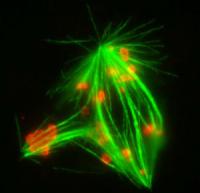
Abnormal mitotic spindle, whose deformation is caused by defective cell division control. The chromosomes are dyed red, the microtubules green. When cells divide, control mechanisms ensure that the genetic material, in other words the chromosomes, is correctly distributed to the daughter cells. Researchers at the Max Planck Institute for Molecular Genetics in Berlin have now explained the molecular principles of these control processes. The so-called checkpoint kinases, i.e. the enzymes which perform this controlling, are not directly associated only with the chromosomes, as was previously assumed to be the case. On the contrary, they interact with a different category of proteins which are involved in the development of the cell division spindle.
| Full story | 0 Comments | 9128 views |
| Biotechnology | October 27, 2006 07:44 PM |
From dental implants to hip replacements, biomaterials have become big business. But scientists pursuing this modern medical revolution share a basic challenge: biocompatibility. How will a biomaterial on the lab bench actually work inside the human body? Will a patient accept the new material or suffer an inflammatory response? And can that material survive in a human's complex system?
| Full story | 0 Comments | 6115 views |

| Bioinformatics | October 27, 2006 06:44 PM |
A respected UK entomology journal, Insect Molecular Biology, today publishes its Honey Bee Genome Special Issue, timed to coincide with the release of the long-awaited Honey Bee Genome Sequence, published earlier this week in Nature magazine.
| Full story | 0 Comments | 5889 views |
| Health & Medicine | October 27, 2006 05:44 PM |
A new study has found that babies that are breastfed for longer than six months have significantly better mental health in childhood.
| Full story | 0 Comments | 7065 views |
| Molecular & Cell Biology | October 26, 2006 11:26 PM |
Immunologists at the Kimmel Cancer Center at Thomas Jefferson University in Philadelphia have used nanotechnology to create a novel "biosensor" to solve in part a perplexing problem in immunology: how immune system cells called killer T-cells hunt down invading viruses.
| Full story | 0 Comments | 6560 views |
| Molecular & Cell Biology | October 26, 2006 10:26 PM |
Alterations in the receptor for a known inflammatory response pathway are strongly associated with Crohn's disease and ulcerative colitis, according to a report by a consortium of American and Canadian researchers in the October 26 online Science Express.
| Full story | 0 Comments | 9582 views |
| Health & Medicine | October 26, 2006 09:26 PM |
A novel combination therapy drastically reduces the infection rate of three viruses – and risk of death – in transplant patients with compromised immune systems. The findings, to be reported in the Nov. 1 print edition of Nature Medicine, originate from a study conducted at Baylor College of Medicine, The Methodist Hospital, and Texas Children's Hospital.
| Full story | 0 Comments | 6726 views |
| Molecular & Cell Biology | October 26, 2006 08:26 PM |
Investigators at St. Jude Children's Research Hospital have discovered in mouse models that a gene called Six3 is one of the earliest critical regulators controlling lens development in the eye of the mammalian embryo.
| Full story | 0 Comments | 7911 views |
| Biology | October 26, 2006 07:26 PM |
The family tree covering almost half the animal species on the planet has been re-drawn following a genetic analysis which has revealed new relationships between four major groups of insects.
| Full story | 0 Comments | 9017 views |
| Bioinformatics | October 26, 2006 06:26 PM |
From humans to honey bees, neuropeptides control brain activity and, hence, our behaviors. Understanding the roles these peptides play in the life of a honey bee will assist researchers in understanding the roles they play in their human counterparts.
| Full story | 0 Comments | 6519 views |

| Stem Cell Research | October 26, 2006 05:26 PM |
Breast cancer survivors might one day avoid the prospect of invasive breast reconstruction surgery, opting instead for an approach that would involve using stem cells derived from their own fat, suggest University of Pittsburgh researchers who are studying the potential these cells may have for regenerating new breast tissue.
| Full story | 0 Comments | 6858 views |
| Biology | October 25, 2006 11:56 PM |
One way to make sense of 165-million-year-old dino tracks may be to hang out with emus, say paleontologists studying thousands of dinosaur footprints at the Red Gulch Dinosaur Tracksite in northern Wyoming. Because they are about the same size, walk on two legs and have similar feet, emus turn out to be the best modern version of the enigmatic reptiles that once trotted along a long-lost coastline in the Middle Jurassic.
| Full story | 0 Comments | 7551 views |
| Microbiology | October 25, 2006 10:56 PM |
A benign virus previously used as a marker in tracing human migration may be unreliable, according to researchers at Penn State. Results of this study also suggest that some viruses might be undergoing much higher rates of evolution than previously thought.
| Full story | 0 Comments | 6333 views |
| Biology | October 25, 2006 09:56 PM |
The general disappearance of cougars from a portion of Zion National Park in the past 70 years has allowed deer populations to dramatically increase, leading to severe ecological damage, loss of cottonwood trees, eroding streambanks, and declining biodiversity.
| Full story | 0 Comments | 8735 views |
| Biotechnology | October 25, 2006 08:56 PM |
A new method for targeting malignant brain tumors through inducing the cancerous cells to "commit suicide" has been developed by a team of researchers headed by a Hebrew University of Jerusalem professor of biochemistry.
| Full story | 0 Comments | 9129 views |

- In some genetic cases of microcephaly, stem cells fail to launch
- Yale team discovers how Zika virus causes fetal brain damage
- Scientists uncover the way a common cell enzyme alerts the body to invading bacteria
- Arctic gives clues on worst mass extinction of life
- Calcium channel blockers caught in the act at atomic level
Search Bio News Net
Free Biology Newsletter
- Flexibility That A.C.A. Lent to Work Force Is Threatened by...International Herald Tribune
- Bacteria Behind Legionnaires’ Disease Found at New York Police StationInternational Herald Tribune
- Prescription Price Crisis? 28 Million Americans See Spike in Drug...MSNBC.com: Health
- Seizing on Opioid Crisis, a Drug Maker Lobbies Hard for...International Herald Tribune
- Republicans are taking a big political risk on health careAP Health News
- Why We're So Divided Over Saving WolvesNational Geographic News