

University of Utah researchers have taken a potentially powerful new therapy for treating diabetes, peripheral vascular disease, and other illnesses out of the test tube and into animals by demonstrating it restores nerve and blood vessel growth in mice.

| Health & Medicine | June 30, 2006 11:59 PM |
For many women, accumulated sun exposure has already permanently damaged their skin cells, causing them to overproduce pigment that shows up as unsightly dark splotches and uneven skin tone over time. But new research indicates that glucosamine - a compound best known for treating arthritis – can actually help stop the formation of new age spots, and help fade existing ones.
| Full story | 0 Comments | 6980 views |

| Molecular & Cell Biology | June 30, 2006 10:59 PM |
Heat-shock protein (HSP) can be utilized as a vaccine to cross-protect against multiple pathogenic species. Investigators from Pusan National University (South Korea) today presented the findings of a study they performed to evaluate the bacterium Porphyromonas gingivalis heat-shock protein (HSP) 60 as a vaccine candidate to inhibit multiple bacteria-induced alveolar bone loss.Recombinant P. gingivalis HSP60 was produced and purified from P. gingivalis GroEL gene. Rats were immunized with P. gingivalis HSP60, and experimental alveolar bone loss was induced by infection with multiple periodontopathogenic bacteria.
| Full story | 0 Comments | 6315 views |
| Molecular & Cell Biology | June 30, 2006 09:59 PM |
A protein that allows breast cancer cells to evade the body's natural immune responses could be a target of future cancer therapies, according to a study by scientists from the Keck School of Medicine of the University of Southern California.
| Full story | 0 Comments | 5657 views |
| Molecular & Cell Biology | June 30, 2006 08:59 PM |
A team of scientists led by Professor Nick Dixon at the Research School of Chemistry at The Australian National University have cracked one of the great DNA mysteries. For more than 20 years scientists have tried in vain to understand the last step in the copying of DNA in cells that are about to divide.
| Full story | 0 Comments | 9081 views |
| Molecular & Cell Biology | June 30, 2006 07:59 PM |
Gardeners and farmers have used the plant hormone auxin for decades, but how plants produce and distribute auxin has been a long-standing mystery. Now researchers at the University of California, San Diego have found the solution, which has valuable applications in agriculture.
| Full story | 0 Comments | 11774 views |
| Molecular & Cell Biology | June 30, 2006 07:02 PM |
Researchers at The University of Texas M. D. Anderson Cancer Center have significantly refined the scientific understanding of how a cell begins the process of self-destruction - an advance they say may help in the design of more targeted cancer therapies.
| Full story | 0 Comments | 8380 views |
| Health & Medicine | June 30, 2006 06:02 PM |
"Bye-bye, bye-bye," said one 3 and a half-year old child, born deaf but with a cochlear implant that partially restored hearing nine months earlier. That's the most complex speech the child uttered during a testing session that involved play with a toy train set.
| Full story | 0 Comments | 6671 views |
| Molecular & Cell Biology | June 30, 2006 04:02 PM |
Researchers at the University of Pennsylvania School of Medicine have identified a new protein required for the circadian response to light in fruit flies. The discovery of this protein – named JET – brings investigators one step closer to understanding the process by which the body's internal clock synchronizes to light. Understanding how light affects circadian (24-hour) rhythms will likely open doors to future treatments of jetlag.
| Full story | 0 Comments | 8737 views |

| Biology | June 30, 2006 02:02 PM |
A new study by McGill University Professor of Psychology Dr. Jeffrey Mogil shows that the capacity for empathy, previously suspected but unproven even among higher primates, is also evident in lower mammals.
| Full story | 0 Comments | 6876 views |
| Molecular & Cell Biology | June 30, 2006 12:02 PM |
Gene amplification plays an important role in causing cancers via activation of oncogenes. If scientists can determine the rules as to which segments of genetic material become amplified and how, oncologists and drug researchers may be able to interrupt that process and prevent the formation and growth of some tumors. Using yeast as a model organism, researchers at the Georgia Institute of Technology have discovered that the location of a hairpin-capped break relative to the end of the chromosome will determine the fate of the amplification event
| Full story | 0 Comments | 5833 views |
| Molecular & Cell Biology | June 30, 2006 10:02 AM |
Dartmouth Medical School geneticists have discovered that DNA damage resets the cellular circadian clock, suggesting links among circadian timing, the cycle of cell division, and the propensity for cancer.
| Full story | 0 Comments | 5703 views |
| Molecular & Cell Biology | June 29, 2006 11:02 PM |
A team led by Johns Hopkins Children's Center scientists has identified and successfully tamed an overactive protein that plays a key role in cystic fibrosis (CF), a genetic disorder that interferes with the body's ability to transport chloride in and out of cells.
| Full story | 0 Comments | 5777 views |

| Environment | June 29, 2006 10:02 PM |
Scientists from NASA and other agencies have concluded that the ozone hole over the Antarctic will recover around 2068, nearly 20 years later than previously believed.
| Full story | 0 Comments | 6879 views |

| Biotechnology | June 29, 2006 09:02 PM |
Using unique nanoparticles that convert laser light into useful information, Rice University scientists have created the world's first nano-sized pH meter.
| Full story | 0 Comments | 5994 views |
| Biology | June 29, 2006 08:12 PM |
Beetles from Uzbekistan are more prolific salt cedar eatersthan beetles from Greece. At least that's what Texas AgriculturalExperiment Station researchers hope.
| Full story | 0 Comments | 7007 views |
| Molecular & Cell Biology | June 29, 2006 08:02 PM |
An ancient avenue for producing cellular energy, the glycolytic pathway, could provide a surprisingly rich target for anti-cancer therapies.
| Full story | 0 Comments | 6713 views |
| Environment | June 29, 2006 07:12 PM |
In a country known more for conflict than conservation, a joint effort by the government of Afghanistan and the Wildlife Conservation Society (WCS) and funded by the United States Agency for International Development (USAID) has been launched to protect the region's unique wildlife and develop the country's first official system of protected areas.
| Full story | 0 Comments | 6777 views |
| Biology | June 29, 2006 07:02 PM |
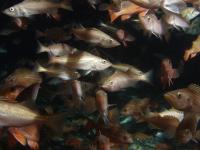
Rockfish thrive with offshore platforms as their home base.While some observers consider offshore oil and gas platforms to be an eyesore on the horizon, new data shows they are performing a critical function for marine life.
| Full story | 0 Comments | 7934 views |

| Stem Cell Research | June 29, 2006 06:12 PM |
Scientists are making headway in exploring the potential future use of stem cells to treat heart disease, according to a review article in the current issue of Nature (June 29, 2006).
| Full story | 0 Comments | 7306 views |

| Microbiology | June 29, 2006 05:12 PM |
Brittleness is often seen as a sign of fragility. But in the case of infectious proteins called prions, brittleness makes for a tougher, more menacing pathogen. Howard Hughes Medical Institute researcher have discovered that brittle prion particles break more readily into new "seeds," which spread infection much more quickly.
| Full story | 0 Comments | 6669 views |
| Biotechnology | June 29, 2006 04:12 PM |
Biotechnology company Biosignal Ltd and the Institute for Eye Research have received ethics approval for the first human clinical trial of an antibacterial extended-wear contact lens.
| Full story | 0 Comments | 6966 views |

| Bioinformatics | June 29, 2006 02:12 PM |
Two gene discoveries announced in separate reports in the June 30, 2006 issue of Cell highlight one way to speed through the human genome in search of those genes most important for spawning cancer. Both groups say that a critical element in the enterprise to efficiently characterize the "human cancer genome" --a comprehensive collection of the genetic alterations responsible for major cancers--is the strategic comparison of human tumors with those of mice.
| Full story | 0 Comments | 6079 views |
| Molecular & Cell Biology | June 29, 2006 12:12 PM |
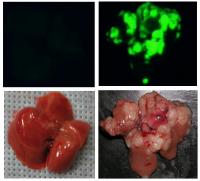
Cold Spring Harbor, New York -- By generating tumors in laboratory mice that mimic human liver cancer and by comparing the DNA of mouse and human tumors, researchers at Cold Spring Harbor Laboratory have identified two genes that are likely to play a role in the third leading cause of human cancer deaths. The study also establishes an efficient and adaptable method for exploring the biology of liver cancer, for validating potential therapeutic targets, and for testing new treatments. The findings are reported in tomorrow's issue of the journal Cell (June 30).
| Full story | 0 Comments | 6561 views |
| Molecular & Cell Biology | June 29, 2006 10:12 AM |
Carnegie Mellon University researchers Kris Noel Dahl and Mohammad F. Islam have made a new breakthrough for children suffering from an extremely rare disease that accelerates the aging process by about seven times the normal rate.
| Full story | 0 Comments | 5463 views |
| Biotechnology | June 28, 2006 11:12 PM |
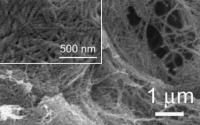
Scanning electron microscope image shows organogel fibers in ethyl acetate. Researchers have created organic gel nanomaterials that could be used to encapsulate pharmaceutical, food, and cosmetic products and to build 3-D biological scaffolds for tissue engineering. Using olive oil and six other liquid solvents, the scientists added a simple enzyme to chemically activate a sugar that changed the liquids to organic gels.
| Full story | 0 Comments | 7199 views |
| Biotechnology | June 28, 2006 10:12 PM |
A team of University of Alberta researchers has created technology to regrow teeth--the first time scientists have been able to reform human dental tissue.
| Full story | 0 Comments | 12162 views |
| Health & Medicine | June 28, 2006 09:12 PM |
Patients have been known to hug Lauren Gerson, MD, so overjoyed are they at hearing her words. What does she say to them? Go ahead and eat chocolate. Indulge your passion for spicy cuisine. Drink red wine. Enjoy coffee when you want it, have that orange juice with breakfast and, what the heck, eat a grapefruit, too. Gerson says that for most heartburn patients, there's insufficient evidence to support the notion that eating these foods will make heartburn worse - or that cutting them out will make it go away.
| Full story | 0 Comments | 6032 views |
| Environment | June 28, 2006 08:12 PM |
Important new measures to protect Antarctica – the world's last great wilderness – from invasive non-native species have been agreed at a meeting of Antarctic experts in Edinburgh.
| Full story | 0 Comments | 6018 views |
| Health & Medicine | June 27, 2006 10:36 PM |
Memory loss associated with early Alzheimer's disease (AD) may be linked to altered activity in several areas of the brain, according to a study in the July issue of Radiology.
| Full story | 0 Comments | 7886 views |
| Health & Medicine | June 27, 2006 09:36 PM |
As the space shuttle Discovery prepares to launch on July 1, researchers at the University of Minnesota have identified a way for astronauts to reduce their risk of developing kidney stones while in space.
| Full story | 0 Comments | 6784 views |
| Biotechnology | June 27, 2006 08:36 PM |
A revolutionary dissolvable scaffold for growing new areas of skin could provide a safer, more effective way of treating burns, diabetic ulcers and similar injuries.
| Full story | 0 Comments | 6678 views |
| Biology | June 27, 2006 07:36 PM |
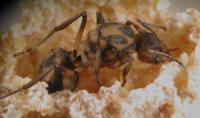
A leaf-cutting ant queen (Acromyrmex coronatus) is sheltered in a chamber deep inside of her fungus garden, made of leaf fragments and strands of a symbiotic fungus.Fungus-farming ants around the world cultivate essentially the same fungus and are not as critical to the reproduction of the fungi as previously believed, biologists at The University of Texas at Austin have discovered.
| Full story | 1 Comment | 9052 views |
| Biology | June 27, 2006 06:36 PM |
Researchers have used a new technique to monitor brain development in infants and detect disturbances in white matter, according to a study in the July issue of Radiology.
| Full story | 0 Comments | 8817 views |
| Molecular & Cell Biology | June 27, 2006 05:36 PM |
Researchers continue to search for genetic clues into rheumatoid arthritis (RA), a chronic inflammatory joint disease. While its specific cause is not yet known, RA has been linked to an inherited susceptibility. Interestingly, despite its strong genetic component, RA's occurrence among siblings seems to be random.
| Full story | 0 Comments | 6100 views |
| Bioinformatics | June 27, 2006 03:36 PM |
Version 1.5 of the Integrated Microbial Genomes (IMG) data management system of the U.S. Department of Energy Joint Genome Institute (DOE JGI) has been released to the public. IMG 1.5 now contains a total of 741 genomes (435 bacterial, 32 archaeal, 15 eukaryotic genomes and 259 bacterial phages) of which 602 are finished and 139 are draft genomes.
| Full story | 0 Comments | 6587 views |
| Health & Medicine | June 27, 2006 01:36 PM |
Health physicists are establishing safe procedures for a promising experimental brain-cancer therapy which uses a radioactive version of a protein found in scorpion venom. For many, this will conjure images of Spiderman's nemesis, the Scorpion. The purpose of this work is not science fiction, but rather to help to develop a promising new therapy for brain cancer. The venom of the yellow Israeli scorpion preferentially attaches to the cells of a type of essentially incurable brain cancers known as gliomas.
| Full story | 1 Comment | 11235 views |
| Biotechnology | June 26, 2006 10:52 PM |
Delft University of Technology research has discovered a method that could drastically change the way we purify water within a few years. Delft, in partnership with DHV engineering bureau, has developed a compact and environmentally-friendly purification method, in which aerobic bacteria form granules that sink quickly. An important part of the project's success was the work of Delft researcher Merle de Kreuk, who, on Tuesday, 27 June, will receive her PhD degree based on this research subject.
| Full story | 0 Comments | 8607 views |
| Environment | June 26, 2006 09:52 PM |
Scientists and resource managers could soon have a highly detailed picture of marine conditions and the migrations of fish and ocean animals throughout the world, according to international experts convening a landmark conference in Canada June 27-30.
| Full story | 0 Comments | 7414 views |
| Health & Medicine | June 26, 2006 08:51 PM |
Portabella and crimini mushrooms rank with carrots, green beans, red peppers and broccoli as good sources of dietary antioxidants, Penn State researchers say.
| Full story | 0 Comments | 7326 views |

- In some genetic cases of microcephaly, stem cells fail to launch
- Yale team discovers how Zika virus causes fetal brain damage
- Scientists uncover the way a common cell enzyme alerts the body to invading bacteria
- Arctic gives clues on worst mass extinction of life
- Calcium channel blockers caught in the act at atomic level
Search Bio News Net
Free Biology Newsletter
- Flexibility That A.C.A. Lent to Work Force Is Threatened by...International Herald Tribune
- Bacteria Behind Legionnaires’ Disease Found at New York Police StationInternational Herald Tribune
- Prescription Price Crisis? 28 Million Americans See Spike in Drug...MSNBC.com: Health
- Seizing on Opioid Crisis, a Drug Maker Lobbies Hard for...International Herald Tribune
- Republicans are taking a big political risk on health careAP Health News
- Why We're So Divided Over Saving WolvesNational Geographic News