

London, UK: Parents of young girls may soon be offered the opportunity to have their daughters immunised against a sexually transmitted virus that is the major cause of cervical cancer, the 4th International Conference on Teenage and Young Adult Cancer Medicine heard today (Thursday 30 March).

| AIDS & HIV | March 31, 2006 08:25 PM |
Researchers at the University of Pennsylvania School of Medicine discovered that an HIV-1 accessory protein called Vpr destroys the host cell's ability to survive by binding to a host receptor. This, in turn, keeps an important enzyme from activating the cell's immune system. These findings refine an earlier understanding of Vpr HIV pathogenesis and imply new approaches to treating AIDS, inflammatory diseases such as rheumatoid arthritis, and possibly sepsis. This research appears in the February print issue of Nature Cell Biology.
| Full story | 0 Comments | 7491 views |

| Health & Medicine | March 31, 2006 07:25 PM |
Three-dimensional ultrasound probes built by researchers at Duke's Pratt School of Engineering have imaged the beating hearts of dogs. The engineers said their demonstration showed that the probes could give surgeons a better view during human endoscopic surgeries in which operations are performed through tiny "keyhole" incisions.
| Full story | 0 Comments | 6376 views |

| Biology | March 31, 2006 06:25 PM |
The Bronx Zoo-based Wildlife Conservation Society (WCS) today applauded a decision today by the U.S. Fish and Wildlife Service to list the Tibetan antelope, also known as "chiru," as an endangered species. Through a series of expeditions to China's windswept Chang Tang Reserve over the past two decades, WCS had played a key role in sounding the alarm about the dramatic decline of this elegant animal due to poaching.
| Full story | 0 Comments | 6744 views |

| Gene Therapy | March 31, 2006 04:17 PM |
Doses of DNA-gene-coated gold particles protect mice against a protein implicated in Alzheimer's disease, researchers at UT Southwestern Medical Center have found.
| Full story | 0 Comments | 7956 views |

| Molecular & Cell Biology | March 31, 2006 02:17 PM |
Delivering a dose of chemotherapy drugs to specific cancer cells without the risk of side affects to healthy cells may one day be possible thanks to a nanoscale drug delivery system being explored by researchers at the U.S. Department of Energy's Ames Laboratory.
| Full story | 0 Comments | 5744 views |
| Biology | March 31, 2006 12:17 PM |
Much of what scientists learn about the evolution of Earth's first animals will have to be gleaned from spherical embryos fossilized under very specific conditions, according to a new study by Indiana University Bloomington and University of Bristol researchers in this week's Proceedings of the National Academy of Sciences.
| Full story | 0 Comments | 7104 views |
| Biology | March 31, 2006 10:17 AM |
A rare frog that lives in rushing streams and waterfalls in east-central China is able to make itself heard above the roar of flowing water by communicating ultrasonically, scientists reported March 16 in the journal Nature. Attributes that enable the frog to hear ultrasounds are made possible by the presence of an ear canal, which most other frogs don't have.
| Full story | 0 Comments | 6715 views |

| Microbiology | March 30, 2006 11:25 PM |
A clinical trial to test different strengths of a vaccine designed to fight avian influenza will begin this month at Duke University Medical Center.
| Full story | 0 Comments | 7031 views |

| Biotechnology | March 30, 2006 10:25 PM |
A novel enzyme in corn helps the plants defend themselves from voracious caterpillars by disrupting the insects' ability to digest food, and ultimately killing them, according to researchers. The enzyme could be used in tandem with other biological pesticides such as the Bt toxin to prevent the pests from developing resistance and making the toxin more effective.
| Full story | 0 Comments | 5725 views |
| Biotechnology | March 30, 2006 09:25 PM |
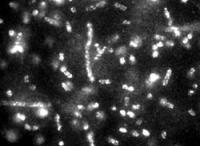
This fluorescence micrograph shows phage-quantum dot complexes (bright spots) bound to E. coli cells (cylindrical shapes). The NCI/NIST method of tagging cells with quantum dots can be used to identify bacteria much faster than conventional methods. The fluorescence signal is strong and stable for hours, enabling scientists to count the number of phage viruses bound to a cell.A rapid method for detecting and identifying very small numbers of diverse bacteria, from anthrax to E. coli, has been developed by scientists from the National Cancer Institute (NCI) and National Institute of Standards and Technology (NIST). Described in the March 28 issue of Proceedings of the National Academy of Sciences,* the work could lead to the development of handheld devices for accelerated identification of biological weapons and antibiotic-resistant or virulent strains of bacteria--situations where speed is essential.
| Full story | 0 Comments | 29274 views |
| Health & Medicine | March 30, 2006 08:25 PM |
Tyler Dunlap, a 27-year-old newlywed in San Francisco, is just one of the many American men eagerly awaiting the results of a large clinical trial in India.
| Full story | 0 Comments | 96576 views |
| Health & Medicine | March 30, 2006 07:25 PM |
While newly published research confirms that under laboratory circumstances prion-protein can be absorbed across the gut, it also shows that this is unlikely to occur in real life. In addition, the results show that the places in the gut that do take up these disease-associated proteins are different from the locations where infectivity is known to be amplified. The findings will be published in the Journal of Pathology.
| Full story | 0 Comments | 6494 views |
| Health & Medicine | March 30, 2006 06:17 PM |
An innovative new study explains, for the first time, the failure of previous attempts to vaccinate against the four known Dengue viruses, and it suggests a very simple solution – injecting the four vaccines simultaneously at different locations on the body.
| Full story | 0 Comments | 5216 views |
| Biology | March 30, 2006 04:17 PM |
Youth with superior IQ are distinguished by how fast the thinking part of their brains thickens and thins as they grow up, researchers at the National Institutes of Health's (NIH) National Institute of Mental Health (NIMH) have discovered.
| Full story | 0 Comments | 5888 views |
| Microbiology | March 30, 2006 02:17 PM |
Results from a clinical trial demonstrate that high doses of an experimental H5N1 avian influenza vaccine can induce immune responses in healthy adults.
| Full story | 0 Comments | 5525 views |

| Environment | March 30, 2006 12:17 PM |
Oxygen depletion in the world’s oceans, primarily caused by agricultural run-off and pollution, could spark the development of far more male fish than female, thereby threatening some species with extinction, according to a study published today on the Web site of the American Chemical Society journal, Environmental Science & Technology. The study is scheduled to appear in the May 1 print issue of the journal.
| Full story | 0 Comments | 19780 views |
| Molecular & Cell Biology | March 30, 2006 10:17 AM |
The unchecked activity of a cell signaling pathway crucial in embryonic development and the liver's response to injury leads to liver cancer, researchers from Duke University Medical Center and John Hopkins University School of Medicine have found.
| Full story | 0 Comments | 7459 views |
| Molecular & Cell Biology | March 29, 2006 11:18 PM |
A pain–killing medication appears to halt the production of an enzyme that is key to a common form of breast cancer, a new study using tissue cultures suggests.
| Full story | 0 Comments | 5593 views |
| Biology | March 29, 2006 10:18 PM |
The sweetgum tree grows widely throughout the country and is known for its mace-like green fruit, which are sometimes called "gumballs." Now, this spiny fruit may become an important source of a chemical needed to make a lifesaving drug against bird flu — a drug that is currently in short supply worldwide, researchers say.
| Full story | 0 Comments | 6357 views |
| Molecular & Cell Biology | March 29, 2006 09:17 PM |
The simplest bacteria need almost twice as many genes to survive than scientists first believed, according to new research published in Nature (30 March 2006).
| Full story | 0 Comments | 7422 views |
| Health & Medicine | March 29, 2006 08:18 PM |
To live we need to breathe. Prior to being born we carry this activity out through the placenta and subsequently by means of our lungs. In normal development, the lungs of the foetus are filled with amniotic liquid and, on being born, the first cry activates this respiration surface. But the main problem that premature babies have is that their lungs are not well formed. Moreover, they often lack surfactant, a compound formed by proteins and lipids that avoids the lungs folding in on themselves before the baby gets stronger.
| Full story | 0 Comments | 8074 views |
| Molecular & Cell Biology | March 29, 2006 07:18 PM |
Johns Hopkins researchers have used mouse mutants to define critical steps involved in learning basic motor skills. The study focuses on the behavior of two proteins and the specific steps they take to control a neuron's ability to learn by adapting to signals from other nerve cells.
| Full story | 0 Comments | 5842 views |
| Biotechnology | March 29, 2006 04:15 PM |
University of Michigan researchers have discovered how to measure the absorption of multi-walled carbon nanoparticles into worms and cancer cells, a breakthrough that will revolutionize scientists' understanding of how the particles impact the living environment.
| Full story | 0 Comments | 8305 views |
| Environment | March 29, 2006 01:15 PM |
A small Pacific Islands nation has distinguished itself on the global conservation map with the declaration today that it is creating the third largest marine protected area in the world, conserving an archipelago of some of the planet's most pristine coral reefs.
| Full story | 0 Comments | 8113 views |
| Microbiology | March 29, 2006 11:15 AM |
The study was conducted by researchers from Scripps Research; the Genomics Research Center, Academia Sinica, Taiwan; and the National Taiwan University. It is being published today in the journal Chemistry and Biology (Vol. 13, No. 3).
| Full story | 0 Comments | 6517 views |

| Bioinformatics | March 28, 2006 11:15 PM |
Scientists at St. Jude Children's Research Hospital have given investigators around the world free access to a powerful tool for studying brain development. The Internet-based tool, called the mouse Brain Gene Expression Map (BGEM), is one of the largest gene expression maps of an organ ever developed, according to the St. Jude researchers. They say the map will likely help scientists discover the genetic origins of brain cancers, which could speed development of novel drugs to treat them.
| Full story | 0 Comments | 7905 views |
| Biotechnology | March 28, 2006 10:15 PM |
Antibodies against the bird flu virus H5N1, derived from horses, prevent mice infected with H5N1 from dying from the virus.
| Full story | 0 Comments | 9917 views |
| Molecular & Cell Biology | March 28, 2006 09:14 PM |
Scientists have found that growth hormone, a substance that is used for body growth, is produced in the brain, according to an article published in this week's Proceedings of the National Academy of Sciences.
| Full story | 0 Comments | 6851 views |
| Biotechnology | March 28, 2006 04:46 PM |
A breakthrough self-assembly technique for growing replacement cartilage offers the first hope of replacing the entire articular surface of knees damaged by arthritis. The technique, developed at Rice University's Musculoskeletal Bioengineering Laboratory, is described in this month's issue of the journal Tissue Engineering.
| Full story | 0 Comments | 7580 views |
| Biology | March 28, 2006 12:45 PM |
If you think you've got a bad boss, one who loves to chew people out, or if you work with backstabbing co-workers, be thankful you are not a wasp.
| Full story | 0 Comments | 6569 views |
| Molecular & Cell Biology | March 27, 2006 10:45 PM |
This "evolutionary conversion" provides a modern-day snapshot of how life as we understand it may have first evolved out of the earliest primordial mix of RNA-like molecules-sometimes referred to as the "pre-RNA world"-into a more complex form of RNA-based life (or the "RNA world") and eventually to cellular life based on DNA and proteins. Nucleic acids are large complex molecules that store and convey genetic information, but can also function as enzymes.
| Full story | 0 Comments | 6976 views |
| Health & Medicine | March 27, 2006 09:45 PM |
Children's Hospital of Pittsburgh of University of Pittsburgh Medical Center researchers Massimo Trucco, MD, and Nick Giannoukakis, PhD, observed marked amelioration of diabetes in a mouse model by a novel treatment strategy involving specific modification of the animal's own dendritic cells, thereby reversing diabetes in animal studies.
| Full story | 0 Comments | 5758 views |
| Molecular & Cell Biology | March 27, 2006 08:45 PM |
Enzymes that can harm the brain immediately after a stroke may actually be beneficial days later, according to new research. Insights from the study could change the way stroke is treated, extending the window for effective treatment from a couple of hours to a couple of weeks. The results may suggest new ideas for drug development.
| Full story | 0 Comments | 5706 views |
| Bioinformatics | March 27, 2006 07:45 PM |
New evidence is emerging that climate change could reduce not only the world's ability to produce food but also international efforts to cut poverty. However, the recent sequencing of the rice genome is already providing researchers with some of the tools they need to help poor rice farmers and consumers avoid the worst effects of the problem.
| Full story | 0 Comments | 8203 views |
| Health & Medicine | March 27, 2006 06:45 PM |
A novel approach to creating a vaccine to treat melanoma has demonstrated promising effectiveness in a new laboratory study led by researchers at The Wistar Institute. About a third of melanoma patients might benefit from such a vaccine. The study appears in the current issue of Cancer Research.
| Full story | 0 Comments | 6340 views |
| Biotechnology | March 27, 2006 05:45 PM |
The ultimate applications are potentially limitless. In the long term it will possibly enable the creation of very sophisticated neural prostheses to combat neurological disorders. What's more, it could allow the creation of organic computers that use living neurons as their CPU.
| Full story | 0 Comments | 7226 views |
| Health & Medicine | March 27, 2006 04:14 PM |
In diverse ecosystems, packed with wildly different species, evolution whizzes along. As different species accumulate mutations, some adapt particularly well to their environment and prosper. It happens in marine sediments, mountain forests – and, as a new study illustrates, in precancerous tumors, too.
| Full story | 1 Comment | 7819 views |
| Biotechnology | March 27, 2006 02:14 PM |
Researchers report they have created pigs that produce omega-3 fatty acids, which are known to improve heart function and help reduce the risks for heart disease, representing the first cloned transgenic livestock in the world that can make the beneficial compound. The research could be a boost to both farmers and health-conscious consumers seeking an alternative and safer source of omega-3 fatty acids. Currently, the only way for humans to realize the benefits of omega-3 fatty acids is by taking dietary supplements or by eating certain types of fish that may also contain high levels of mercury.
| Full story | 0 Comments | 7047 views |
| Health & Medicine | March 27, 2006 12:14 PM |
One of the most effective chemotherapy drugs against cancer is cisplatin because it attaches to cancer DNA and disrupts repair. However, it also kills healthy tissue. Many scientists are creating alternative drugs or cisplatin analogs in attempts to find treatments without side effects. One approach to analog development is light activated drugs, or photodynamic therapy (PDT). Now a Virginia Tech chemistry-biology research team that has been working on both non-cisplatin drugs and cisplatin analogs has combined their findings to create a molecular complex (supramolecule) that exploits cisplatins tumor targeting to deliver a light activated drug.
| Full story | 0 Comments | 6086 views |

- In some genetic cases of microcephaly, stem cells fail to launch
- Yale team discovers how Zika virus causes fetal brain damage
- Scientists uncover the way a common cell enzyme alerts the body to invading bacteria
- Arctic gives clues on worst mass extinction of life
- Calcium channel blockers caught in the act at atomic level
Search Bio News Net
Free Biology Newsletter
- Flexibility That A.C.A. Lent to Work Force Is Threatened by...International Herald Tribune
- Bacteria Behind Legionnaires’ Disease Found at New York Police StationInternational Herald Tribune
- Prescription Price Crisis? 28 Million Americans See Spike in Drug...MSNBC.com: Health
- Seizing on Opioid Crisis, a Drug Maker Lobbies Hard for...International Herald Tribune
- Republicans are taking a big political risk on health careAP Health News
- Why We're So Divided Over Saving WolvesNational Geographic News