

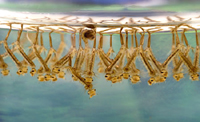
A shift in the feeding behavior of Culex mosquitoes (their larvae amass in standing water, as seen above) helps explain the rising incidence of West Nile virus in North America. (Image: James Gathany, CDC)Since its introduction to the United States in 1999, West Nile virus has become the major vector-borne disease in the U.S., with 770 reported deaths, 20,000 reported illnesses, and perhaps around a million people infected. The virus is transmitted by Culex mosquitoes (the "vector") and cycles between birds that the mosquitoes feed on. Humans can also be infected with the virus when bitten by these mosquitoes.

| Microbiology | February 28, 2006 11:16 PM |
| Full story | 1 Comment | 7932 views |

| Biology | February 28, 2006 11:06 PM |
In the first study of native African honeybees and honey-making stingless bees in the same habitat, humans and chimpanzees are the primary bee nest predators. Robert Kajobe of the Dutch Tropical Bee Research Unit and David Roubik from the Smithsonian Tropical Research Institute report this finding in the March, 2006 issue of Biotropica.
| Full story | 0 Comments | 7199 views |

| Biotechnology | February 28, 2006 10:06 PM |
Yale biomedical engineers have created an implantable system that can form and stabilize a functional network of fine blood vessels critical for supporting tissues in the body, according to a report in the Proceedings of the National Academy of Sciences.
| Full story | 0 Comments | 7840 views |
| Microbiology | February 28, 2006 08:07 PM |
The MRSA 'superbug' evades many of the measures introduced to combat its spread by infecting a common single-celled organism found almost everywhere in hospital wards, according to new research published in the journal Environmental Microbiology.
| Full story | 0 Comments | 9586 views |

| Molecular & Cell Biology | February 28, 2006 08:06 PM |
In addition to triggering a depression-like social withdrawal syndrome, repeated defeat by dominant animals leaves a mouse with an enduring "molecular scar" in its brain that could help to explain why depression is so difficult to cure, suggest researchers funded by the National Institutes of Health's (NIH) National Institute of Mental Health (NIMH).
| Full story | 0 Comments | 8177 views |

| Stem Cell Research | February 28, 2006 08:06 PM |
Therapy that involved bone marrow stem cells did not improve cardiac function in patients following a heart attack, according to a study in the March 1 issue of JAMA.
| Full story | 0 Comments | 10222 views |

| Environment | February 28, 2006 08:06 PM |
Predators are, ironically, the key to keeping the world green, because they keep the numbers of plant-eating herbivores under control, reports a research team lead by John Terborgh, a professor of environmental science at Duke University's Nicholas School of the Environment and Earth Sciences.
| Full story | 1 Comment | 9358 views |

| AIDS & HIV | February 28, 2006 06:16 PM |
Combining aggressive HIV therapy and chemotherapy significantly improves the survival rates of HIV-positive men and women treated for lymphoma, according to a new study.
| Full story | 0 Comments | 6607 views |
| AIDS & HIV | February 28, 2006 06:15 PM |
New research shows that highly active antiretroviral therapy (HAART) is very cost-effective, despite the high price tag. However, the study also shows that reimbursement to physicians treating patients with HIV is critically low, threatening patients' access to care. The study findings are reported in the April 1 issue of Clinical Infectious Diseases, now available online.
| Full story | 0 Comments | 8763 views |
| Biotechnology | February 27, 2006 11:15 PM |
A real-time sensor for detecting cocaine –– made with inexpensive, off-the-shelf electronics –– has been developed by a team of researchers at the University of California, Santa Barbara. Two local high school students and a Nobel laureate participated in the discovery. The potential applications of the sensor are far-reaching and include bioterrorism detection and important medical uses.
| Full story | 0 Comments | 9196 views |
| Biology | February 27, 2006 10:14 PM |
A team of researchers from the University of Alberta, the Yerkes National Primate Research Center of Emory University and the Emory Transplant Center has successfully transplanted insulin-producing neonatal porcine islet cells into monkeys, a procedure the researchers say represents a promising intermediate solution to the critical supply problem in clinical islet cell transplantation.
| Full story | 0 Comments | 6543 views |
| Biology | February 27, 2006 10:14 PM |
Scientists can now predict memory of an event before it even happens. A team at UCL (University College London) can now tell how well memory will serve us before we have seen what we will remember.
| Full story | 1 Comment | 8157 views |
| Biology | February 27, 2006 09:15 PM |
Anabolic steroids not only make teens more aggressive, but may keep them that way into young adulthood. The effect ultimately wears off but there may be other, lasting consequences for the developing brain. These findings, published in February's Behavioral Neuroscience, also showed that aggression rose and fell in synch with neurotransmitter levels in the brain's aggression control region. Behavioral Neuroscience is published by the American Psychological Association (APA).
| Full story | 0 Comments | 7790 views |

| Health & Medicine | February 27, 2006 08:15 PM |
A cut can be life-threatening for people with hemophilia, whose bodies don't produce enough of a protein that prevents prolonged bleeding.
| Full story | 0 Comments | 9998 views |
| Molecular & Cell Biology | February 27, 2006 06:16 PM |
An international research team has provided the first conclusive evidence that neurodevelopmental disorders such as mental retardation and neurodegenerative disorders such as Alzheimer's disease, Parkinson's disease and ataxias can be caused, at least in part, by specific gene defects that interfere with the electrical impulses of rapid-firing brain nerve cells called bursting neurons.
| Full story | 0 Comments | 7324 views |
| AIDS & HIV | February 27, 2006 06:16 PM |
A study by researchers at the University of California, San Diego (UCSD) School of Medicine indicates that the rate of HIV/AIDS infection in Tijuana, Mexico is increasing, and much higher than had been previously estimated. The findings are based on data compiled by a team of researchers working in San Diego and Mexico to create a population-based model in order to estimate HIV infection rates.
| Full story | 0 Comments | 7260 views |
| Stem Cell Research | February 27, 2006 06:16 PM |
Researchers at the University of California, Riverside have discovered a molecular mechanism directing the fate and function of cells during animal development. The findings could hold promise for the advancement of cancer and stem-cell research.
| Full story | 0 Comments | 10455 views |
| Environment | February 26, 2006 06:55 PM |
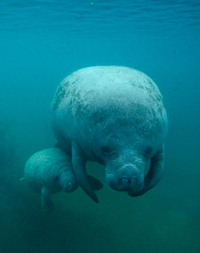 According to statistics released in January 2006, the year 2005 was the second deadliest on record for Florida's endangered manatee population. One of the leading causes of fatalities was the toxins produced by "red tide" blooms of the alga Karenia brevis, which appear to be growing increasingly common in Florida. A recently completed collaborative study now suggests a surprisingly tight connection between the effects of the toxins on manatees and on humans, and potential implications for human impacts.
| Full story | 1 Comment | 29234 views |

| Microarray | February 26, 2006 06:31 PM |
UCSF and Cleveland Clinic scientists have discovered a new virus in human prostate tumors. The type of virus, closely related to viruses typically found in mice, has never been detected in humans. The virus's link to human disease is still unclear, and more study is needed to determine the relationship between the virus and cancer, if any, the scientists say.
| Full story | 0 Comments | 15010 views |
| Molecular & Cell Biology | February 26, 2006 06:30 PM |
Drawing on lab experiments and computer studies, Johns Hopkins researchers have learned how a common protein delivers its warning message to cells when an infectious agent invades the body. The findings are important because this biological intruder alarm causes the body's immune system to leap into action to fight the infection. Learning more about how this process works, the researchers said, could lead to better treatments for diseases that occur when the immune system overreacts or pays too little attention to the infection alarm.
| Full story | 0 Comments | 7550 views |
| Molecular & Cell Biology | February 26, 2006 06:30 PM |
Discoveries made during the first large-scale analysis of interactions between proteins in our cells hold promise for identifying new genes involved in genetic diseases, according to researchers at Johns Hopkins and the Institute of Bioinformatics (IOB) in Bangalore.
| Full story | 0 Comments | 7145 views |

| General | February 26, 2006 06:30 PM |
As of 2006 more than 130 environmental journals from the scientific publisher Springer will be part of the initiative Online Access to Research in the Environment (OARE), a digital library for developing countries. Public and non-profit institutions in underdeveloped nations in Africa, Asia, Latin America, the Caribbean and Eastern Europe will have free access to the peer-reviewed scientific literature of Springer and other leading international publishing houses.
| Full story | 0 Comments | 12719 views |
| Biology | February 24, 2006 11:06 PM |
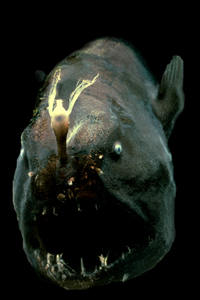
Menacing Deep-sea Anglerfish. Credit: Harbor Branch/E. WidderFor centuries scientists have thought of deep-sea pelagic fish as nomadic wanderers, in part because information about them was so limited. However, new results from the ongoing Mid-Atlantic Ridge Ecosystems program (MAR-ECO), a Sloan Foundation-sponsored component of the Census of Marine Life, have revealed that these fishes may in fact be gathering at features such as ridges or seamounts to spawn.
| Full story | 0 Comments | 10792 views |
| Biotechnology | February 24, 2006 09:15 PM |
Researchers from the Monell Chemical Senses Center have succeeded in growing mature taste receptor cells outside the body and for the first time have been able to successfully keep the cells alive for a prolonged period of time. The establishment of a viable long-term model opens a range of new opportunities to increase scientists' understanding of the sense of taste and how it functions in nutrition, health and disease.
| Full story | 0 Comments | 7584 views |
| Biotechnology | February 24, 2006 09:15 PM |
University of Rochester Medical Center scientists have demonstrated a new technology that accurately and rapidly detects the meat-spoiling and sometimes dangerous E. coli bacteria.
| Full story | 1 Comment | 7315 views |
| Molecular & Cell Biology | February 24, 2006 09:14 PM |
Evolutionary paths to new therapeutic drugs, as well as a wide assortment of other enzyme products, have been created through, of all things, intelligent design. A team of researchers with the Lawrence Berkeley National Laboratory (Berkeley Lab) and the University of California at Berkeley have developed a technique in which the evolution of an important class of proteins is steered towards a desired outcome.
| Full story | 0 Comments | 5829 views |
| Biology | February 24, 2006 09:14 PM |
University of Florida scientists have found that people have an ancient skeleton in their closets - a skeleton personified today by a jawless, eel-like fish.
| Full story | 0 Comments | 6626 views |
| Health & Medicine | February 24, 2006 06:30 PM |
A team of scientists has identified a cellular mechanism that may help explain the puzzle of why people of African descent are more susceptible to tuberculosis infection and why, once infected, they develop more severe states of the disease than whites. The team includes researchers from University of California, Los Angeles (UCLA), and Harvard School of Public Health (HSPH). The paper will appear online in the February 23 issue of Science Express.
| Full story | 0 Comments | 6819 views |
| Biology | February 23, 2006 11:56 PM |
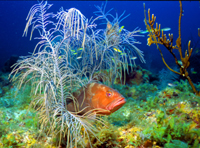
A red grouper pauses on the seabed of Dry Tortugas National Park, Florida, surrounded by gorgonian soft coral, sponges, and algae. (Photo by UM Rosenstiel School Associate Scientist Jiangang Luo.)Rosenstiel School fisheries researchers will embark on state-of-the-art research at the end of February to track black and red grouper in the Dry Tortugas National Park to develop a better understanding of species' movement and habitat requirements, so they can help more efficiently design and assess future marine-protected areas. Through funding from the National Park Service and transportation support from Yankee Fleet Ferry Service, scientists will be able to conduct this high-tech observation that involves surgically implanted transmitters for approximately a year.
| Full story | 0 Comments | 6650 views |
| Stem Cell Research | February 23, 2006 11:45 PM |
In a giant step towards understanding prostate disease, Melbourne scientists have grown a human prostate from embryonic stem cells.
| Full story | 0 Comments | 8406 views |
| Microbiology | February 23, 2006 11:14 PM |
Bacteria could help transform a key component of disposable cups, plates and utensils into a useful eco-friendly plastic, significantly reducing the environmental impact of this ubiquitous, but difficult-to-recycle waste stream, according to a study scheduled to appear in the April 1 issue of the American Chemical Society journal, Environmental Science & Technology.
| Full story | 0 Comments | 12450 views |
| Biology | February 23, 2006 10:15 PM |
Scientists at Carnegie Mellon University have discovered that our ears use the most efficient way to process the sounds we hear, from babbling brooks to wailing babies. These results represent a significant advance in our understanding of how sound is encoded for transmission to the brain, according to the authors, whose work is published with an accompanying "News and Views" editorial in the Feb. 23 issue of Nature.
| Full story | 0 Comments | 6780 views |
| Molecular & Cell Biology | February 23, 2006 09:15 PM |
In the March issue of Trends in Biotechnology, scientists and doctors with the Physicians Committee for Responsible Medicine (PCRM) recommend using only animal serum-free media to grow live cells in the laboratory. At issue is the use of fetal calf serum, which is obtained by puncturing the heart of a fetal calf without anesthesia. Recent breakthroughs permit the growth of human cells in a medium free of animal serum, enabling scientists and researchers to make cell culture safer and more humane.
| Full story | 0 Comments | 5474 views |
| Microbiology | February 23, 2006 09:15 PM |
Bacteria are bad. Mothers and doctors, not to mention the cleaning product industry, repeatedly warn of their dangers. But a Stanford University School of Medicine microbiologist is raising the intriguing idea that persistent bacterial and viral infections have benefits.
| Full story | 0 Comments | 5024 views |
| Environment | February 23, 2006 06:56 PM |
One of the greatest challenges facing marine ecologists today is finding innovative ways to reverse the rapid decline of coral reef ecosystems around the world. Ten percent of the planet's reefs already have been degraded beyond recovery, according to one survey, and another 60 percent could die by 2050, primarily because of human activities, such as pollution, overfishing and climate change.
| Full story | 0 Comments | 5226 views |
| Biology | February 23, 2006 06:55 PM |
If mastering flight is your goal, you can't do better than to emulate a dragonfly. With four wings instead of the standard two and an unusual pitching stroke that allows the bug to hover and even shift into reverse, the slender, elegant insect is a marvel of engineering.
| Full story | 0 Comments | 6143 views |
| Health & Medicine | February 22, 2006 11:57 PM |
The federal agency that oversees childhood vaccinations today recommended a new vaccine for routine use against rotavirus infection, a common childhood illness that is the single largest infectious disease killer of infants and young children worldwide. Three scientists associated with The Children's Hospital of Philadelphia and The Wistar Institute are co-inventors of the vaccine, based on research dating to 1980.
| Full story | 0 Comments | 9292 views |
| Biology | February 22, 2006 11:40 PM |
Marine scientists have discovered that the deepest oceans of the world would appear to be shark free.
| Full story | 0 Comments | 8100 views |
| Biology | February 22, 2006 11:33 PM |
Researchers have identified three new species of lemurs, the small, big-eyed primates native to the island of Madagascar.
| Full story | 0 Comments | 10723 views |
| Molecular & Cell Biology | February 22, 2006 11:32 PM |
A recent study shows that hundreds of genes contribute to cell growth and cell division. For the first time these genes, many of which are potential contributors to cancer, have been mapped in a single systematic study.
| Full story | 0 Comments | 6244 views |

- In some genetic cases of microcephaly, stem cells fail to launch
- Yale team discovers how Zika virus causes fetal brain damage
- Scientists uncover the way a common cell enzyme alerts the body to invading bacteria
- Arctic gives clues on worst mass extinction of life
- Calcium channel blockers caught in the act at atomic level
Search Bio News Net
Free Biology Newsletter
- Flexibility That A.C.A. Lent to Work Force Is Threatened by...International Herald Tribune
- Bacteria Behind Legionnaires’ Disease Found at New York Police StationInternational Herald Tribune
- Prescription Price Crisis? 28 Million Americans See Spike in Drug...MSNBC.com: Health
- Seizing on Opioid Crisis, a Drug Maker Lobbies Hard for...International Herald Tribune
- Republicans are taking a big political risk on health careAP Health News
- Why We're So Divided Over Saving WolvesNational Geographic News