

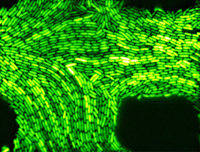
A high level of variation in the amount of green fluorescence protein in individual non-growing E. coli cells surprised synthetic biology researchers at Boston University and the University of California, San Diego An experiment designed to show how a usually innocuous bacterium regulates the expression of an unnecessary gene for green color has turned up a previously unrecognized phenomenon that could partially explain a feature of bacterial pathogenicity.

| Microarray | February 17, 2006 11:34 PM |
| Full story | 0 Comments | 4536 views |

| Biotechnology | February 17, 2006 11:03 PM |
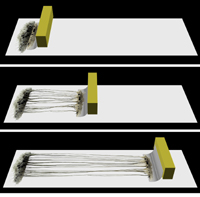
Development of a nervous tissue construct for transplantation. Full caption at the end of the article. (Credit: Douglas H. Smith, MD, University of Pennsylvania School of Medicine)
Researchers at the University of Pennsylvania School of Medicine have created – in a rodent model – a completely new way to engineer nerve structures, or constructs, in culture. This proof-of-principle research has implications for eventually becoming a new method to repair spinal cord injury in humans. The work appears in the latest issue of Tissue Engineering.
| Full story | 0 Comments | 5503 views |

| Health & Medicine | February 17, 2006 11:02 PM |
Almost 200 countries agreed in 1990 to cut worldwide hunger in half by 2015. That commitment is now looking like an empty promise -- all talk and no action -- according to a Cornell University expert on world hunger.
| Full story | 0 Comments | 4624 views |

| Stem Cell Research | February 17, 2006 11:02 PM |
Human embryonic stem cells (hES) offer great hope for the treatment of some devastating diseases, but finding a way to keep enough of these cells usable and healthy for transplantation in patients has been an ongoing problem. Now scientists at UC Irvine have discovered a way to keep large quantities of these cells alive, a finding that could potentially lead to mass production of hES cells for therapeutic use at lower cost.
| Full story | 0 Comments | 3891 views |

| Bioinformatics | February 17, 2006 11:02 PM |
Since the genome sequence of the bacterial pathogen Haemophilus influenzae was published in 1995, the genetic code of many other large, complex, medically, and commercially significant organisms including humans has also been elucidated.
| Full story | 0 Comments | 4660 views |

| Molecular & Cell Biology | February 17, 2006 11:02 PM |
Researchers at the University of Pennsylvania School of Medicine discovered that a key receptor protein is a critical component of the internal molecular clock in mammals. What's more, this molecule –called Rev-erb– is sensitive to lithium and may help shed light on circadian rhythm disorders, including bipolar disorder. The findings, which also provide insight into clock-controlled aspects of metabolism, are reported in this week's issue of Science.
| Full story | 0 Comments | 5529 views |

| Microbiology | February 17, 2006 11:02 PM |
Editor: Yeah, I hate it too when there's no picture in this kind of article
A detailed structural picture of a molecule that plays a key role in activating the Epstein Barr Virus in human cells has now been obtained by researchers at the European Molecular Biology Laboratory (EMBL) and the Institut de Virologie Moléculaire et Structurale (IVMS), associated with the Université Joseph Fourier and the CNRS, in Grenoble.
| Full story | 0 Comments | 6401 views |

| Biology | February 17, 2006 10:43 PM |
Do human newborns develop their preference for speech through in-utero eavesdropping, or is their penchant for speech innate? It's a bedevilling question to test, but one that's central to understanding the origins and dynamics of humans unique propensity for speech. Now a McGill University psychologist believes she's separated out the complicating effects of the uterine sound barrier. And the results, says Dr. Athena Vouloumanos, point to a genetic predilection for listening in on speech above other similar sounds.
| Full story | 0 Comments | 5904 views |

- In some genetic cases of microcephaly, stem cells fail to launch
- Yale team discovers how Zika virus causes fetal brain damage
- Scientists uncover the way a common cell enzyme alerts the body to invading bacteria
- Arctic gives clues on worst mass extinction of life
- Calcium channel blockers caught in the act at atomic level
Search Bio News Net
Free Biology Newsletter
- Flexibility That A.C.A. Lent to Work Force Is Threatened by...International Herald Tribune
- Bacteria Behind Legionnaires’ Disease Found at New York Police StationInternational Herald Tribune
- Prescription Price Crisis? 28 Million Americans See Spike in Drug...MSNBC.com: Health
- Seizing on Opioid Crisis, a Drug Maker Lobbies Hard for...International Herald Tribune
- Republicans are taking a big political risk on health careAP Health News
- Why We're So Divided Over Saving WolvesNational Geographic News