

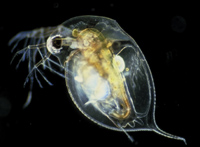
The water flea Daphnia pulex is a commonly used model organism among ecologists and other environmental scientists. Copyright Holder: P.D.N. Hebert, University of Guelph When sexual species reproduce asexually, they accumulate bad mutations at an increased rate, report two Indiana University Bloomington evolutionary biologists in this week's Science. The researchers used the model species Daphnia pulex, or water flea, for their studies.

| Biology | February 16, 2006 11:45 PM |
| Full story | 0 Comments | 12492 views |

| Molecular & Cell Biology | February 16, 2006 11:35 PM |
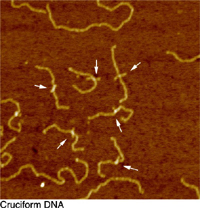
This microscopic image of DNA containing the chromosome 11 palindrome shows cruciform configurations (indicated by arrows), where potentially unstable sections of DNA protrude from the main strands. As the human genome gradually yields up its secrets, scientists are finding some genetic events, such as rearrangements in chromosomes, are less random than they had previously thought. Originating as structural weaknesses in unstable stretches of DNA, abnormal chromosomes may, rarely, result in a disabling genetic disease one or two generations later.
| Full story | 0 Comments | 7334 views |

| Health & Medicine | February 16, 2006 11:03 PM |
Concerns over the fast tracking of new drugs for commercial licensing are raised by a senior doctor in this week's BMJ.
| Full story | 0 Comments | 4453 views |

| Bioinformatics | February 16, 2006 11:03 PM |
Ehrlichiosis is no star of science. This emerging disease has an awkward name, vague flu-like symptoms, and a nasty habit of being caused by bacteria that live inside ticks and flatworms. But in the current issue of the journal Public Library of Science Genetics (PLoS Genetics), scientists put ehrlichiosis under the genomic spotlight--and discover some brilliant biology.
| Full story | 0 Comments | 5409 views |

| Biotechnology | February 16, 2006 11:03 PM |
Researchers at Virginia Tech's College of Agriculture and Life Sciences are part of consortium of public wheat breeders and scientists that have been awarded $5 million from the USDA to enable routine use of modern breeding technologies to produce higher quality, disease-resistant wheat.
| Full story | 0 Comments | 6564 views |
| Molecular & Cell Biology | February 16, 2006 11:03 PM |
The tumblers of life continue to click as Cornell University researchers have fabricated a set of "nano-keys" on the molecular scale to interact with receptors on cell membranes and trigger larger-scale responses within cells -- such as the release of histamines in an allergic response.
| Full story | 0 Comments | 5449 views |

| Microbiology | February 16, 2006 11:03 PM |
Using cell-based methods researchers have developed a commercially viable method for mass producing effective vaccines against potential pandemic influenza strains in weeks instead of the months required for traditional egg-based vaccines. They report their results today at the 2006 ASM Biodefense Research
| Full story | 0 Comments | 8030 views |

| Microarray | February 16, 2006 11:02 PM |
Researchers at Walter Reed Army Institute of Research are developing a method to determine in a matter of hours if someone has been exposed to a bioterrorism agent just by looking at the pattern of active genes in that person's white blood cells. They report their findings today at the ASM Biodefense Research Meeting.
| Full story | 0 Comments | 5680 views |

- In some genetic cases of microcephaly, stem cells fail to launch
- Yale team discovers how Zika virus causes fetal brain damage
- Scientists uncover the way a common cell enzyme alerts the body to invading bacteria
- Arctic gives clues on worst mass extinction of life
- Calcium channel blockers caught in the act at atomic level
Search Bio News Net
Free Biology Newsletter
- Flexibility That A.C.A. Lent to Work Force Is Threatened by...International Herald Tribune
- Bacteria Behind Legionnaires’ Disease Found at New York Police StationInternational Herald Tribune
- Prescription Price Crisis? 28 Million Americans See Spike in Drug...MSNBC.com: Health
- Seizing on Opioid Crisis, a Drug Maker Lobbies Hard for...International Herald Tribune
- Republicans are taking a big political risk on health careAP Health News
- Why We're So Divided Over Saving WolvesNational Geographic News