

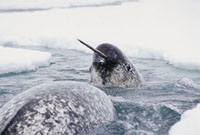
 Today, Harvard School of Dental Medicine (HSDM) researcher Martin Nweeia, DMD, DDS, answers a marine science question that has eluded the scientific community for hundreds of years: why does the narwhal, or "unicorn," whale have an 8-foot-long tooth emerging from its head, and what is its function? Nweeia, a clinical instructor in restorative dentistry and biomaterials sciences at HSDM, will be presenting his conclusions at the 16th Biennial Conference on the Biology of Marine Mammals in San Diego.

| Biology | December 13, 2005 11:35 PM |
| Full story | 0 Comments | 7101 views |

| Molecular & Cell Biology | December 13, 2005 11:35 PM |
A new study, presented at the American College of Neuropsychopharmacology's (ACNP) Annual Meeting, has identified a specific gene that is necessary for the development of connections between the brain and the spinal cord. This research, conducted by Stanford University through a grant from the National Institutes of Health (NIH), could be critical for future understanding of the development of the human brain and possibly the treatment of spinal cord injuries.
| Full story | 0 Comments | 5886 views |

| Microbiology | December 13, 2005 11:35 PM |
Leave it to the bacteria that cause tooth decay to be able to live without something all cells were thought to require.
| Full story | 0 Comments | 5638 views |

| Bioinformatics | December 13, 2005 11:35 PM |
The National Cancer Institute (NCI) and the National Human Genome Research Institute (NHGRI), both part of the National Institutes of Health (NIH), today launched a comprehensive effort to accelerate our understanding of the molecular basis of cancer through the application of genome analysis technologies, especially large-scale genome sequencing. The overall effort, called The Cancer Genome Atlas (TCGA), will begin with a pilot project to determine the feasibility of a full-scale effort to systematically explore the universe of genomic changes involved in all types of human cancer.
| Full story | 0 Comments | 5495 views |
| Biology | December 13, 2005 11:35 PM |
Thick-skinned bottle gourds widely used as containers by prehistoric peoples were likely brought to the Americas some 10,000 years ago by individuals who arrived from Asia, according to a new genetic comparison of modern bottle gourds with gourds found at archaeological sites in the Western Hemisphere. The finding solves a longstanding archaeological enigma by explaining how a domesticated variant of a species native to Africa ended up millennia ago in places as far removed as modern-day Florida, Kentucky, Mexico and Peru.
| Full story | 0 Comments | 5761 views |

| Environment | December 13, 2005 11:35 PM |
Trees in the Amazon tropical forests are old. Really old, in fact, which comes as a surprise to a team of American and Brazilian researchers studying tree growth in the world's largest tropical region.
| Full story | 0 Comments | 7292 views |

| Biotechnology | December 13, 2005 11:35 PM |
New tomato research has its roots in yielding more food to feed more people, according to Dr. Kendal Hirschi about results announced today.
| Full story | 0 Comments | 5589 views |

- In some genetic cases of microcephaly, stem cells fail to launch
- Yale team discovers how Zika virus causes fetal brain damage
- Scientists uncover the way a common cell enzyme alerts the body to invading bacteria
- Arctic gives clues on worst mass extinction of life
- Calcium channel blockers caught in the act at atomic level
Search Bio News Net
Free Biology Newsletter
- Flexibility That A.C.A. Lent to Work Force Is Threatened by...International Herald Tribune
- Bacteria Behind Legionnaires’ Disease Found at New York Police StationInternational Herald Tribune
- Prescription Price Crisis? 28 Million Americans See Spike in Drug...MSNBC.com: Health
- Seizing on Opioid Crisis, a Drug Maker Lobbies Hard for...International Herald Tribune
- Republicans are taking a big political risk on health careAP Health News
- Why We're So Divided Over Saving WolvesNational Geographic News