

Research has suggested yellow perch grow more rapidly during the short winters resulting from climate change, but a new study shows warmer water temperatures can lead to the production of less hardy eggs and larvae that have trouble surviving these early stages of life in Lake Erie.

| Health & Medicine | July 15, 2015 06:43 PM |
Oxford University doctors and scientists are performing the second phase of clinical studies of an experimental Ebola vaccine regimen. The study is part of the EBOVAC2 project, a collaborative programme involving the University of Oxford, French Institute of Health and Medical Research (INSERM) as project coordinator, London School of Hygiene & Tropical Medicine (LSHTM), Le Centre Muraz (CM), Inserm Transfert (IT) and the Janssen Pharmaceutical Companies of Johnson & Johnson (Janssen).
| Full story | 0 Comments | 4998 views |

| Molecular & Cell Biology | July 15, 2015 06:43 PM |
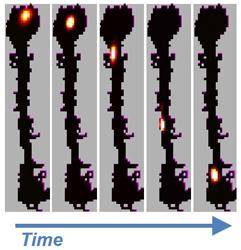
Each of the five panels shows a memory snapshot created by hundreds of place cells while the rat was physically stationary at the top of the 1.8 m track By using electrode implants to track nerve cells firing in the brains of rats as they plan where to go next, Johns Hopkins scientists say they have learned that the mammalian brain likely reconstructs memories in a way more like jumping across stepping stones than walking across a bridge. A summary of their experiments, published in the journal Science on July 10, sheds light on what memories are and how they form, and gives clues about how the system can fail.
| Full story | 0 Comments | 4389 views |

| Biotechnology | July 15, 2015 06:43 PM |
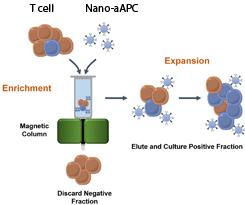
This is a graphic showing a process for producing large numbers of activated, customized T cells using magnetic nanoparticles and a column. In recent years, researchers have hotly pursued immunotherapy, a promising form of treatment that relies on harnessing and training the body's own immune system to better fight cancer and infection. Now, results of a study led by Johns Hopkins investigators suggests that a device composed of a magnetic column paired with custom-made magnetic nanoparticles may hold a key to bringing immunotherapy into widespread and successful clinical use. A summary of the research, conducted in mouse and human cells, appears online July 14 in the journal ACS Nano.
| Full story | 0 Comments | 5316 views |
| Health & Medicine | July 15, 2015 06:43 PM |
If you can't tell a smile from a scowl, you're probably not getting enough sleep.
| Full story | 0 Comments | 4973 views |

| AIDS & HIV | July 15, 2015 06:43 PM |
A Canadian research team at the IRCM in Montreal, led by molecular virologist Eric A. Cohen, PhD, made a significant discovery on how HIV escapes the body's antiviral responses. The team uncovered how an HIV viral protein known as Vpu tricks the immune system by using its own regulatory process to evade the host's first line of defence. This breakthrough was published yesterday in the scientific journal PLOS Pathogens and will be presented at the upcoming IAS 2015 conference in Vancouver. The findings pave the way for future HIV prevention or cure strategies.
| Full story | 0 Comments | 5438 views |

| Environment | July 15, 2015 06:43 PM |
The growing consumer demand for protein--and the lack of new farmland to raise more livestock--could make insects an attractive alternative to traditional protein sources, according to a July 13 symposium at IFT15: Where Science Feeds Innovation hosted by the Institute of Food Technologists (IFT) in Chicago.
| Full story | 0 Comments | 4935 views |

| Microbiology | July 15, 2015 06:43 PM |
For decades, researchers have worked to improve cacao fermentation by controlling the microbes involved. Now, to their surprise, a team of Belgian researchers has discovered that the same species of yeast used in production of beer, bread, and wine works particularly well in chocolate fermentation. The research was published ahead of print July 6th in Applied and Environmental Microbiology, a publication of the American Society for Microbiology.
| Full story | 0 Comments | 6696 views |
| Health & Medicine | July 15, 2015 06:43 PM |
Epidural electrostimulation is a medical technique that has been used for several years now to help patients affected by paralysis due to a spinal cord injury. It involves implanting electrodes over the dorsal nerve roots (which convey incoming "sensory" inputs) of the spinal cord below the level of the trauma and applying electrical stimuli of varying intensity and frequency. This technique, which produces or helps produce activation patterns of the motor nerves (ventral, outgoing) has shown promising results, and the scientists hope that one day it will be able to help paralysed people, for example, to stand and take a few steps, as well as restoring sphincter control and sexual function.
| Full story | 0 Comments | 4356 views |

- In some genetic cases of microcephaly, stem cells fail to launch
- Yale team discovers how Zika virus causes fetal brain damage
- Scientists uncover the way a common cell enzyme alerts the body to invading bacteria
- Arctic gives clues on worst mass extinction of life
- Calcium channel blockers caught in the act at atomic level
Search Bio News Net
Free Biology Newsletter
- Flexibility That A.C.A. Lent to Work Force Is Threatened by...International Herald Tribune
- Bacteria Behind Legionnaires’ Disease Found at New York Police StationInternational Herald Tribune
- Prescription Price Crisis? 28 Million Americans See Spike in Drug...MSNBC.com: Health
- Seizing on Opioid Crisis, a Drug Maker Lobbies Hard for...International Herald Tribune
- Republicans are taking a big political risk on health careAP Health News
- Why We're So Divided Over Saving WolvesNational Geographic News