


A group led by Assistant Professor Dan Ohtan Wang from Kyoto University's Institute for Integrated Cell-Material Sciences (iCeMS) in Japan successfully visualized RNA behavior and its response to drugs within the living tissue brain of live mice by labeling specific RNA molecules with fluorescent probes. Their study, published in Nucleic Acids Research, can potentially lead to faster, and more accurate screening processes for the discovery and development of new drugs.

| Stem Cell Research | July 14, 2015 07:18 PM |
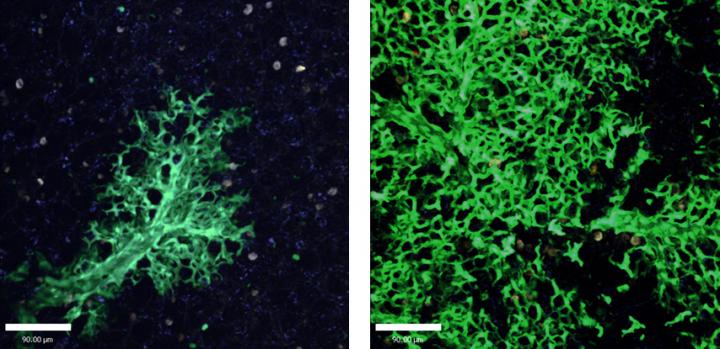
New lung cells are continuously created to replace the damaged ones: Lung tissue six weeks after stem cell transplantation (left) and 16 weeks after transplantation (right). Collectively, such diseases of the airways as emphysema, bronchitis, asthma and cystic fibrosis are the second leading cause of death worldwide. More than 35 million Americans alone suffer from chronic respiratory disease. Weizmann Institute scientists have now proposed a new direction that could, in the future, lead to the development of a method for alleviating some of their suffering. The study's findings, which appeared today in Nature Medicine, show how it might be possible to use embryonic stem cells to repair damaged lung tissue.
| Full story | 0 Comments | 6321 views |

| Health & Medicine | July 14, 2015 07:18 PM |
University of Leicester psychologist describes unique case as new to science
| Full story | 0 Comments | 4293 views |

| Molecular & Cell Biology | July 14, 2015 07:18 PM |
Case Western Reserve researchers already demonstrated that a single protein plays a pivotal role in the use of nutrients by major organs that allow for the burning of fat during exercise or regulating the heart's contractile and electrical activity. Now they have found a new benefit of Kruppel-like Factor 15 (KLF15) -- keeping the body in metabolic balance.
| Full story | 0 Comments | 3847 views |
| Stem Cell Research | July 14, 2015 07:18 PM |
Researchers at the University of California, Berkeley, in collaboration with scientists at the Gladstone Institutes, have developed a template for growing beating cardiac tissue from stem cells, creating a system that could serve as a model for early heart development and a drug-screening tool to make pregnancies safer.
| Full story | 0 Comments | 5211 views |

| Bioinformatics | July 14, 2015 07:18 PM |
The first comprehensive genome analyses of 7 melon varieties was completed by a research team led by Josep Casacuberta, Jordi Garcia-Mas and Sebastian Ramos-Onsins, providing breeders new knowledge important for understanding phenotypic variability and helping increasing plant quality yields by selective breeding. The findings were published in the advanced online edition of Molecular Biology and Evolution.
| Full story | 0 Comments | 4084 views |

- In some genetic cases of microcephaly, stem cells fail to launch
- Yale team discovers how Zika virus causes fetal brain damage
- Scientists uncover the way a common cell enzyme alerts the body to invading bacteria
- Arctic gives clues on worst mass extinction of life
- Calcium channel blockers caught in the act at atomic level
Search Bio News Net
Free Biology Newsletter
- Flexibility That A.C.A. Lent to Work Force Is Threatened by...International Herald Tribune
- Bacteria Behind Legionnaires’ Disease Found at New York Police StationInternational Herald Tribune
- Prescription Price Crisis? 28 Million Americans See Spike in Drug...MSNBC.com: Health
- Seizing on Opioid Crisis, a Drug Maker Lobbies Hard for...International Herald Tribune
- Republicans are taking a big political risk on health careAP Health News
- Why We're So Divided Over Saving WolvesNational Geographic News