

Researchers say there should be an international database containing the very latest information about organ donations and transplants, so policy makers can make informed decisions on whether to adopt an opt-out or opt-in system.

| Bioinformatics | September 24, 2014 06:26 PM |
Cell division, the process that ensures equal transmission of genetic information to daughter cells, has been fundamentally conserved for over a billion years of evolution. Considering its ubiquity and essentiality, it is expected that proteins that carry out cell division would also be highly conserved. Challenging this assumption, scientists from Fred Hutchinson Cancer Research Center have found that one of the foundational proteins in cell division, previously shown to be essential in organisms as diverse as yeast, flies and humans, has been surprisingly lost on multiple occasions during insect evolution.
| Full story | 0 Comments | 7951 views |

| Biology | September 24, 2014 06:26 PM |
Eyeless Mexican cavefish show no metabolic circadian rhythm in either light and dark or constant dark conditions, according to a study published September 24, 2014 in the open-access journal PLOS ONE by Damian Moran from Lund University, Sweden, and colleagues.
| Full story | 0 Comments | 8893 views |
| Biology | September 23, 2014 06:19 PM |
Achieving complete breakdown of plant biomass for energy conversion in industrialized bioreactors remains a complex challenge, but new research shows that termite fungus farmers solved this problem more than 30 million years ago. The new insight reveals that the great success of termite farmers as plant decomposers is due to division of labor between a fungus breaking down complex plant components and gut bacteria contributing enzymes for final digestion.
| Full story | 0 Comments | 7988 views |

| Molecular & Cell Biology | September 23, 2014 06:19 PM |
Most organisms, including humans, have parasitic DNA fragments called "jumping genes" that insert themselves into DNA molecules, disrupting genetic instructions in the process. And that phenomenon can result in age-related diseases such as cancer. But researchers at the University of Rochester now report that the "jumping genes" in mice become active as the mice age when a multi-function protein stops keeping them in check in order to take on another role.
| Full story | 0 Comments | 8050 views |
| Biology | September 23, 2014 06:19 PM |
Although the immediate welfare consequences of removing infant chimpanzees from their mothers are well documented, little is known about the long-term impacts of this type of early life experience. In a year-long study, scientists from Lincoln Park Zoon observed 60 chimpanzees and concluded that those who were removed from their mothers early in life and raised by humans as pets or performers are likely to show behavioral and social deficiencies as adults.
| Full story | 0 Comments | 11135 views |
| Molecular & Cell Biology | September 22, 2014 04:29 PM |
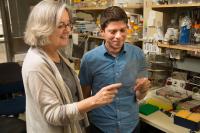
Victoria Lundblad and Timothy Tucey are researchers at the Salk Institute. Scientists at the Salk Institute have discovered an on-and-off "switch" in cells that may hold the key to healthy aging. This switch points to a way to encourage healthy cells to keep dividing and generating, for example, new lung or liver tissue, even in old age.
| Full story | 0 Comments | 12225 views |
| Biology | September 19, 2014 06:16 PM |
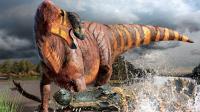
Rhinorex, a newly discovered dinosaur from the Late Cretaceous period, had an impressive nose. Call it the Jimmy Durante of dinosaurs – a newly discovered hadrosaur with a truly distinctive nasal profile. The new dinosaur, named Rhinorex condrupus by paleontologists from North Carolina State University and Brigham Young University, lived in what is now Utah approximately 75 million years ago during the Late Cretaceous period.
| Full story | 0 Comments | 9762 views |

| Health & Medicine | September 19, 2014 06:16 PM |
New research published today in the online journal PLoS Outbreaks predicts new Ebola cases could reach 6,800 in West Africa by the end of the month if new control measures are not enacted.
| Full story | 0 Comments | 7932 views |
| Health & Medicine | September 19, 2014 06:16 PM |
A leading Dartmouth researcher, working with The Melanoma Genetics Consortium, GenoMEL, an international research consortium, co-authored a paper published today in the Journal of the National Cancer Institute that proves longer telomeres increase the risk of melanoma.
| Full story | 0 Comments | 6443 views |
| Bioinformatics | September 17, 2014 05:48 PM |
Researchers in Biomedical Informatics at IMIM (Hospital del Mar Medical Research Institute) and at the Universitat Politècnica de Catalunya (UPC) have recently published a study in eLife showing that RNA called non-coding (IncRNA) plays an important role in the evolution of new proteins, some of which could have important cell functions yet to be discovered.
| Full story | 0 Comments | 7524 views |
| Bioinformatics | September 17, 2014 05:48 PM |
A team of Spanish researchers have obtained the first partial genome sequence of an ancient pig. Extracted from a sixteenth century pig found at the site of the Montsoriu Castle in Girona, the data obtained indicates that this ancient pig is closely related to today's Iberian pig. Researchers also discard the hypothesis that Asian pigs were crossed with modern Iberian pigs.
| Full story | 0 Comments | 6718 views |
| Biology | September 17, 2014 05:48 PM |
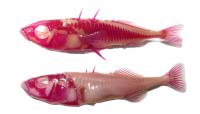
These are adult marine (top) and freshwater (bottom) threespine sticklebacks (Gasterosteus aculeatus) stained with a red dye that labels calcified bone. Sticklebacks, the roaches of the fish world, are the ideal animal in which to study the genes that control body shape. They've moved from the ocean into tens of thousands of freshwater streams and lakes around the world, each time changing their skeleton to adapt to the new environment.
| Full story | 0 Comments | 9049 views |
| Health & Medicine | September 17, 2014 05:48 PM |
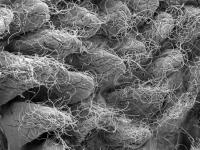
This image depicts gut microbiota. Artificial sweeteners, promoted as aids to weight loss and diabetes prevention, could actually hasten the development of glucose intolerance and metabolic disease; and they do it in a surprising way: by changing the composition and function of the gut microbiota – the substantial population of bacteria residing in our intestines. These findings, the results of experiments in mice and humans, were published today in Nature. Among other things, says Dr. Eran Elinav of the Weizmann Institute's Immunology Department, who led this research together with Prof. Eran Segal of Computer Science and Applied Mathematics Department, the widespread use of artificial sweeteners in drinks and food may be contributing to the obesity and diabetes epidemic that is sweeping much of the world.
| Full story | 0 Comments | 11333 views |

| Microbiology | September 15, 2014 05:20 PM |
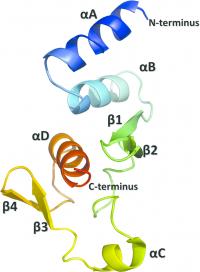
This is a ribbon diagram showing the tertiary structure with secondary-structure elements identified and labeled. The current Ebola virus outbreak in West Africa, which has claimed more than 2000 lives, has highlighted the need for a deeper understanding of the molecular biology of the virus that could be critical in the development of vaccines or antiviral drugs to treat or prevent Ebola hemorrhagic fever. Now, a team at the University of Virginia (UVA), USA – under the leadership of Dr Dan Engel, a virologist, and Dr Zygmunt Derewenda, a structural biologist – has obtained the crystal structure of a key protein involved in Ebola virus replication, the C-terminal domain of the Zaire Ebola virus nucleoprotein (NP) [Dziubanska et al. (2014). Acta Cryst. D70, 2420-2429; doi:10.1107/S1399004714014710].
| Full story | 0 Comments | 13278 views |
| Molecular & Cell Biology | September 15, 2014 05:20 PM |
Leaky intestines may cripple bacteria-fighting immune cells in patients with a rare hereditary disease, according to a study by researchers in Lausanne, Switzerland. The study, published in The Journal of Experimental Medicine on September 15, may explain why these patients suffer from recurrent bacterial infections.
| Full story | 0 Comments | 6506 views |
| Molecular & Cell Biology | September 15, 2014 05:20 PM |
Researchers at Johns Hopkins have identified a highly sensitive means of analyzing very tiny amounts of DNA. The discovery, they say, could increase the ability of forensic scientists to match genetic material in some criminal investigations. It could also prevent the need for a painful, invasive test given to transplant patients at risk of rejecting their donor organs and replace it with a blood test that reveals traces of donor DNA.
| Full story | 0 Comments | 6079 views |
| Microbiology | September 15, 2014 05:20 PM |
For multicellular life—plants and animals—to thrive in the oceans, there must be enough dissolved oxygen in the water. In certain coastal areas, extreme oxygen-starvation produces "dead zones" that decimate marine fisheries and destroy food web structure. As dissolved oxygen levels decline, energy is increasingly diverted away from multicellular life into microbial community metabolism resulting in impacts on the ecology and biogeochemistry of the ocean.
| Full story | 0 Comments | 6127 views |
| Molecular & Cell Biology | September 15, 2014 05:20 PM |
Neuroscientists have found that a gene mutation that arose more than half a million years ago may be key to humans' unique ability to produce and understand speech.
| Full story | 0 Comments | 6969 views |
| Molecular & Cell Biology | September 10, 2014 07:06 PM |
University at Buffalo researchers and colleagues studying a rare, blistering disease have discovered new details of how autoantibodies destroy healthy cells in skin. This information provides new insights into autoimmune mechanisms in general and could help develop and screen treatments for patients suffering from all autoimmune diseases, estimated to affect 5-10 percent of the U.S. population.
| Full story | 0 Comments | 9053 views |
| Molecular & Cell Biology | September 10, 2014 07:06 PM |
As we and other vertebrates age, our DNA accumulates mutations and becomes rearranged, which may result in a variety of age-related illnesses, including cancers. Biologists Vera Gorbunova and Andrei Seluanov have now discovered one reason for the increasing DNA damage: the primary repair process begins to fail with increasing age and is replaced by one that is less accurate.
| Full story | 0 Comments | 6577 views |
| Bioinformatics | September 10, 2014 07:06 PM |

Lucia Carbone, Ph.D., is an assistant professor of behavioral neuroscience in the OHSU School of Medicine and an assistant scientist at OHSU's Oregon National Primate Research Center. A team led by an Oregon Health & Science University researcher has sequenced and annotated the genome of the only ape whose DNA had yet to be sequenced — the gibbon, an endangered small ape that inhabits the tropical forests of Southeast Asia.
| Full story | 0 Comments | 11410 views |
| Molecular & Cell Biology | September 8, 2014 04:27 PM |
The information encoded in our genes is translated into proteins, which ultimately mediate biological functions in an organism. Messenger RNA (mRNA) plays an important role, as it is the molecular template used for translation. Scientists from the Helmholtz Zentrum Muenchen and the Technische Universität Muenchen, in collaboration with international colleagues, have now unraveled a molecular mechanism of mRNA recognition, which is essential for understanding differential gene regulation in male and female organisms. The results are published in the renowned scientific journal Nature.
| Full story | 0 Comments | 7432 views |
| Health & Medicine | September 8, 2014 04:27 PM |
Raw honey has been used against infections for millennia, before honey - as we now know it - was manufactured and sold in stores. So what is the key to its' antimicrobial properties? Researchers at Lund University in Sweden have identified a unique group of 13 lactic acid bacteria found in fresh honey, from the honey stomach of bees. The bacteria produce a myriad of active antimicrobial compounds.
| Full story | 0 Comments | 13172 views |
| Biology | September 3, 2014 05:17 AM |
It's hard to comprehend how bad the current rate of species extinction around the world has become without knowing what it was before people came along. The newest estimate is that the pre-human rate was 10 times lower than scientists had thought, which means that the current level is 10 times worse.
| Full story | 0 Comments | 12941 views |
| Molecular & Cell Biology | September 3, 2014 05:17 AM |
All human cells contain essentially the same DNA sequence – their genetic information. How is it possible that shapes and functions of cells in the different parts of the body are so different? While every cell's DNA contains the same construction master plan, an additional regulatory layer exists that determines which of the many possible DNA programs are active. This mechanism involves modifications of genome-bound histone proteins or the DNA itself with small chemical groups (e.g. methylation). It acts on top of the genetic information and is thus called 'epi'-genetic from the corresponding Greek word that means 'above' or 'attached to'.
| Full story | 0 Comments | 6842 views |
| Biology | September 3, 2014 05:17 AM |
Move over antibiotic ointment, there might be a new salve to dominate medicine cabinets of the future, and it comes from an unlikely place—the lowly salamander. Salamanders may not be the cuddliest of animals, but they can regenerate lost limbs and achieve amazing recovery of seriously damaged body parts. Now, a new report published in the September 2014 issue of The FASEB Journal, identifies a small protein (called a "peptide") from the skin of salamanders that may be the key to unlocking the secret of this amazing wound healing trick in humans.
| Full story | 0 Comments | 9970 views |
| Molecular & Cell Biology | September 3, 2014 05:17 AM |
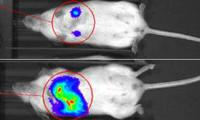
This image depicts a tumor with reduced levels of enzyme UBC13 (top) and a control tumor (bottom) that has spread to the lungs. Researchers at the University of California, San Diego School of Medicine have identified an enzyme that controls the spread of breast cancer. The findings, reported in the current issue of PNAS, offer hope for the leading cause of breast cancer mortality worldwide. An estimated 40,000 women in America will die of breast cancer in 2014, according to the American Cancer Society.
| Full story | 0 Comments | 9879 views |
| Molecular & Cell Biology | September 1, 2014 07:25 PM |
About 50 years ago, electron microscopy revealed the presence of tiny blob-like structures that form inside cells, move around and disappear. But scientists still don't know what they do — even though these shifting cloud-like collections of proteins are believed to be crucial to the life of a cell, and therefore could offer a new approach to disease treatment.
| Full story | 0 Comments | 7406 views |
| Molecular & Cell Biology | September 1, 2014 07:25 PM |
When we learn, we associate a sensory experience either with other stimuli or with a certain type of behaviour. The neurons in the cerebral cortex that transmit the information modify the synaptic connections that they have with the other neurons. According to a generally-accepted model of synaptic plasticity, a neuron that communicates with others of the same kind emits an electrical impulse as well as activating its synapses transiently. This electrical pulse, combined with the signal received from other neurons, acts to stimulate the synapses. How is it that some neurons are caught up in the communication interplay even when they are barely connected? This is the crucial chicken-or-egg puzzle of synaptic plasticity that a team led by Anthony Holtmaat, professor in the Department of Basic Neurosciences in the Faculty of Medicine at UNIGE, is aiming to solve. The results of their research into memory in silent neurons can be found in the latest edition of Nature.
| Full story | 0 Comments | 6712 views |

- In some genetic cases of microcephaly, stem cells fail to launch
- Yale team discovers how Zika virus causes fetal brain damage
- Scientists uncover the way a common cell enzyme alerts the body to invading bacteria
- Arctic gives clues on worst mass extinction of life
- Calcium channel blockers caught in the act at atomic level
Search Bio News Net
Free Biology Newsletter
- Flexibility That A.C.A. Lent to Work Force Is Threatened by...International Herald Tribune
- Bacteria Behind Legionnaires’ Disease Found at New York Police StationInternational Herald Tribune
- Prescription Price Crisis? 28 Million Americans See Spike in Drug...MSNBC.com: Health
- Seizing on Opioid Crisis, a Drug Maker Lobbies Hard for...International Herald Tribune
- Republicans are taking a big political risk on health careAP Health News
- Why We're So Divided Over Saving WolvesNational Geographic News