


A scientific group of the Universities of Illinois (USA), Georgia (USA), Hawaii (USA) and Nakai (China), among others, have deciphered for the first time fruit genomic sequence, in this case papaya (Carica papaya), according to the cover of the last issue of the prestigious journal Nature. One of the researchers is a scientist assigned to the group of Molecular Genetics of the Department of Genetics of the University of Granada

| Molecular & Cell Biology | May 14, 2008 11:37 PM |
Researchers from the Howard Florey Institute in Melbourne have identified a factor that may contribute towards the development of heroin addiction by manipulating the adenosine A2A receptor, which plays a major role in the brain’s ‘reward pathway’.
| Full story | 0 Comments | 9423 views |

| Biology | May 14, 2008 11:37 PM |
A Swiss marine biologist and an Australian quantum physicist have found that a species of shrimp from the Great Barrier Reef, Australia, can see a world invisible to all other animals.
| Full story | 0 Comments | 7897 views |
| Biology | May 14, 2008 10:37 PM |
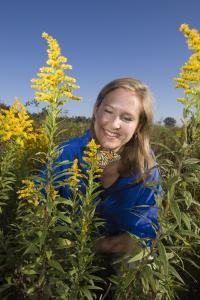
Altizer with monarch. It’s a paradox that has confounded evolutionary biologists since Charles Darwin published On the Origin of Species in 1859: Since parasites depend on their hosts for survival, why do they harm them?
| Full story | 0 Comments | 7905 views |
| Biology | May 14, 2008 10:37 PM |
The mouse is a stalwart stand-in for humans in medical research, thanks to genomes that are 85 percent identical. But identical genes may behave differently in mouse and man, a study by University of Michigan evolutionary biologists Ben-Yang Liao and Jianzhi Zhang reveals.
| Full story | 0 Comments | 6013 views |

| AIDS & HIV | May 14, 2008 09:37 PM |
Researchers have developed what they believe is the first new mechanism in nearly 20 years for inhibiting a common target used to treat all HIV patients, which could eventually lead to a new class of AIDS drugs.
| Full story | 0 Comments | 5963 views |

| Health & Medicine | May 14, 2008 09:37 PM |
Researchers at the Yerkes National Primate Research Center, Emory University, have discovered the first conclusive evidence of Alzheimer's-like neurofibrillary brain tangles in an aged nonhuman primate. The unprecedented finding, described in the online issue of the Journal of Comparative Neurology, has the potential to move the scientific community one step closer to understanding why age-related neurodegenerative diseases, such as Alzheimer's disease, are uniquely human and seem to never fully manifest in other species--including our closest evolutionary relative, the chimpanzee.
| Full story | 0 Comments | 4454 views |

| Environment | May 14, 2008 08:37 PM |
You might think that stocking the Great Lakes with things like trout and salmon would be good for the herring gull. The birds often eat from the water, so it would be natural to assume that more fish would mean better dining. But a new report published in the April journal of Ecology by the Ecological Society of America says that the addition of species such as exotic salmon and trout to the area has not been good for the birds, demonstrating that fishery management actions can sometimes have very unexpected outcomes.
| Full story | 0 Comments | 5132 views |

| Microbiology | May 14, 2008 08:37 PM |
Researchers at the University of British Columbia and Vancouver Coastal Health Research Institute have discovered how tuberculosis (TB) bacteria hide and multiply in the human body and are working toward a treatment to block this mechanism of infection.
| Full story | 0 Comments | 5322 views |
| Microbiology | May 14, 2008 07:37 PM |
A bacteria commonly found in soil and water triggered autoimmune symptoms in mice similar to those found in an incurable liver disease called Primary Biliary Cirrhosis (PBC). Reporting their findings in the May 15 Cell Host & Microbe, the multi-institutional research team said injecting laboratory mice with the bacterium – Novosphingobium aromaticivorans – prompted activation of Natural Killer T (NKT) cells, which were critical to initiating autoimmune processes that led to liver disease.
| Full story | 0 Comments | 5935 views |
| Molecular & Cell Biology | May 14, 2008 07:37 PM |
Aprotinin is associated with a 50 per cent increase in the relative risk of death, according to a major Canadian clinical trial comparing three drugs routinely used to prevent blood loss during heart surgery. The trial, published in the New England Journal of Medicine, shows that approximately six per cent of patients who received aprotinin died within 30 days of surgery compared to four per cent of patients who received tranexamic acid or aminocaproic acid.
| Full story | 0 Comments | 4727 views |
| Health & Medicine | May 14, 2008 06:37 PM |
Researchers at the University of Oklahoma Health Sciences Center have found a new use for an old drug. Their findings appear online in the American Journal of Gastroenterology.
| Full story | 0 Comments | 10915 views |

| Biotechnology | May 14, 2008 06:37 PM |
A team composed of Harvard students and alumni was among the winners of the World Bank’s Lighting Africa 2008 Development Marketplace competition, held in Accra, Ghana from May 6 to 8, 2008. The innovation, microbial fuel cell-based lighting systems suitable for Sub-Saharan Africa, netted the group a $200,000 prize.
| Full story | 0 Comments | 7369 views |

- In some genetic cases of microcephaly, stem cells fail to launch
- Yale team discovers how Zika virus causes fetal brain damage
- Scientists uncover the way a common cell enzyme alerts the body to invading bacteria
- Arctic gives clues on worst mass extinction of life
- Calcium channel blockers caught in the act at atomic level
Search Bio News Net
Free Biology Newsletter
- Flexibility That A.C.A. Lent to Work Force Is Threatened by...International Herald Tribune
- Bacteria Behind Legionnaires’ Disease Found at New York Police StationInternational Herald Tribune
- Prescription Price Crisis? 28 Million Americans See Spike in Drug...MSNBC.com: Health
- Seizing on Opioid Crisis, a Drug Maker Lobbies Hard for...International Herald Tribune
- Republicans are taking a big political risk on health careAP Health News
- Why We're So Divided Over Saving WolvesNational Geographic News