

Compared to humans, bacteria have a much tidier genome. The tiny microorganisms pack their genes closely together, and don’t carry around a lot of extraneous DNA, so-called junk DNA that fills in the gaps between genes. Some 90 percent of the complete genome sequence of the bacteria E. coli contains sequences of DNA that code for protein, while 90 percent of the human genome is non–coding junk DNA.

| AIDS & HIV | May 15, 2008 10:28 PM |
On the 25th anniversary of the first scientific article linking a retrovirus to AIDS, Anthony S. Fauci, M.D., director of the National Institute of Allergy and Infectious Diseases, part of the National Institutes of Health, reflects in an essay in Nature on his experience treating and studying HIV/AIDS for the past quarter century. Outlining the peaks and valleys of the scientific community’s journey so far, Dr. Fauci writes, “…we must learn from our mis-steps, build on our successes in treatment and prevention, and renew our commitment to developing the truly transforming tools that will one day put this scourge behind us.”
| Full story | 0 Comments | 6406 views |

| Molecular & Cell Biology | May 15, 2008 09:28 PM |
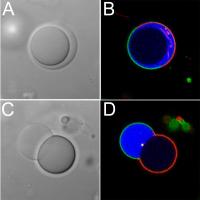
The model cell developed in the lab of Christine D. Keating at Penn State uses as the cytoplasm a solution of two different polymers, PEG and dextran (Panel A). The image in Panel B is the image in Panel A highlighted with fluorescent dyes. The blue region is PEG, which is concentrated in the outer polymer solution; the green area is the portion of the membrane that contains PEG groups, which interact with the contents of the cell; and the red area is the portion of the membrane with fewer PEG groups, which interact with the contents of the cell to a lesser extent. After exposure to a concentrated solution of sugar, the cell converted to a budded form (Panel C). A dextran-rich mixture filled the bud, while a PEG-rich mixture remained inside the body of the cell. Panel D shows the image in Panel C highlighted with fluorescent dyes. The blue area is the PEG-rich region. This new structure exhibits polarity both in the membrane and in the aqueous interior of the model cell. A team of Penn State researchers has developed a simple artificial cell with which to investigate the organization and function of two of the most basic cell components: the cell membrane and the cytoplasm--the gelatinous fluid that surrounds the structures in living cells. The work could lead to the creation of new drugs that take advantage of properties of cell organization to prevent the development of diseases. The team's findings will be published later this month (late May 2008) in the Journal of the American Chemical Society.
| Full story | 0 Comments | 6885 views |

| Health & Medicine | May 15, 2008 09:28 PM |
In an effort to better define and ultimately address fatigue more effectively, a qualitative study from The University of Texas M. D. Anderson Cancer Center has identified three primary themes - loss of strength or energy, major effects of fatigue and associated sensations - among patients being treated with standard radiation therapy.
| Full story | 0 Comments | 5271 views |
| Molecular & Cell Biology | May 15, 2008 09:28 PM |
Saskatoon, SK: University of Saskatchewan microbiologist Wei Xiao has found a way to trigger a protein combination called 9-1-1 that sends an SOS signal for cells to fight cancer-causing agents such as industrial toxins, ultraviolet radiation, and X-rays.
| Full story | 0 Comments | 6139 views |

| Biology | May 15, 2008 09:28 PM |
As Charles Darwin showed nearly 150 years ago, bird beaks are exquisitely adapted to the birds' feeding strategy. A team of MIT mathematicians and engineers has now explained exactly how some shorebirds use their long, thin beaks to defy gravity and transport food into their mouths.
| Full story | 0 Comments | 6304 views |
| Biology | May 15, 2008 09:28 PM |
Smaller primates expend no more energy climbing than they do walking, Duke University researchers have found. This surprising discovery may explain the evolutionary edge that encouraged the tiny ancestors of modern humans, apes and monkeys to climb into the trees about 65 million years ago and stay there.
| Full story | 0 Comments | 6494 views |

| Biotechnology | May 15, 2008 09:28 PM |
Having found that whether bacteria stick to surfaces depends partly on how stiff those surfaces are, MIT engineers have created ultrathin films made of polymers that could be applied to medical devices and other surfaces to control microbe accumulation.
| Full story | 0 Comments | 7513 views |

- In some genetic cases of microcephaly, stem cells fail to launch
- Yale team discovers how Zika virus causes fetal brain damage
- Scientists uncover the way a common cell enzyme alerts the body to invading bacteria
- Arctic gives clues on worst mass extinction of life
- Calcium channel blockers caught in the act at atomic level
Search Bio News Net
Free Biology Newsletter
- Flexibility That A.C.A. Lent to Work Force Is Threatened by...International Herald Tribune
- Bacteria Behind Legionnaires’ Disease Found at New York Police StationInternational Herald Tribune
- Prescription Price Crisis? 28 Million Americans See Spike in Drug...MSNBC.com: Health
- Seizing on Opioid Crisis, a Drug Maker Lobbies Hard for...International Herald Tribune
- Republicans are taking a big political risk on health careAP Health News
- Why We're So Divided Over Saving WolvesNational Geographic News