

A new study into the way in which parasites interact with each other could help predict when infectious diseases are likely to break out.

| Biology | December 12, 2007 09:50 PM |
Aggressive territorial male Mozambique tilapia fish (Oreochromis mossambicus) send chemical messages to rival males via their urine. They increase urination, have smellier urine and store more in their bladders than less aggressive males, according to research published in the open access journal BMC Biology. Animal behaviourists have known for some time that the urine of freshwater fish is a vehicle for reproductive hormones that act in the water as pheromones, affecting the behaviour and physiology of members of the opposite sex. Now, this research sheds light on the role of urine in influencing members of the same sex.
| Full story | 0 Comments | 5566 views |

| Environment | December 12, 2007 08:50 PM |
Scientists studying ancient fish bones in Scandinavia have discovered that warm-water species like anchovies and black sea bream that once thrived in Danish waters during a prehistoric warm period are now returning. Some cold-water species, such as cod, were also abundant during this period, having benefited from a lower fishing effort.
| Full story | 0 Comments | 7918 views |

| Biotechnology | December 12, 2007 07:50 PM |
Using computer simulations, researchers at the University of Illinois have demonstrated a strategy for sequencing DNA by driving the molecule back and forth through a nanopore capacitor in a semiconductor chip. The technique could lead to a device that would read human genomes quickly and affordably.
| Full story | 2 Comments | 7782 views |

| Microbiology | December 12, 2007 06:50 PM |
When a vaccine to prevent shingles was approved for use in 2006, the Food and Drug Administration recommended the vaccine for people age 60 and older who previously had chickenpox. But two issues -- the vaccine’s cost and the perception that shingles primarily affects adults with weakened immune systems -- have left some physicians undecided about whether healthy adults need the vaccine. This uncertainty prompted a group of researchers led by Barbara Yawn, M.D., of Olmsted Medical Center in Rochester, to gather new data about the incidence and impact of shingles in unvaccinated patients.
| Full story | 0 Comments | 7265 views |
| Microbiology | December 12, 2007 05:50 PM |
When the alert goes out that a virus has invaded the body, cells that have yet to be attacked prepare by "armoring" themselves for combat, attaching specific antiviral molecules to many of their own proteins to help resist the invader.
| Full story | 0 Comments | 6562 views |
| Biology | December 12, 2007 04:50 PM |
A team of U.S. and Chilean scientists working high in the Andes have discovered the fossilized remains of an extinct, tank-like mammal they conclude was a primitive relative of today’s armadillos. The results of their surprising new discovery are described in an upcoming issue of Journal of Vertebrate Paleontology.
| Full story | 0 Comments | 5272 views |

| Molecular & Cell Biology | December 12, 2007 12:11 PM |
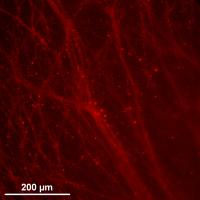
Fluorescence micrograph of a ganglion on a 70 percent acetylcholine polymer that shows neurites expressing an established neuronal marker called synaptophysin. The bright red spots on the neurites indicate the presence of synaptic vesicle proteins, which are required for functional restoration after nerve injury. Credit: Image courtesy of Christiane Gumera Research reported December 11 in the journal Advanced Materials describes a potentially promising strategy for encouraging the regeneration of damaged central nervous system cells known as neurons.
| Full story | 0 Comments | 6278 views |

| Health & Medicine | December 12, 2007 10:11 AM |
Novel treatment strategies for major depression with broader treatment success or a more rapid onset of action would have immense impact on public health, a new study published in the December 1st issue of Biological Psychiatry explains. This new study reports findings that support the evaluation of a potential new antidepressant agent.
| Full story | 0 Comments | 6659 views |

- In some genetic cases of microcephaly, stem cells fail to launch
- Yale team discovers how Zika virus causes fetal brain damage
- Scientists uncover the way a common cell enzyme alerts the body to invading bacteria
- Arctic gives clues on worst mass extinction of life
- Calcium channel blockers caught in the act at atomic level
Search Bio News Net
Free Biology Newsletter
- Flexibility That A.C.A. Lent to Work Force Is Threatened by...International Herald Tribune
- Bacteria Behind Legionnaires’ Disease Found at New York Police StationInternational Herald Tribune
- Prescription Price Crisis? 28 Million Americans See Spike in Drug...MSNBC.com: Health
- Seizing on Opioid Crisis, a Drug Maker Lobbies Hard for...International Herald Tribune
- Republicans are taking a big political risk on health careAP Health News
- Why We're So Divided Over Saving WolvesNational Geographic News