


A researcher funded by the Lupus Research Institute (LRI) has discovered an entirely new and powerful molecular switch that controls the inflammatory response of the immune system. The major finding, reported in the December 14th issue of the journal Cell, means that new methods can now be pursued to shut down uncontrolled inflammation, restore immune system regulation, and treat chronic autoimmune disorders such as lupus.

| Molecular & Cell Biology | December 13, 2007 10:10 PM |
A baby's brain has a lot of work to do, growing more neurons and connections. Later, a growing child's brain begins to pare down these connections until it develops into the streamlined brain of an adult.
| Full story | 1 Comment | 9113 views |

| Stem Cell Research | December 13, 2007 09:10 PM |
One of the biggest stories in cancer research over the past few years has been, unexpectedly, stem cells. Not embryonic stem cells, but tumor stem cells. These mutated cells, which live indefinitely and can seed new tumors, are now suspected of causing many, if not all, cancers. What is worse, these persistent cells are not killed by chemotherapy or other current treatments. Their survival might explain why tumors frequently recur or spread after treatment. Increasingly, researchers view the challenge of getting rid of these bad seeds as the key to treating cancer far more effectively. However, because they are extremely rare, even in large tumors, studying them has been difficult.
| Full story | 0 Comments | 7288 views |

| Microbiology | December 13, 2007 08:10 PM |
University of Pennsylvania researchers have uncovered an important step in how herpes simplex virus, HSV-1, uses cooperating proteins found on its outer coat to gain entry into healthy cells and infect them. Further, the study’s authors say, they have demonstrated the effectiveness of monitoring these protein interactions using biomolecular complementation.
| Full story | 0 Comments | 6448 views |

| Biology | December 13, 2007 07:10 PM |
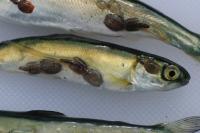
Pink salmon fry infected with sea lice. A study appearing in the December 14 issue of the journal Science shows, for the first time, that parasitic sea lice infestations caused by salmon farms are driving nearby populations of wild salmon toward extinction. The results show that the affected pink salmon populations have been rapidly declining for four years. The scientists expect a 99% collapse in another four years, or two salmon generations, if the infestations continue.
| Full story | 0 Comments | 29196 views |
| Biology | December 13, 2007 06:10 PM |
A pioneering study of wild chimpanzees has found that these close human relatives do not routinely experience menopause, rebutting previous studies of captive individuals which had postulated that female chimpanzees reach reproductive senescence at 35 to 40 years of age.
| Full story | 0 Comments | 6503 views |
| Biology | December 13, 2007 05:10 PM |
The human spine evolved differently in males and females in order to alleviate back pressure from the weight of carrying a baby, according to research spearheaded at The University of Texas at Austin.
| Full story | 0 Comments | 5391 views |

- In some genetic cases of microcephaly, stem cells fail to launch
- Yale team discovers how Zika virus causes fetal brain damage
- Scientists uncover the way a common cell enzyme alerts the body to invading bacteria
- Arctic gives clues on worst mass extinction of life
- Calcium channel blockers caught in the act at atomic level
Search Bio News Net
Free Biology Newsletter
- Flexibility That A.C.A. Lent to Work Force Is Threatened by...International Herald Tribune
- Bacteria Behind Legionnaires’ Disease Found at New York Police StationInternational Herald Tribune
- Prescription Price Crisis? 28 Million Americans See Spike in Drug...MSNBC.com: Health
- Seizing on Opioid Crisis, a Drug Maker Lobbies Hard for...International Herald Tribune
- Republicans are taking a big political risk on health careAP Health News
- Why We're So Divided Over Saving WolvesNational Geographic News