

Expanding evidence that tiny strands of RNA – called microRNAs – play big roles in the progress of some cancers, UC Davis researchers have identified one that helps jump start prostate cancer cell growth midway through the disease process, eventually causing it to become fatal. The discovery is an important link to finding new treatments targeting this cellular function and reducing cancer deaths among American men.

| Bioinformatics | November 29, 2007 07:28 PM |
Researchers at the University of California San Diego have developed a novel computer technique to search for the side effects of major pharmaceuticals. The study, reported November 30 in PLoS Computational Biology relates to a class of drugs known as Select Estrogen Receptor Modulators (SERMs), which includes tamoxifen, the most prescribed drug in the treatment of breast cancer.
| Full story | 0 Comments | 6825 views |

| Molecular & Cell Biology | November 29, 2007 06:28 PM |
Researchers at the National Institute of Aging and Stanford University have used gene arrays to identify genes whose activity changes with age in 16 different mouse tissues. The study, published November 30 in PLoS Genetics, uses a newly available database called AGEMAP to document the process of aging in mice at the molecular level. The work describes how aging affects different tissues in mice, and ultimately could help explain why lifespan is limited to just two years in mice.
| Full story | 0 Comments | 8311 views |
| Molecular & Cell Biology | November 29, 2007 05:28 PM |
Researchers at Jefferson Medical College and Jefferson’s Kimmel Cancer Center in Philadelphia have used PET imaging to see hyperactive cancer genes inside breast tumors in laboratory animals, marking the first time such gene activity has been observed from outside the body. This technology might someday help physicians to detect and classify cancer, enabling them to find cancerous breast tumors as early as possible, and determine the appropriate treatment.
| Full story | 0 Comments | 8320 views |

| Microarray | November 29, 2007 03:28 PM |
A team led by scientists at MIT and Harvard University and supported in part by the National Institute of Allergy and Infectious Diseases, a component of the National Institutes of Health, collected blood samples from 43 P. falciparum-infected malaria patients in Senegal who were suffering from a range of malaria symptoms. The scientists isolated the parasites’ genomic information and determined which of the nearly 6,000 P. falciparum genes were switched on or off during infection, revealing distinct groups of parasites with characteristic sets of active and inactive genes. By comparing this information about P. falciparum with gene activation patterns in a similar but better-understood organism—baker’s yeast—the scientists described three biological classes of malaria parasites, each with a different metabolic state. One state is well known from laboratory studies, but the other two have never been observed before. One newly described state appears to reflect starving parasites, while the other suggests parasites under extreme environmental stress. Remarkably, say the scientists, the latter group correlated with specific patient symptoms, including high fevers and elevated levels of inflammatory markers in their blood.
| Full story | 0 Comments | 10707 views |
| Molecular & Cell Biology | November 29, 2007 01:28 PM |
Sirtris Pharmaceuticals, Inc. (NASDAQ: SIRT), a biopharmaceutical company focused on discovering and developing small molecule drugs to treat diseases of aging, announced today that findings in the journal Nature demonstrate that Sirtris has developed novel drug candidates that offer a promising, new approach to treating diseases of aging, including Type 2 Diabetes, by targeting SIRT1, a gene that controls the aging process.
| Full story | 1 Comment | 7411 views |

| Microbiology | November 29, 2007 12:28 PM |
As much as $945 million. That's what agricultural economists at Kansas State University say could be the impact on Kansas' economy were there a large-scale foot-and-mouth outbreak in a region thick with livestock operations.
| Full story | 0 Comments | 6750 views |

| Environment | November 29, 2007 10:28 AM |
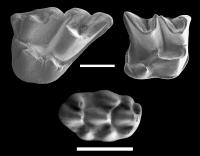
Holotypes from the new species discovered in this research: first superior molar of the Archaeodesmana elvirae, Blarinoides aliciae and Micromys caesaris. The scale is equivalent to 1 mm. How did the rodents which inhabited the south of the Iberian Peninsula live six million years ago" The researcher of the UGR Raef Minwer-Barakat has attempted to answer this question through his doctoral thesis "Rodents and insectivorous of Upper Turoliense and the Pliocene of the central section of the Guadix basin", supervised by doctors Elvira Martín and César Viseras, of the Dept. of Stratigraphy and Palaeontology of the University of Granada. His studied has concluded with the discovering of three new species of rodents and insectivores (Micromys caesaris, Blarinoides aliciae and Archaeodesmana elvirae) and the finding, for the first time in the region, of nine more species.
| Full story | 0 Comments | 6946 views |

- In some genetic cases of microcephaly, stem cells fail to launch
- Yale team discovers how Zika virus causes fetal brain damage
- Scientists uncover the way a common cell enzyme alerts the body to invading bacteria
- Arctic gives clues on worst mass extinction of life
- Calcium channel blockers caught in the act at atomic level
Search Bio News Net
Free Biology Newsletter
- Flexibility That A.C.A. Lent to Work Force Is Threatened by...International Herald Tribune
- Bacteria Behind Legionnaires’ Disease Found at New York Police StationInternational Herald Tribune
- Prescription Price Crisis? 28 Million Americans See Spike in Drug...MSNBC.com: Health
- Seizing on Opioid Crisis, a Drug Maker Lobbies Hard for...International Herald Tribune
- Republicans are taking a big political risk on health careAP Health News
- Why We're So Divided Over Saving WolvesNational Geographic News