

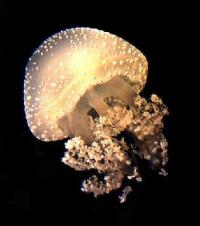
The Australian spotted jellyfish can weigh up to 25 pounds. The invasive Australian jellyfish, Phyllorhiza punctata, first reported in great quantities in the Gulf of Mexico in 2000, has made a vigorous reappearance this summer in waters from southwestern Louisiana to Morehead City, North Carolina. Beachgoers and boaters are encouraged to report their sightings of these exotic jellies to the Dauphin Island Sea Lab’s jellyfish website, Dockwatch, at http://dockwatch.disl.org.

| Biology | August 19, 2007 10:09 PM |
| Full story | 0 Comments | 8243 views |
| Biology | August 19, 2007 08:09 PM |
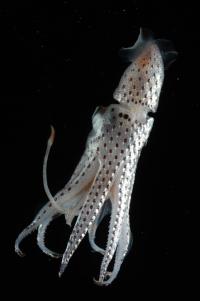
An international team aboard the RRS James Cook collected hundreds of marine specimens during a 5-week expedition along the Mid-Atlantic Ridge. A scientist from the University of Aberdeen is leading a team of international researchers whose work will continue our understanding of life in the deepest oceans, and contribute to the global Census of Marine Life.
| Full story | 0 Comments | 7347 views |

| Health & Medicine | August 19, 2007 06:09 PM |
Experts have today called for international agencies to provide insecticide-treated bed nets for all children in Africa as the most equitable way of tackling malaria. Their call is supported by new research co-funded by the Wellcome Trust showing how successful a scheme run by the Kenyan government has been at distributing the nets.
| Full story | 0 Comments | 5364 views |

| Biotechnology | August 19, 2007 04:09 PM |
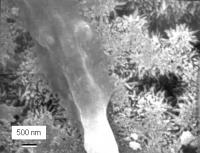
High-magnification scanning electron microscopy shows (center of micrograph) the leg of an osteoblast (bone precursor), called a cytoplasmic extension, attaching to nano-sized hydroxyapatite crystals, similar to those in natural bone, that make up a CPC implant. Credit: NIST Researchers from the American Dental Association Foundation (ADAF) and the National Institute of Standards and Technology (NIST) have developed a new method for layering two kinds of biomaterials into one strong, yet porous unit that may lead to improved reconstruction or repair of bones.
| Full story | 0 Comments | 6848 views |
| Health & Medicine | August 19, 2007 02:09 PM |
Are too many people now diagnosed as having depression? Two experts give their views in this week’s BMJ.
| Full story | 0 Comments | 6653 views |

| Molecular & Cell Biology | August 19, 2007 12:09 PM |
One way tumors fly under the radar of the immune system is by using IDO, an enzyme used by fetuses to help avoid rejection, to recruit powerful regulatory T cells that turn down the immune response, researchers say.
| Full story | 0 Comments | 7448 views |

| Microbiology | August 19, 2007 10:09 AM |
Researchers at the University of Pennsylvania School of Medicine have identified a new strategy that Kaposi’s Sarcoma Associated Herpesvirus (KSHV) uses to dupe infected cells into replicating its viral genome. This allows the virus to remain virtually undetected by the body’s immune system. Previous work suggested KSHV needed viral proteins to initiate replication, but this is the first study to directly show that a section of viral DNA can independently draw upon proteins within a host cell to promote its own replication. The study was published in the August issue of Cell Host and Microbe.
| Full story | 0 Comments | 7495 views |

- In some genetic cases of microcephaly, stem cells fail to launch
- Yale team discovers how Zika virus causes fetal brain damage
- Scientists uncover the way a common cell enzyme alerts the body to invading bacteria
- Arctic gives clues on worst mass extinction of life
- Calcium channel blockers caught in the act at atomic level
Search Bio News Net
Free Biology Newsletter
- Flexibility That A.C.A. Lent to Work Force Is Threatened by...International Herald Tribune
- Bacteria Behind Legionnaires’ Disease Found at New York Police StationInternational Herald Tribune
- Prescription Price Crisis? 28 Million Americans See Spike in Drug...MSNBC.com: Health
- Seizing on Opioid Crisis, a Drug Maker Lobbies Hard for...International Herald Tribune
- Republicans are taking a big political risk on health careAP Health News
- Why We're So Divided Over Saving WolvesNational Geographic News