


The good news, if you’re grazing normally on algae in the rocky intertidal zone of the North Atlantic, is that you may not be infected by a parasite. But the better news is, according to new research from the University of New Hampshire, that you might have more to eat if plenty of your neighbors are infected.

| Biotechnology | May 14, 2007 10:52 PM |
A team of scientists at the University of Missouri-Columbia has discovered a way to create engineered minichromosomes in maize and attach genes to those minichromosomes. This discovery opens new possibilities for the development of crops that are multiply resistant to viruses, insects, fungi, bacteria and herbicides, and for the development of proteins and metabolites that can be used to treat human illnesses.
| Full story | 1 Comment | 10733 views |

| Environment | May 14, 2007 09:52 PM |
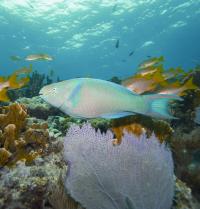
Adult male of the queen parrotfish, Scarus vetula, one of the most important grazers on Caribbean coral reefs. Threatened coral reefs could be given a helping hand by establishing marine reserves, according to a research team led by the University of Exeter. Marine reserves have already proved to be a successful way of protecting marine life against commercial fishing. Now, research published today (15 May 2007) in Proceedings of the National Academy of Sciences, shows for the first time how marine reserves could also help in the recovery of corals, which are already suffering the effects of climate change and over-fishing.
| Full story | 0 Comments | 10087 views |

| Bioinformatics | May 14, 2007 12:01 PM |
With the advent of more powerful and economical DNA sequencing technologies, gene discovery and characterization is transitioning from single-organism studies to revealing the potential biotechnology applications embedded in communities of microbial genomes, or metagenomes. The field of metagenomics is still in its infancy -- the equivalent of the early days of the California Gold Rush, with labs vying to stake their claim.
| Full story | 0 Comments | 8014 views |

- In some genetic cases of microcephaly, stem cells fail to launch
- Yale team discovers how Zika virus causes fetal brain damage
- Scientists uncover the way a common cell enzyme alerts the body to invading bacteria
- Arctic gives clues on worst mass extinction of life
- Calcium channel blockers caught in the act at atomic level
Search Bio News Net
Free Biology Newsletter
- Flexibility That A.C.A. Lent to Work Force Is Threatened by...International Herald Tribune
- Bacteria Behind Legionnaires’ Disease Found at New York Police StationInternational Herald Tribune
- Prescription Price Crisis? 28 Million Americans See Spike in Drug...MSNBC.com: Health
- Seizing on Opioid Crisis, a Drug Maker Lobbies Hard for...International Herald Tribune
- Republicans are taking a big political risk on health careAP Health News
- Why We're So Divided Over Saving WolvesNational Geographic News