


Dr Pep Canadell, from the Global Carbon Project and CSIRO Marine and Atmospheric Research, says today in the journal Science that tropical deforestation releases 1.5 billion tonnes of carbon each year into the atmosphere.

| Health & Medicine | May 12, 2007 07:04 PM |
Researchers at the University of Illinois at Chicago explain in the May 11 issue of Circulation Research how an enzyme acts on the heart's pacemaker to slow the rapid beating of the heart's "fight-or-flight" reaction to adrenaline.
| Full story | 0 Comments | 7202 views |

| Microbiology | May 12, 2007 06:04 PM |
In a new study published online in the open-access journal PLoS Pathogens, Dr. Vincent J. Munster, of Erasmus Medical Center, Rotterdam, and colleagues identify new host species for avian influenza A virus (H5N1) and provide important information on the distinctions between the ecology and epidemiology of various global strains of the virus.
| Full story | 0 Comments | 7011 views |
| Microbiology | May 12, 2007 04:04 PM |
Pigs carry hepatitis E virus (HEV), which they can pass on to humans. But now research from Japan published in Online Open Access journal BMC Veterinary Research says that pigs get HEV early enough to minimise the risk of human infection. The scenario humans need to worry about would occur if the infection rate in pigs drops. At low infection rates, there is actually a higher chance pigs will pass on HEV to humans at slaughter.
| Full story | 0 Comments | 6421 views |

| Biotechnology | May 12, 2007 02:04 PM |
Magnetic switches like those in computers also might be used to manipulate individual strands of DNA for high-speed applications such as gene sequencing, experiments at the National Institute of Standards and Technology (NIST) suggest.
| Full story | 0 Comments | 5614 views |
| Biotechnology | May 12, 2007 12:04 PM |
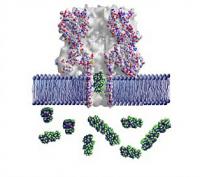
Graphic showing a lipid bilayer membrane (blue) with an alpha-hemolysin nanopore. A polyethylene glycol molecule (green globular structure) is transiting the pore; others are in solution on one side of the membrane. The colored spheres represent individual atoms, and are approximately 0.5 nanometers in diameter, or one twenty-thousandth the width of a human hair. Credit: NIST Imagine being able to rapidly identify tiny biological molecules such as DNA and toxins using less than a drop of salt water in a system that can fit on a microchip. It's closer than you might believe, say a team of researchers at the National Institute of Standards and Technology (NIST), Brazil's Universidade Federal de Pernambuco, and Wright State University in Dayton, Ohio.
| Full story | 0 Comments | 9782 views |
| Health & Medicine | May 12, 2007 10:04 AM |
Pretreatment with double-dose anticlotting medication just before percutaneous coronary intervention (PCI) cuts the combined risk of heart attack and cardiac death by half, according to a study reported at the 30th Annual Scientific Sessions of the Society for Cardiovascular Angiography and Interventions (SCAI), May 9–12, 2007, in Orlando, FL.
| Full story | 0 Comments | 5352 views |

- In some genetic cases of microcephaly, stem cells fail to launch
- Yale team discovers how Zika virus causes fetal brain damage
- Scientists uncover the way a common cell enzyme alerts the body to invading bacteria
- Arctic gives clues on worst mass extinction of life
- Calcium channel blockers caught in the act at atomic level
Search Bio News Net
Free Biology Newsletter
- Flexibility That A.C.A. Lent to Work Force Is Threatened by...International Herald Tribune
- Bacteria Behind Legionnaires’ Disease Found at New York Police StationInternational Herald Tribune
- Prescription Price Crisis? 28 Million Americans See Spike in Drug...MSNBC.com: Health
- Seizing on Opioid Crisis, a Drug Maker Lobbies Hard for...International Herald Tribune
- Republicans are taking a big political risk on health careAP Health News
- Why We're So Divided Over Saving WolvesNational Geographic News