


Parents-to-be might soon don 3-D glasses in the ultrasound lab to see their developing fetuses in the womb "in living 3-D, just like at the IMAX movies," according to researchers at Duke University's Pratt School of Engineering.

| Health & Medicine | April 24, 2007 09:58 PM |
University of Cincinnati (UC) environmental health researchers say a therapy commonly used to remove dangerously high levels of lead from the body may also improve muscle functions associated with postural balance and movement in lead-exposed children.
| Full story | 0 Comments | 4274 views |

| Biology | April 24, 2007 08:58 PM |
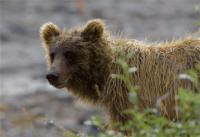
North American grizzly bear (Ursus arctos) in Denali National Park, Alaska. A fascinating new study from the May/June 2007 issue of Physiological and Biochemical Zoology quantifiably measures the loss of strength and endurance in black bears during long periods of hibernation. T.D. Lohuis (Alaska Department of Fish and Game) and his coauthors find that black bears in hibernation lose about one-half as much skeletal muscle strength as humans confined to bed rest for similar periods of time do.
| Full story | 0 Comments | 5848 views |
| Biology | April 24, 2007 07:58 PM |
The planarian is not as well known as other, more widely used subjects of scientific study – model creatures such as the fruit fly, nematode or mouse. But University of Illinois cell and developmental biology professor Phillip Newmark thinks it should be. As it turns out, the tiny, seemingly cross-eyed flatworm is an ideal subject for the study of germ cells, precursors of eggs and sperm in all sexually reproducing species.
| Full story | 0 Comments | 5189 views |
| Biology | April 24, 2007 06:58 PM |
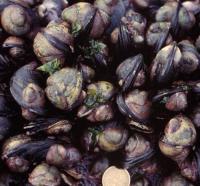
Smaller males on top of larger
females. The eggs are brooded under the shell and so are not visible.
Lizards gave rise to legless snakes. Cave fishes don’t have eyeballs. In evolution, complicated structures often get lost. Dollo’s Law states that complicated structures can't be re-evolved because the genes that code for them were lost or have mutated. A group of sea snails breaks Dollo’s law, Rachel Collin, Staff Scientist at the Smithsonian Tropical Research Institute and colleagues from two Chilean universities announce in the April, 2007, Biological Bulletin.
| Full story | 0 Comments | 7443 views |
| Health & Medicine | April 24, 2007 05:58 PM |
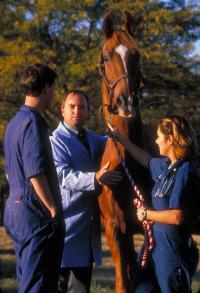
Philip Johnson, professor of veterinary medicine and surgery. Horses are inheritably couch potatoes. An overeating, slothful horse leads to an obese horse. Unlike humans, however, horse owners often don’t see the dangers of an obese horse. Caretakers may see no harm in giving their horses rich foods, but obesity in horses is just as unhealthy as obesity in humans and can lead to fatal diseases.
| Full story | 0 Comments | 8438 views |

| Microbiology | April 24, 2007 04:58 PM |
Researchers from the Schulich School of Medicine & Dentistry at The University of Western Ontario , working with a group from Edinburgh, have discovered a way to kill the cystic fibrosis superbug, Burkholderia cenocepacia. These investigators, under the leadership of Dr. Miguel Valvano, Department of Microbiology and Immunology, have had their research published in the May issue of the Journal of Bacteriology, and highlighted in Nature Reviews/Microbiology.
| Full story | 0 Comments | 6354 views |

| Molecular & Cell Biology | April 24, 2007 03:58 PM |
It has long been known that UV light can damage DNA, reducing its ability to replicate and interact with proteins, and often resulting in the development of skin cancers. However, not much is known about how the elasticity of DNA strands is altered upon exposure to UV light. Now a group of researchers at Duke University have developed a method to measure changes in the mechanical properties of DNA upon irradiation with UV light.
| Full story | 0 Comments | 6156 views |
| Health & Medicine | April 24, 2007 02:58 PM |
Findings described in a new study by Stanford scientists may be the first step toward a major revolution in human regenerative medicine—a future where advanced organ damage can be repaired by the body itself. In the May 2007 issue of The FASEB Journal, researchers show that a human evolutionary ancestor, the sea squirt, can correct abnormalities over a series of generations, suggesting that a similar regenerative process might be possible in people.
| Full story | 0 Comments | 22459 views |
| Biology | April 24, 2007 12:11 PM |
Scientists at the University of Chicago and the National Museum of Natural History in Washington, D.C., have produced new evidence to finally resolve the mysterious identity of what they regard as one of the weirdest organisms that ever lived.
| Full story | 0 Comments | 6193 views |
| Molecular & Cell Biology | April 24, 2007 10:11 AM |
So much for the adage, ‘All things in moderation.’ Researchers at the University of Calgary have found that people who consume a single, high-fat meal are more prone to suffer the physical consequences of stress than those who eat a low-fat meal.
| Full story | 0 Comments | 4759 views |

- In some genetic cases of microcephaly, stem cells fail to launch
- Yale team discovers how Zika virus causes fetal brain damage
- Scientists uncover the way a common cell enzyme alerts the body to invading bacteria
- Arctic gives clues on worst mass extinction of life
- Calcium channel blockers caught in the act at atomic level
Search Bio News Net
Free Biology Newsletter
- Flexibility That A.C.A. Lent to Work Force Is Threatened by...International Herald Tribune
- Bacteria Behind Legionnaires’ Disease Found at New York Police StationInternational Herald Tribune
- Prescription Price Crisis? 28 Million Americans See Spike in Drug...MSNBC.com: Health
- Seizing on Opioid Crisis, a Drug Maker Lobbies Hard for...International Herald Tribune
- Republicans are taking a big political risk on health careAP Health News
- Why We're So Divided Over Saving WolvesNational Geographic News