

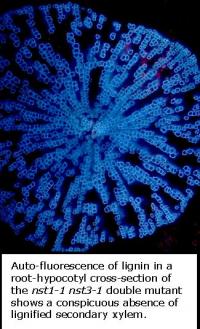
Auto-fluorescence of lignin in a root-hypocotyl cross-section of the nst1-1 nst3-1 double mutant shows a conspicuous absence of lignified secondary xylem. Wood is formed from secondary xylem tissue consisting of cells with a heavily thickened secondary cell wall that is enriched in lignin and cellulose. In contrast, primary cell walls are composed mainly of polysaccharides (including cellulose), but contain very little lignin. Wood formation occurs through a complex series of steps involving cell division and expansion and the biosynthesis of lignin and cellulose. In addition, heartwood (darker wood at the center of the trunk) forms in many tree species through a highly regulated process of programmed cell death.

| Biology | March 3, 2007 07:58 PM |
| Full story | 0 Comments | 6037 views |

| Biotechnology | March 3, 2007 06:58 PM |
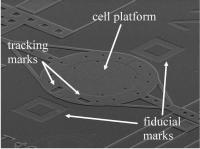
Electron micrograph of the NIST "cell puller," which measures the mechanical properties of a living cell. After the cell spreads and adheres to the center of the 200-micrometer-wide circular platform, half of the platform is pulled slowly away, while a sensor connected to the other half measures the force on the cell. Credit: D. Serrell/NIST Researchers at the National Institute of Standards and Technology (NIST) have developed a microelectromechanical system (MEMS) cell-stretcher that can measure the mechanical properties of a living cell, such as its ability to stick to a surface. The new device is expected to enable novel studies of cell mechanics, which influence basic cell functions such as growth and division, and diseases such as sickle cell anemia and asthma.
| Full story | 0 Comments | 5329 views |

| Molecular & Cell Biology | March 3, 2007 05:58 PM |
One of the mysteries of the brain is how it avoids ending up in a state of chaos, something which happens only on exceptional occasions, when it can lead to epileptic fits. Scientists at Karolinska Institutet have now uncovered a new mechanism controlling how the brain keeps its neuronal activity in check.
| Full story | 0 Comments | 5110 views |

| Bioinformatics | March 3, 2007 04:58 PM |
As the national push for alternative energy sources heats up, researchers at the University of Rochester have for the first time identified how genes responsible for biomass breakdown are turned on in a microorganism that produces valuable ethanol from materials like grass and cornstalks.
| Full story | 0 Comments | 4898 views |

| Environment | March 3, 2007 02:58 PM |
While humans can survive large temperature fluctuations, such species as corals are only comfortable within a 12-degree temperature range. And rising global temperatures appear to be threatening their survival, according to Drew Harvell, Cornell professor of ecology and evolutionary biology.
| Full story | 0 Comments | 5619 views |
| Biology | March 3, 2007 12:58 PM |
Ecosystems are such intricate webs of connections that few studies have been able to explore exactly what happens when a species dies out.
| Full story | 0 Comments | 4666 views |
| Biology | March 3, 2007 10:58 AM |
A new genus of millipede was recently discovered by a Northern Arizona University doctoral student and a Bureau of Land Management researcher.
| Full story | 0 Comments | 7226 views |

- In some genetic cases of microcephaly, stem cells fail to launch
- Yale team discovers how Zika virus causes fetal brain damage
- Scientists uncover the way a common cell enzyme alerts the body to invading bacteria
- Arctic gives clues on worst mass extinction of life
- Calcium channel blockers caught in the act at atomic level
Search Bio News Net
Free Biology Newsletter
- Flexibility That A.C.A. Lent to Work Force Is Threatened by...International Herald Tribune
- Bacteria Behind Legionnaires’ Disease Found at New York Police StationInternational Herald Tribune
- Prescription Price Crisis? 28 Million Americans See Spike in Drug...MSNBC.com: Health
- Seizing on Opioid Crisis, a Drug Maker Lobbies Hard for...International Herald Tribune
- Republicans are taking a big political risk on health careAP Health News
- Why We're So Divided Over Saving WolvesNational Geographic News