


Researchers have found a way to activate Epstein-Barr viruses inside tumors as a way to identify patients whose infection can then be manipulated to destroy their tumors. They say this strategy could offer a novel way of treating many cancers associated with Epstein-Barr, including at least four different types of lymphoma and nasopharyngeal and gastric cancers.

| Environment | March 2, 2007 12:36 PM |
In the March 2007 issue of BioScience, an international team of 19 researchers calls for better forecasting of the effects of global warming on extinction rates. The researchers, led by Daniel B. Botkin, note that although current mathematical models indicate that many species could be at risk from global warming, surprisingly few species became extinct during the past 2.5 million years, a period encompassing several ice ages. They suggest that this "Quaternary conundrum" arises because the models fail to take adequate account of the mechanisms by which species persist in adverse conditions. Consequently, the researchers "believe that current projections of extinction rates are overestimates." A critical review of the four types of model now in common use leads the team to identify various simplifying assumptions in the models that can lead to biases.
| Full story | 0 Comments | 5402 views |

| Biotechnology | March 2, 2007 10:36 AM |
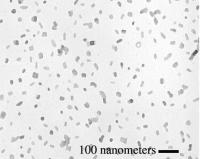
Nanoparticle Gene Therapy for Parkinson's Disease -- This electron micrograph shows the minute scale of DNA compacted into nanoparticles. After it is condensed, the DNA is delivered to the brain in an attempt to repair faulty genes in hopes of halting or preventing the neurodegenerative process. Credit: David Yurek, University of Kentucky University of Kentucky researcher David Yurek was recently awarded $66,000 by The Michael J. Fox Foundation for Parkinson's Research (MJFF) under the foundation's Rapid Response Innovation Awards program. The goal of this newly launched initiative is to move quickly to support innovative research focused on the cause of and cure for Parkinson's disease (PD). In particular, MJFF seeks to fund high-risk, high-reward projects tackling critical scientific roadblocks that if successful, can open new avenues for PD therapy development.
| Full story | 0 Comments | 5188 views |

- In some genetic cases of microcephaly, stem cells fail to launch
- Yale team discovers how Zika virus causes fetal brain damage
- Scientists uncover the way a common cell enzyme alerts the body to invading bacteria
- Arctic gives clues on worst mass extinction of life
- Calcium channel blockers caught in the act at atomic level
Search Bio News Net
Free Biology Newsletter
- Flexibility That A.C.A. Lent to Work Force Is Threatened by...International Herald Tribune
- Bacteria Behind Legionnaires’ Disease Found at New York Police StationInternational Herald Tribune
- Prescription Price Crisis? 28 Million Americans See Spike in Drug...MSNBC.com: Health
- Seizing on Opioid Crisis, a Drug Maker Lobbies Hard for...International Herald Tribune
- Republicans are taking a big political risk on health careAP Health News
- Why We're So Divided Over Saving WolvesNational Geographic News